
⭐ Cat Litter Dust Guide: Air Quality, Micro-Dust, Ventilation & Health
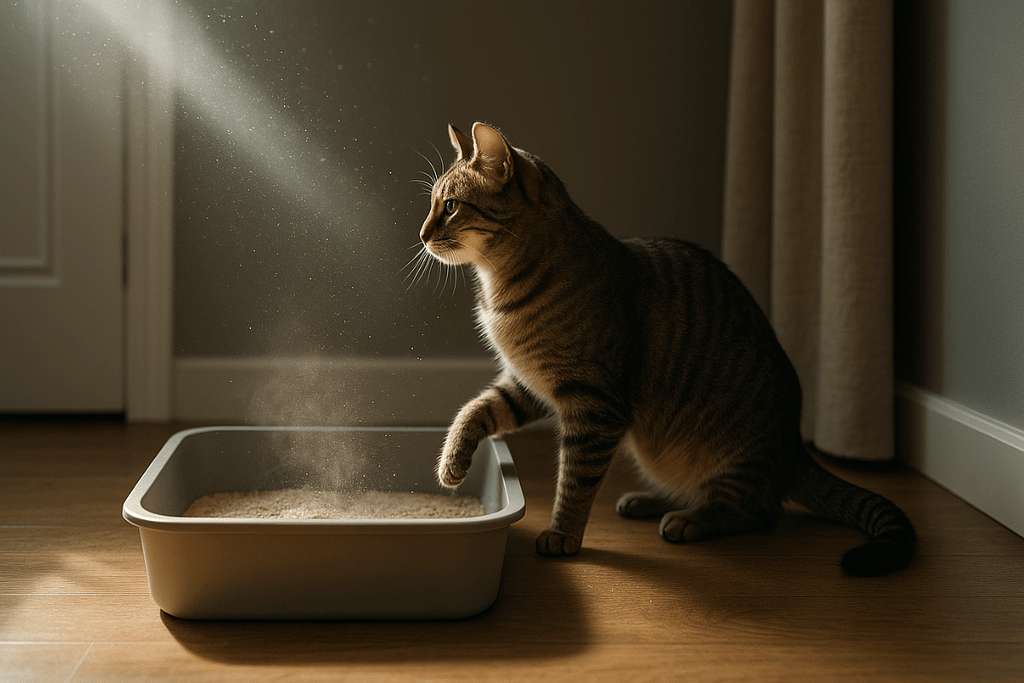
If your cat’s litter box is creating dust everywhere — and you’re worried about what this means for your cat’s health and your own — this guide explains what’s really going on. Learn why litter dust spreads through your home, how it irritates eyes and airways, and the simple tests, cleaning methods and litter choices that truly reduce dust and make breathing easier for both you and your cat.
Cat litter dust can irritate both cats and humans, triggering sneezing, eye irritation and respiratory discomfort — especially in small apartments with limited airflow. Understanding how dust forms, moves and settles helps you protect air quality, reduce allergies and create a more comfortable litter environment.
Maybe you noticed a soft cloud rising when your cat dug.
Or particles floating in a sunbeam.
Or a subtle layer of dust settling on shelves no matter how often you clean.
That’s when most people think:
“Is this normal… or is my home full of cat litter dust?”
The truth: cat litter dust isn’t just mess.
It’s an indoor air quality issue, involving two types of particles:
- visible dust
- micro-dust (PM10 and PM2.5) — the particles you breathe without seeing
Inside your home, these particles interact with:
- AC airflow
- heaters
- drafts
- humidity
- ventilation patterns
- room design
- and even your cat’s digging style
Some cats feel this intensely — seniors, asthmatics, anxious cats, rescues, kittens.
And humans with sensitive airways feel it too.
This guide goes far beyond “choose a low-dust litter.”
We’re diving into:
- how dust forms
- how it moves
- how airflow spreads it
- how to diagnose dust levels
- how to fix dust at the source
- how to clean the surrounding area
- and how to protect both your cat and yourself
Let’s start with the core phenomenon.
? Understanding Cat Litter Dust as an Air Quality Issue
Cat litter dust doesn’t just sit near the box. It’s a dynamic interaction of:
- particle size
- airflow
- turbulence
- substrate friction
- humidity
- static electricity
- and environmental conditions
? Visible Dust vs Micro-Dust: PM10, PM2.5 & Micron Particles
Visible dust is the cloud you see when your cat digs.
It settles quickly.
Micro-dust is the real problem:
- invisible
- stays airborne longer
- travels through air currents
- reaches deeper into the lungs
- irritates even in small amounts
Clay litters create dust through mineral abrasion, while lightweight formulas break down through fragmentation and static lift.
⭐ What Are PM10 and PM2.5? (Simple, Clear Explanation)
“PM” means particulate matter.
These particles are measured in microns (µm), far smaller than what your eyes can detect.
- PM10 → particles 10 microns or smaller
Big enough to irritate nose and eyes.
Usually part of the “visible cloud.” - PM2.5 → particles 2.5 microns or smaller
Invisible.
Stay suspended longer.
Reach deep into the lungs of both cats and humans.
Strongly affected by AC, heat, drafts and turbulence.
Cat litter can produce both, depending on material and digging intensity.
?️ How Dust Moves: Suspension, Turbulence & Indoor Airflow
Dust lifts and travels because air moves.
Micro-dust rises with:
- scratching
- convection currents
- warm air rising
- cold air sinking
- human movement
- AC blowing sideways
- scooping motions
This is why dust spreads far beyond the litter box.
❄️ HVAC, AC Drafts & Small-Apartment Ventilation
Small homes amplify dust:
- AC blowing directly over the box
- heaters lifting warm air
- narrow hallways acting like tunnels
- stagnant corners trapping particles
This is why dust appears even in rooms far away.
? Dust Accumulation Zones: Where Particles Settle
Common hotspots:
- behind curtains
- under beds
- in corners
- on shelves
- behind the litter box
- HVAC intake
? How Different Litters Release Dust
- Clay: grains grind into powder
- Lightweight clay: breaks easily
- Silica: micro-fractures during movement
- Plant-based: heavier; lowest PM2.5
- Paper: lowest dust; moderate odor control
⭐ Quick Guide — Best Low-Dust Litter Types
Instant, practical list:
- ? Plant-Based Granules: lowest PM2.5
- ? Heavy Premium Clay: low-dust option
- ? Silica Crystals: moderate PM, good in ventilated areas
- ? Avoid: lightweight clay (high fragmentation)
⭐ Ideal Litter Depth (5–7 cm)
Too deep = more turbulence.
Too shallow = aggressive scratching.
The sweet spot: 5–7 cm (2–3 inches).
Seniors do best at the lower end.
? Behavioral Impact: How Dust Affects Cats
Your cat doesn’t just breathe dust — they feel it.
? Sensory Irritation
Signs:
- blinking
- paw lifting
- backing up
- head shaking
- mini coughs
- nose wrinkles
? Micro-Behaviors That Reveal Discomfort
Watch for:
- shallow scratching
- hesitation
- interrupted digging
- escaping the box immediately
- avoiding the box during refills
? Dust-Related Avoidance
Dust-heavy boxes often cause:
- not burying
- avoiding the center
- using only one corner
- rushed elimination
? Why Dust Happens: The Scientific Explanation
- Friction & abrasion: releases new particles
- Static lift: dry air increases airborne dust
- Turbulence: deep litter or enclosed boxes amplify clouds
- Drafts & HVAC: spread dust throughout the home
- Small spaces: trap suspended particles
Humidity 40–45% reduces static lift.
⭐ Quick Diagnostic: Do You Have a Dust Problem?
You probably do if you notice 2 or more:
- visible cloud when digging
- dust film on surfaces
- particles in a flashlight beam
- blinking or hesitation
- throat scratchiness
- sneezing or itchy eyes
- HVAC dust buildup
One occasional symptom = mild.
Multiple = actual dust issue.
? Diagnosis Checklist: How Much Dust Do You Actually Have?
? Light Beam Test
Floating particles = micro-dust.
? Shake Test
Observe how long the cloud lingers.
? Dust Cloth Test
Leave for 48h; evaluate accumulation.
? HVAC Intake Test
Dust here = house-wide circulation.
? Behavioral Test
Blinking, hesitation = irritation.
⭐ Final Diagnostic Summary — What’s Normal and Not
? Light Beam
Normal: few drifting particles
Not normal: swirling field lasting 20 seconds
? Shake Test
Normal: tiny puff
Not normal: large lingering cloud
? Dust Cloth
Normal: light household dust
Not normal: fine mineral powder
? HVAC Intake
Normal: light film
Not normal: thick grit
? Behavior
Normal: relaxed digging
Not normal: blinking, stepping back, rushing out
? Practical Dust Control Methods
?️ Airflow Mapping
Use incense to visualize currents.
? Ventilation Protocol
Open windows 5–10 minutes; avoid direct drafts on the box.
? Substrate Comparison Test
Compare side-by-side.
? The 3-Box Dust Method
Clay vs lightweight vs plant-based.
? Humidity & Anti-Static
Keep 40–45%.
? Fixes & Adjustments
⚡ Immediate
- scoop slowly
- reduce litter depth
- move the box away from vents
? Medium-Term
- switch substrate
- use larger boxes
- avoid enclosed designs
? Long-Term
- HEPA purifier
- clean HVAC filters
- improve humidity
- declutter dust traps
? Larger Boxes Reduce Turbulence
Bigger = smoother digging.
? reduce Dust Around the Box
Dust around the box gets re-aerosolized.
This is one of the biggest sources of PM2.5 in small homes.
✨ The Zero-Lift Cleaning Method
Do NOT sweep. Sweeping launches dust.
Instead:
1) Dry Microfiber Capture
Press and lift — don’t push.
2) HEPA Vacuum
Short, slow passes prevent dust blowback.
3) Damp Wipe Finish
Captures remaining PM2.5.
4) Mat Care
Replace every 6–12 months or wash weekly.
Shake outside, never indoors.
Hotspots to Clean
- behind the box
- sides
- corners
- baseboards
- textured floors
- under mats
Ideal Cleaning Frequency
- Plant-based litter: every 3–4 days
- Clay litter: every 1–2 days
- Multi-cat homes: daily quick pass
? When Dust Becomes a Health Risk
❤️ Effects on Cats and Humans
PM2.5 irritates:
- nose
- eyes
- throat
- airways
Worsens asthma and bronchitis in both species.
? Feline Asthma & Bronchitis
Dust triggers inflammation.
? Senior Cat Vulnerability
Older cats react faster.
? Human Risks
Sneezing, dryness, congestion.
? Seek Help If
Coughing or wheezing persists.
? Insights from Rescue Cats (acatwithstory.com)
From observing 200+ litter behaviors in rescue and senior cats, one pattern is clear:
Cats always choose boxes with lower turbulence and stable airflow.
This matches feline welfare environmental research.
? Final Action Plan
If most tests look normal:
Maintain ventilation, humidity, gentle scooping.
If 2–3 tests abnormal:
Switch substrates, reposition the box, reduce depth.
If 4+ tests abnormal:
Full intervention:
- new litter type
- larger box
- adjust airflow
- HEPA purifier
- clean HVAC intake
- Zero-lift cleaning routine
If symptoms persist:
Seek veterinary/medical advice.
? FAQ: Cat Litter Dust, Air Quality & Micro-Dust
❓ u003cstrongu003eWhat causes cat litter dust to form?u003c/strongu003e
Friction, abrasion, static lift and particle breakage — especially in clay and lightweight litters.
❓ u003cstrongu003eHow can I reduce cat litter dust in a small apartment?u003c/strongu003e
Improve ventilation, avoid vents, adjust humidity and consider low-dust substrates.
❓ u003cstrongu003eIs cat litter dust harmful to cats?u003c/strongu003e
Yes. Dust irritates airways and worsens asthma — especially in seniors and sensitive cats.
❓ u003cstrongu003eWhy is my cat sneezing after using the litter box?u003c/strongu003e
Dust clouds rise during digging and irritate nasal passages.
❓ u003cstrongu003eHow do I test if my litter produces micro-dust?u003c/strongu003e
Use the Light Beam Test, Shake Test or Dust Cloth Test.
❓ u003cstrongu003eIs lightweight litter dustier?u003c/strongu003e
Usually yes — it breaks apart more easily.
❓ u003cstrongu003eWhat is the best low-dust litter for sensitive cats?u003c/strongu003e
Plant-based granules or heavier clumping clay.
❓ u003cstrongu003eHow do I keep dust from spreading?u003c/strongu003e
Avoid airflow sources, scoop gently and use HEPA filtration.
? Explore More From Our Cat Litter Series
If you want to explore this topic even deeper, I recommend checking the rest of our litter series. Each guide builds on the next and helps you understand your cat’s comfort from a sensory and behavioral point of view:
? Cat Litter Guide 2026 — the full big-picture overview
? Cat Litter Texture Guide — how the floor feels under your cat’s paws
? Senior Cat Litter Types — choosing the right substrate for older cats
Together, these posts create a complete picture of how your cat experiences the litter box. ?
For readers who want scientific context or clinical guidance, here are two trusted resources that complement what we discussed:
?? AAHA Indoor Air Quality Notes for Pet Homes — helpful for understanding how household air affects both pets and people
These sources support a healthier environment for everyone who shares the space — cats included. ?️?

With the sensitivity of one who loves deeply, Sissi writes stories celebrating the animal world. Her felines Estrela and Safira illuminate her days, while Pete and Gabrich live eternally through her words. Every piece she writes is a love letter to the companions who make life truly meaningful.