
Bold vs Cautious Cats: Two Expressions of the Same Underlying System
Bold and cautious cats are not defined by personality traits, but by differences in feline temperament. Variations in sensitivity, activation threshold, and recovery explain why some cats explore immediately while others observe before acting.
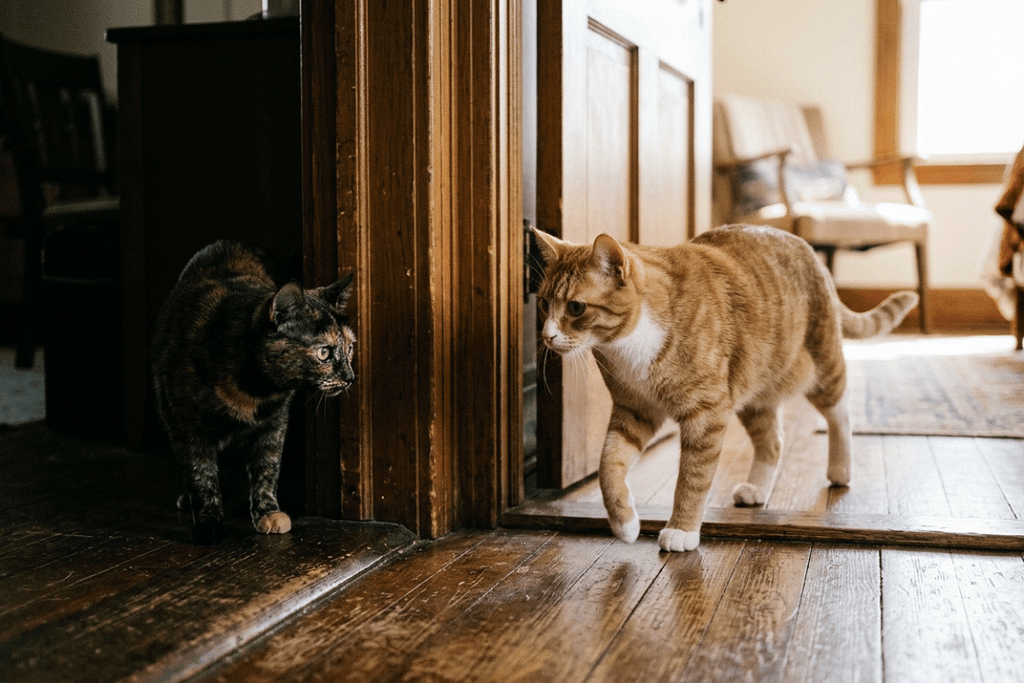
Differences between bold and cautious cats become most visible in unfamiliar situations.
The same environment can lead to very different responses. One cat moves forward immediately, while another pauses, observes, and waits before acting.
These reactions are often labeled as personality — confident, shy, bold, anxious.
But those labels describe what you see. They do not explain what produces it.
Boldness and caution are not traits to evaluate. They are expressions of how a cat’s system processes and responds to the world.
🧠 What Makes a Cat Bold or Cautious
Before the label, there is a mechanism.
Cats that appear bold and those that appear cautious are operating from different configurations of feline temperament — particularly in three dimensions:
Activation threshold — how much stimulation is needed before the system responds.
A higher threshold often results in faster exploration because the environment does not immediately trigger caution.
Sensitivity — how precisely the system detects change.
A highly sensitive cat notices subtle differences that others may not register.
Recovery speed — how quickly the system returns to baseline after activation.
A fast-recovering cat moves through states quickly, while a slower one remains activated longer.
These differences shape how behavior appears — not as personality, but as system response patterns.
At a deeper level, these differences reflect the neurobiology of cat behavior, where response patterns are shaped before behavior becomes visible.
⚖️ Why Cautious Cats Are Often Misread
Cautious behavior is frequently interpreted as fear or insecurity.
In practice, it reflects a system that detects more and evaluates earlier.
For example:
- A cautious cat may pause at the entrance of a new room, scanning before entering.
- When a visitor arrives, it may observe from a distance instead of approaching.
- It may take longer to engage with unfamiliar objects or changes in routine.
These behaviors are not signs of distress. They reflect a lower activation threshold and higher sensitivity — a system that processes more information before acting.
Misinterpretation happens when this pattern is viewed through expectation.
If you expect immediate engagement, hesitation can feel like rejection.
In reality, it is simply a threshold that has not yet been crossed.
⚡ Why Bold Cats Can Also Be Misinterpreted
Cats that appear bold are often easier to read.
They approach, engage, and move on.
But this pattern also has its own structure.
For example:
- A bold cat may greet visitors quickly, then disengage just as fast.
- It may investigate new objects immediately, then lose interest within seconds.
- It may shift rapidly between play, exploration, and rest.
This is not inconsistency.
It reflects a system with:
- higher activation thresholds,
- faster transitions,
- quicker recovery.
When interpreted as personality, this can feel like unpredictability — “interested one moment, indifferent the next.”
When understood as temperament, the pattern becomes clear:
this system moves quickly through its responses.
🔄 Why Most Cats Are Neither Fully Bold nor Fully Cautious
Most cats do not sit at a fixed point on this spectrum.
The same cat can:
- explore confidently in a familiar space,
- hesitate in a new environment,
- engage easily with one person,
- remain distant with another.
This is not inconsistency.
Feline temperament is stable — but its expression shifts with:
- context,
- familiarity,
- internal state.
Boldness and caution are not fixed identities.
They are tendencies that become visible under specific conditions.
🎯 How to Understand Bold vs Cautious Behavior in Context
Understanding this distinction changes how behavior is interpreted.
Instead of asking:
“Is my cat bold or cautious?”
The question becomes:
“What conditions is my cat responding to right now?”
A cat that pauses at a doorway is not insecure.
It is responding to a threshold that has not yet been crossed.
A cat that disengages quickly is not indifferent.
It is completing its response cycle.
Temperament tells you how the system operates.
Context determines how it appears.
🌿 A Clearer Way to Read Your Cat’s Behavior
When behavior is viewed through temperament rather than personality, interpretation becomes more precise.
What once seemed like:
- fear
- rejection
- inconsistency
becomes easier to understand as:
- sensitivity
- thresholds
- response timing
Cats are not trying to communicate traits.
They are responding to conditions.
And when you learn to recognize that, behavior stops feeling unpredictable — and starts to feel structured.
This article is based on Sissi’s long-term experience living closely with cats, combined with continuous observation of feline behavior and insights informed by consultations with veterinary professionals. For any health-related concerns, always seek guidance from a qualified veterinarian.
? FAQ
Are bold cats more confident than cautious cats?
No. Bold and cautious describe differences in temperament — activation threshold, sensitivity, and recovery speed — not levels of confidence or security. A cautious cat is not an insecure bold cat. It is a cat with a different configuration.
Is my cautious cat afraid?
Not necessarily. Caution in temperament terms means a lower threshold and higher sensitivity — the system detects and responds earlier. This can look like fear but is structurally different: it is the system evaluating carefully before acting, not a state of distress.
Why does my bold cat suddenly seem cautious in new situations?
Because temperament expresses differently depending on context. A higher-threshold cat can still respond more carefully to genuinely unfamiliar input. The underlying temperament is the same; the expression shifts with conditions.
Can I change my cat’s temperament?
Temperament is relatively stable and neurobiologically grounded. What you can influence is the conditions under which it expresses — familiarity, routine, and positive associations can all affect how a cat’s temperament shows up in daily life, without changing the underlying configuration.

With the sensitivity of one who loves deeply, Sissi writes stories celebrating the animal world. Her felines Estrela and Safira illuminate her days, while Pete and Gabrich live eternally through her words. Every piece she writes is a love letter to the companions who make life truly meaningful.