
Understanding Cat Behavior: The Evolutionary Blueprint Explained
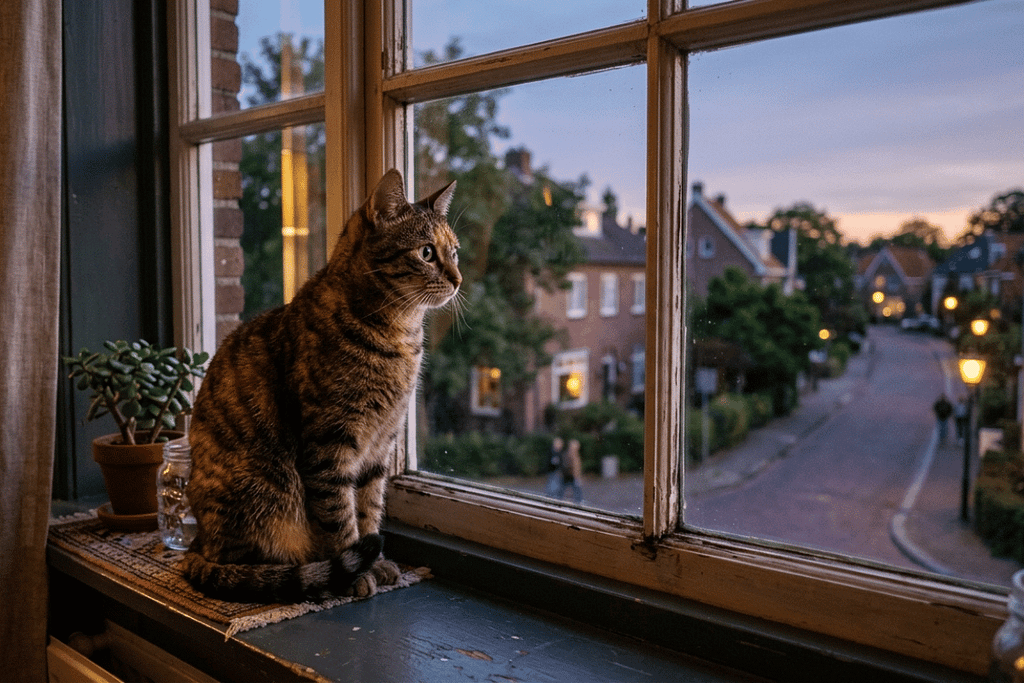
Understanding cat behavior starts with one key insight: nothing your cat does is random. Every action — from freezing mid-room to chasing invisible targets — emerges from a biological architecture shaped by millions of years of evolution. Instinct, energy regulation, territorial logic, and environmental learning all work together to explain why cats behave the way they do.
A cat suddenly stops moving in the middle of a room.
Its body becomes still.
Its ears rotate slightly.
Its eyes fix on something invisible to the human observer.
Nothing obvious has changed in the environment, yet the cat has clearly detected something important.
Moments later, the stillness disappears. The cat moves again as if nothing unusual happened.
Scenes like this are common in homes with cats, and they often feel mysterious. Why do cats suddenly freeze? Why do they chase invisible targets? Why do they investigate objects that humans barely notice?
If you’ve ever wondered why do cats behave the way they do, the answer doesn’t start with personality — it starts with biology.
To answer these questions, we must first understand how cat behavior is built.
Feline behavior is not random. Every action a cat performs emerges from a complex biological architecture shaped by evolution, instinctive neural systems, and environmental adaptation.
Long before cats lived alongside humans, their ancestors survived as solitary hunters in environments where perception, precision, and energy efficiency determined survival.
Understanding this is the first step in truly understanding cat behavior beyond surface observations.
🧭 The Biological System Behind Cat Behavior
Modern animal behavior research increasingly describes cat behavior as a system of interconnected biological processes.
Rather than isolated reactions, feline behavior emerges from multiple behavioral systems that regulate perception, motivation, movement, and decision-making. These systems interact continuously, shaping how cats respond to their environment.
The architecture of feline behavior includes several major components:
instinctive action patterns
predatory motivation
vigilance and risk assessment
exploration and environmental mapping
energy regulation and biological rhythms
territorial organization
learning and environmental adaptation
Together, these systems form the biological foundation that explains why cats behave the way they do.
To fully understand how cat behavior is built, each of these systems must be considered as part of a larger evolutionary framework.
🐆 How Evolution Shaped the Foundation of Cat Behavior
Domestic cats (Felis catus) evolved from the African wildcat (Felis lybica), a solitary predator, adapted to environments where prey was unpredictable and widely dispersed.
In such ecosystems, survival favored individuals capable of detecting subtle movements, approaching prey silently, and launching precise attacks while conserving energy between hunting attempts.
This ecological pressure shaped the core patterns of feline behavior.
Key evolutionary adaptations include:
heightened sensitivity to movement
powerful predatory motivation
refined vigilance systems
strong territorial awareness
efficient energy conservation strategies
According to the Cornell Feline Health Center, the behavioral traits observed in domestic cats today remain deeply connected to the survival strategies of their wild ancestors, particularly in areas of predatory motivation and environmental awareness.
Even in modern homes, domestic cats continue to express many of these ancient behavioral systems. The instincts and behavioral patterns seen in household cats still reflect the evolutionary architecture that shaped their ancestors.
Current research in animal behavior and comparative cognition suggests that many everyday feline behaviors—from stalking toys to sudden bursts of activity—are expressions of these inherited behavioral systems. For a deeper exploration of these evolutionary mechanisms, see Evolutionary Architecture of Cat Behavior .
🧠Cat Instincts: The Core of Understanding Cat Behavior
At the core of cat behavior lies instinct.
Instinctive behaviors are patterns encoded within the nervous system that appear without formal learning. These behaviors emerge early in life and follow recognizable structures across individuals. Examples of instinctive behavior in cats include:
stalking moving objects
pouncing during play
orienting toward sudden sounds
grooming sequences
kneading soft surfaces
Even kittens raised entirely indoors still perform stalking and pouncing motions during play. These behaviors appear without training because they are part of the biological architecture of feline instincts.
I’ve watched this in my own cats from their earliest weeks — the stalking motion appears before they’ve ever seen real prey. It’s one of the clearest signs that instinct operates independently of experience.
Instinct defines the behavioral possibilities available to the species. While learning and experience can modify behavior, they operate within the boundaries established by instinctive neural systems.
⚙️ How the Feline Brain Regulates Behavior and Motivation
Instinct alone does not determine behavior. Neural systems control when behaviors activate.
Inside the brain, networks of neurons control attention, motivation, and response thresholds. These systems determine how strongly a cat reacts to environmental signals.
For example, some cats respond instantly to small movements, while others observe carefully before acting. Some cats explore unfamiliar environments quickly, while others remain cautious.
These variations arise from differences in neural sensitivity and motivational thresholds.
Understanding these neurological systems helps explain why individual cats often display distinct behavioral styles. Explore these mechanisms further in Neurobiology of Cat Behavior.
What the Brain Controls
Attention, motivation, and response intensity shape how each cat reacts to the environment.
This explains why different cats respond differently to the same stimulus.
😴 Why Cats Sleep So Much: Energy as a Behavioral Strategy
Cats do not sleep excessively — they follow an energy strategy.
In reality, extended sleep is part of an evolutionary strategy known as energy economy.
Small predators expend large amounts of energy during hunting attempts. To remain efficient, cats evolved behavioral rhythms that alternate between long periods of rest and short bursts of activity.
Typical Energy Cycle
Periods of quiet observation
exploratory movement
sudden bursts of activity
predatory engagement
then recovery and rest.
This rhythm explains why cats may sleep for long periods and then suddenly engage in intense activity.
understanding energy economy in cats reveals that these cycles are not signs of laziness but adaptive strategies shaped by evolution. Learn more in Behavioral Organization and Energy Economy in Cats .
🔍 How Cats Explore and Map Their Environment
Cats possess powerful exploratory systems that allow them to construct detailed maps of their surroundings. Through exploration, cats gather information about:
pathways and escape routes
resting locations
scent signals from other animals
resource distribution
environmental changes
Investigating new objects or cautiously approaching unfamiliar spaces helps cats update their internal maps of the environment.
🏠 Territorial Behavior: How Cats Organize Their World
Another major component of feline behavior is territorial organization.
Territory allows cats to control access to resources while minimizing conflict with other animals. Even within homes, cats often organize their environment into functional zones.
These zones may include:
feeding areas
resting locations
observation points
elimination sites
Vertical spaces often play an important role because elevated positions expand visual awareness and increase environmental control.
Understanding territorial behavior in cats helps explain why many cats prefer elevated locations or repeatedly patrol certain areas of the home. Learn more in Territorial and Spatial Logic in Cats.
🎓 What Cats Can (and Cannot) Learn: Biological Limits
Although instinct forms the foundation of cat behavior, learning still shapes how behaviors develop.
Cats learn through:
environmental association
routine recognition
reward-based reinforcement
observational experience
However, learning operates within biological limits. Some instinctive behaviors—particularly those related to predatory behavior or territorial communication—are difficult to eliminate because they originate from deeply embedded survival systems.
Recognizing these limits prevents misinterpretation of natural feline behaviors as stubbornness or disobedience.
Explore this interaction further in Instinct vs Learning in Cats.
⚠️ Why Modern Life Conflicts With Cat Behavior
Domestic cats now live primarily within human environments, yet their behavioral architecture evolved under very different ecological conditions.
Indoor environments often compress territory, alter natural activity cycles, and reduce environmental variability.
These changes can influence how instinctive behavioral systems appear in modern cats.
Many behaviors observed in domestic environments are therefore the result of interactions between ancient evolutionary systems and modern living conditions.
Explore this topic further in Domestication and Environmental Mismatch in Cats.
🐾 Why Every Cat Behaves Differently
Although all cats share the same evolutionary architecture, behavioral expression varies significantly among individuals.
Differences in feline personality and temperament may arise from:
sensitivity to environmental stimuli
early developmental experiences
neural activation thresholds
environmental exposure
Some cats are naturally cautious observers, while others are bold explorers. These individual differences represent stable behavioral patterns that emerge within the broader framework of feline behavioral systems.
Learn more in Individual Differences and Trait Stability in Cats.
🌿 The Complete Picture: Cat Behavior as a System
When viewed in isolation, many feline behaviors appear puzzling.
But when we examine the system as a whole, these actions become part of a coherent biological architecture.
Instinctive drives initiate behavior. Neural systems regulate attention and motivation. Exploration builds environmental maps. Territorial logic organizes space. Biological rhythms manage energy expenditure.
Once you understand the system, the answer to why do cats behave the way they do becomes remarkably clear.
Understanding this architecture does not eliminate the mystery of cats — but it reveals that even the most surprising feline behaviors follow predictable patterns shaped by millions of years of evolution.
This article reflects Sissi’s lifelong experience living with cats, informed by years of observation and regular consultations with licensed veterinarians. For medical concerns about your cat, always consult a qualified vet.
❓ FAQ
What is the best way to start understanding cat behavior?
Start by recognizing that cat behavior is a biological system, not a series of random actions. Every behavior — from freezing mid-room to sudden bursts of energy — has an evolutionary origin. Once you see behavior as a system rather than a mystery, even the most puzzling feline actions begin to make sense.
Why do cats act like predators even when fed?
Because predatory behavior is instinctive, not hunger-driven. The neural systems that activate stalking, pouncing, and chasing evolved independently from hunger. This is why even well-fed cats still chase toys obsessively, track movements across a room, and engage in sudden bursts of hunting-like activity.
Can cat behavior be changed through training?
Some behaviors can be shaped through positive reinforcement and environmental management. However, instinctive behaviors — especially those tied to predatory drives and territorial communication — operate within biological limits that training cannot fully override. Working with instinct is always more effective than working against it.
Understanding Cat Behavior: The Evolutionary Blueprint Explained
All cats share the same evolutionary architecture, but individual differences in neural sensitivity, early experiences, and environmental exposure create distinct behavioral profiles. The instincts are the same — the expression varies. This is why two cats raised in the same home can respond so differently to identical situations.

With the sensitivity of one who loves deeply, Sissi writes stories celebrating the animal world. Her felines Estrela and Safira illuminate her days, while Pete and Gabrich live eternally through her words. Every piece she writes is a love letter to the companions who make life truly meaningful.