
How Cat Behavior Evolved: Instinct, Vigilance and Exploration
How cat behavior evolved is the key to understanding everything your cat does today. From hunting and freezing to exploring and forming social bonds, every feline behavior traces back to survival strategies shaped over thousands of years — long before cats ever lived alongside humans.
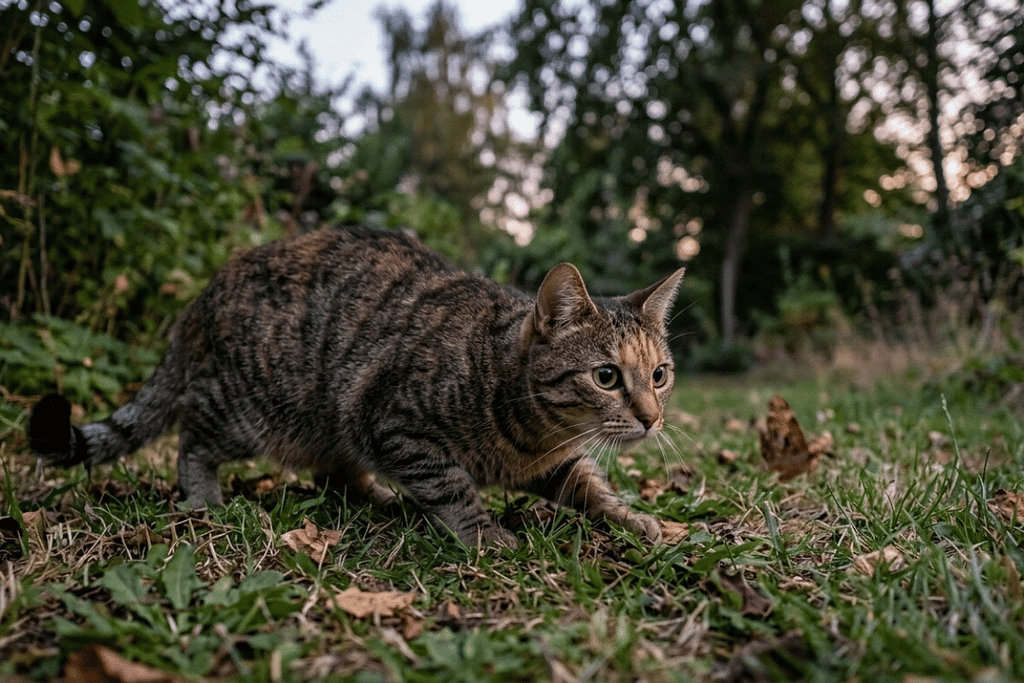
Your cat may sleep peacefully on the couch, stretch lazily in the sun, and wait patiently for dinner.
But inside that quiet body lives the mind of a highly specialized predator.
In evolutionary terms, your cat is not completely removed from the wild.
It is the descendant of a solitary hunter whose instincts were shaped by thousands of years of survival — stalking prey, detecting movement, and reacting with astonishing precision.
Understanding how cat behavior evolved reveals why modern cats still display these ancient patterns every day.
The silent stare at a bird outside the window.
The sudden pounce on a moving toy.
The mysterious bursts of energy at night.
None of these behaviors are random.
They are echoes of a predator’s past.
🧭 Cat Behavior Evolution: A Timeline of Instincts

The story of feline behavior stretches far beyond the history of domestication.
Long before cats became companions, their ancestors evolved as small, highly specialized hunters.
Wildcat Ancestors (≈100,000 years ago)
Early small wildcats developed stealth hunting strategies for catching rodents and birds.
Early Domestication (≈9,000 years ago)
Cats began living near human settlements where grain storage attracted rodents.
Agricultural Societies
Humans tolerated cats because they controlled pests, forming a loose partnership between species.
Modern Domestic Cats
Today’s cats still carry the behavioral architecture shaped by these early evolutionary pressures.
This continuity explains why domestic cats behave so similarly to their wild relatives.
🧬 The Evolution of Cat Behavior and Survival Traits
Unlike many animals that evolved to hunt cooperatively, cats developed strategies based on independence and precision.
Their survival depended on several key adaptations:
- silent movement
- heightened sensory awareness
- explosive bursts of speed
- patience during stalking
These traits allowed early cats to thrive as ambush predators.
Even today, domestic cat wild instincts are visible when they interact with toys, insects, or birds outside a window.
Evolution may have changed their environment, but it did not erase their instincts.
According to Cornell Feline Health Center, many behaviors seen in domestic cats today are directly inherited from their wild ancestors and remain essential to their survival instincts.
For the complete framework behind these systems, see Understanding Cat Behavior: The Evolutionary Blueprint Explained.
🐾 Instincts: Why Cat Hunting Behavior Still Dominates
One of the most important outcomes of how cat behavior evolved is the development of powerful hunting instincts.
Cats evolved as small-prey predators, specializing in animals such as rodents, birds, and insects. This explains why many cats continue to display feline predatory behavior even when they are well fed.
These behaviors include:
- stalking moving objects
- sudden pouncing
- silent observation before attacking
- chasing quick movements
If you’ve ever wondered how cats developed hunting instincts, the answer is simple: survival required it for thousands of generations.
To understand why this drive never turns off, even after a full meal, read Why Cats Hunt Even After Eating: The Predatory Drive Explained.
The full sequence of stalking, chasing, pouncing and biting follows a precise neurological chain. You can explore each stage in detail in Cat Predation Sequence: Stalking, Pouncing and Biting Explained.
And when cats have no real prey to hunt, they redirect this drive entirely into play. To understand why, read Why Do Cats Play Like They Are Hunting? The Instinct Behind the Game — one of the most revealing windows into feline instinct
👁️ Vigilance: How Cats Evolved to Assess Risk
Hunting was only part of the survival equation.
Small predators are also prey. And how cat behavior evolved reflects this dual reality — cats needed to hunt efficiently while remaining constantly aware of threats around them.
This is why cat vigilance behavior is so deeply wired.
A cat that stops mid-movement, freezes completely, and scans the environment is not being dramatic. It is running a survival protocol shaped by thousands of years of predator-prey dynamics.
Why do cats freeze before acting? Why do sudden movements trigger such intense reactions? The full answer is in Why Cats Freeze Before Acting: How They Assess Risk Without Moving.
And if you’ve ever noticed how a sudden movement sends your cat into immediate alert — even from deep sleep — Why Sudden Movements Trigger Cats explains exactly why this reaction is so hardwired.
🔍 Exploration: How Cat Curiosity Evolved as a Survival Tool
Vigilance kept cats safe. But exploration kept them informed.
Cat exploration instinct evolved as a way to map territory, locate resources, detect threats before they arrived, and understand environmental changes.
A cat that explores is not simply curious — it is actively building a mental model of its world.
This is why cats investigate every new object, map every corner of a new environment, and react with caution before accepting change.
To understand why cats investigate every unfamiliar object with such focus, read Why Cats Investigate New Objects Immediately.
Scent plays a central role in this mapping process — explored in depth in Scent Exploration and Environmental Mapping in Cats.
And if you’ve ever noticed your cat’s hesitation before accepting something new, Why Cats React to Changes in Their Environment Before Accepting Them explains the survival logic behind that caution.
🧬 Reproductive & Social Evolution: The Instincts Behind Feline Bonds
How cat behavior evolved extends beyond hunting and survival.
Reproduction, social tolerance, and territorial negotiation also shaped the feline behavioral architecture.
Cats are not pack animals — but they are not entirely solitary either.
Their social behavior evolved in a specific context: loose colonies where resources were shared but independence was maintained.
This explains why cats form bonds but resist control, tolerate companions but defend personal space, and express behaviors differently between males and females.
Feline social behavior evolution produced a highly specific social profile — one that modern cat owners often misread as aloofness or indifference.
🏠 Indoor Cat Behavior Problems and Evolution
The environments where cats evolved were rich with opportunities to hunt, explore, and assert territory.
Modern homes are very different.
Indoor cats enjoy safety, warmth, and reliable food — but they may lack natural outlets for their instincts.
When natural behaviors have no outlet, cats may experience:
- boredom
- nighttime hyperactivity
- frustration
- destructive scratching
Providing enrichment that mimics hunting and exploration helps restore behavioral balance.
🌿 The Ancient Hunter in Your Living Room
Modern homes may seem far removed from the ecosystems where cats evolved.
Yet the instincts guiding feline behavior remain remarkably intact.
The cat sleeping quietly beside you is not simply a domesticated pet.
It is the descendant of a finely tuned predator whose behavioral systems were shaped by thousands of years of survival in the wild.
And once we understand how cat behavior evolved, many feline mysteries begin to make perfect sense.
This article reflects Sissi’s lifelong experience living with cats, informed by years of observation and regular consultations with licensed veterinarians. For medical concerns about your cat, always consult a qualified vet.
❓ FAQ
How did cat behavior evolve over time?
Cat behavior evolved through thousands of years of survival pressure as small solitary predators. Hunting instincts, vigilance systems, exploratory drive, and social tolerance all developed as adaptive responses to environments where prey was unpredictable and threats were constant. These systems remain largely intact in domestic cats today.
Why do cats still act like wild animals even when they’re pets?
Because domestication changed the environment, not the instincts. The neural systems that drive stalking, freezing, exploring, and territorial behavior evolved over thousands of generations and cannot be erased by a few thousand years of living with humans. Your cat is behaviorally much closer to its wild ancestors than it might appear.
Why do indoor cats still have predator instincts?
Indoor cats retain the same instinctive architecture as their wild relatives. Hunting, vigilance, and exploration are not learned behaviors — they are biological systems encoded in the nervous system. Without natural outlets, these instincts express themselves through play, sudden bursts of activity, and environmental investigation.
Why do cats explore everything in the house?
Cat exploration instinct evolved as a survival mechanism. Knowing every corner of their territory allowed cats to locate resources, detect threats early, and plan escape routes. Indoor cats apply this same drive to their home environment — investigating every new object or change as a matter of instinct, not mere curiosity.

With the sensitivity of one who loves deeply, Sissi writes stories celebrating the animal world. Her felines Estrela and Safira illuminate her days, while Pete and Gabrich live eternally through her words. Every piece she writes is a love letter to the companions who make life truly meaningful.