
Why Cats Freeze Before Acting: How They Assess Risk Without Moving
Cats freeze before acting because their brains assess risk and process sensory input before movement. This stillness allows cats to evaluate threats, track motion, and decide whether to hunt, retreat, or stay alert.
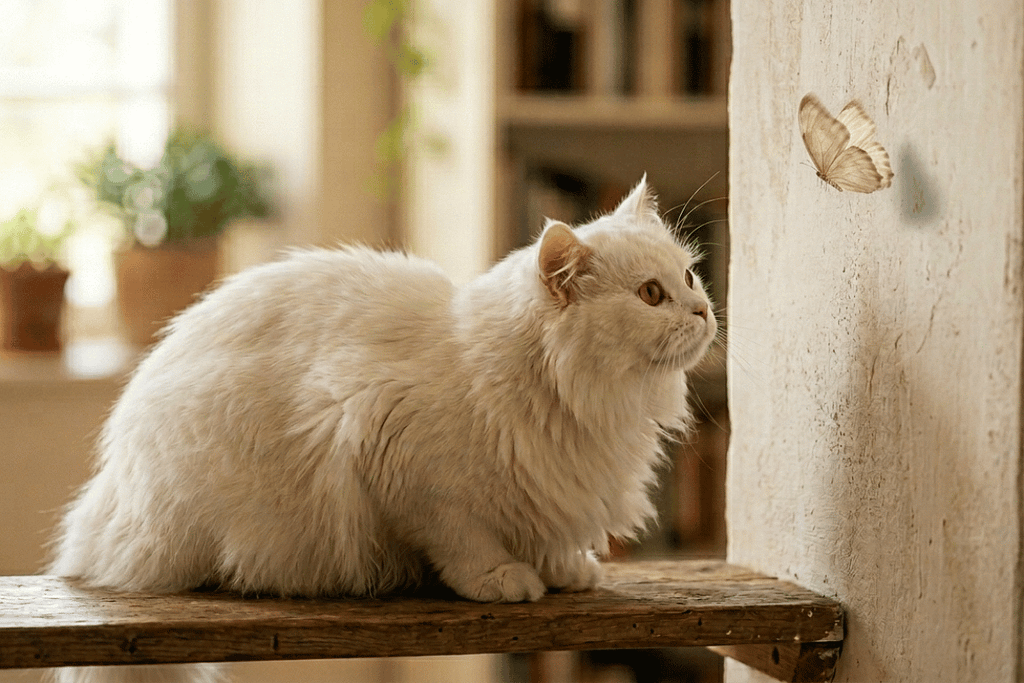
You’ve probably seen it many times.
Your cat is walking… exploring…
and then suddenly — it stops.
Completely still.
The body freezes.
The eyes lock onto something you can’t even see.
The tail pauses mid-motion.
At first, it may look like hesitation.
But understanding why cats freeze before acting reveals something much deeper.
This moment of stillness is not confusion.
It is a highly refined behavioral system where cats assess risk, process information, and prepare for action.
Before a cat moves, it evaluates — carefully and deliberately.
🧠 Cats Freeze Before Acting: The Body Stops, the Brain Starts
To understand this response, we need to separate what we see from what is happening internally.
On the outside:
- the body is still
- movement stops
On the inside:
- the brain becomes highly active
This state is known as cat motor inhibition — the deliberate suppression of movement while the brain processes.
This is what behaviorists call cat freezing behavior — deliberate, controlled, and purposeful.
According to Cornell Feline Health Center, the suppression of movement in cats during predatory assessment is a neurologically active state — not passivity, but controlled preparation for precise action.
Why does movement stop? Because movement has consequences.
In the wild, moving too early could:
- alert prey
- expose the cat to predators
- waste energy
So instead, cats freeze — and during this freeze, they begin to assess risk.
👁️ Feline Risk Assessment: What Happens During the Freeze
A key part of understanding why cats freeze before acting is recognizing that freezing and thinking happen at the same time.
While the body is still, the brain is evaluating:
- Is this prey?
- Is this dangerous?
- Is this worth acting on?
This is how feline risk assessment works — cats gather information first, then decide.
If you’ve ever wondered why does my cat suddenly stop and stare, you’re watching feline risk assessment in real time.
I’ve watched my own cats hold this freeze for what felt like minutes — completely locked in, reading something I couldn’t even detect.
This decision process includes:
- predicting movement
- estimating distance
- calculating timing
This is not random behavior. It is real-time analysis.
🔍 Why Cats Go Still Suddenly: Sensory Processing Explained
Another important reason why cats freeze before acting is to maximize sensory accuracy.
When a cat stops moving, its senses become more precise.
- Vision: Cats are highly sensitive to movement, especially small, rapid changes.
- Hearing: They detect high-frequency sounds, even those humans cannot hear.
- Whiskers: Whiskers sense subtle air currents and nearby motion.
By remaining still, cats reduce sensory noise from their own body movement.
Why do cats freeze and stare at nothing? Because they are detecting signals humans simply cannot perceive.
This allows cats to:
- focus more clearly
- detect subtle environmental changes
- interpret signals with maximum accuracy
- stillness improves perception
Why cats go still suddenly is not a mystery — it is precision at work.
⚖️ The Hidden Calculation Behind Cat Freezing Behavior
At the core of why cats freeze before acting is a simple but powerful calculation:
Is this worth it?
Cats constantly evaluate:
- effort vs reward
- safety vs danger
- certainty vs uncertainty
A moving object could be:
- prey → high reward
- threat → high risk
- irrelevant → no action
This is how cats assess risk in real time — and it all happens during that moment of stillness. Cat stillness before hunting is not hesitation — it is preparation at its most refined.
🎯 Why Cats Pause Before Pouncing: Precision Over Speed
Cats are not built for long chases. They are built for precision.
Why cats pause before pouncing comes down to one thing: precision requires preparation.
Freezing allows the cat to:
- choose the perfect moment
- align its body correctly
- prepare muscles for explosive movement
Without this step, the chances of a successful hunt drop dramatically.
This is also why cats freeze before acting is directly connected to the predation sequence:
- detection
- freezing
- stalking
- pouncing
The freeze is not optional. It is essential.
To understand how this fits into the full hunting chain, read Cat Predation Sequence: Stalking, Pouncing and Biting Explained.
🔮 Cats Freeze Before Acting to Predict — Not Just Observe
Most explanations say cats freeze to observe.
But that’s only part of the story.
Cats are also predicting.
During the freeze, the brain tries to anticipate:
- where the object will move next
- how fast it will move
- when to act
This predictive ability is what makes cats such efficient hunters.
They are not reacting to the present. They are preparing for the future.
🧩 Freezing vs Hesitation: Why Cats Are Never Confused
Many people misinterpret this behavior.
They think the cat is unsure, confused, or slow to react.
But there is a critical difference:
- hesitation = lack of clarity
- freezing = controlled analysis
Cats freeze before acting with complete intention.
When movement is sudden, fast, or unpredictable, the brain switches systems entirely — bypassing the freeze and reacting instantly. To understand this reaction, read Why Sudden Movements Trigger Cats.
🏠 Indoor Cats Freezing Behavior: Why It Never Disappears
Because the instinct is hardwired. Common triggers include:
– toys
– shadows
– insects
– reflections
– light movement
Indoor cats freezing behavior appears constantly — triggered by toys, shadows, and reflections.
The brain does not distinguish between real prey and simulated movement.
It simply activates the same system.
This is why cats freeze before acting even in completely safe environments — the evolutionary wiring does not care about context.
To understand how this freeze fits into the complete evolutionary picture, explore How Cat Behavior Evolved: Instinct, Vigilance and Exploration.
This article reflects Sissi’s lifelong experience living with cats, informed by years of observation and regular consultations with licensed veterinarians. For medical concerns about your cat, always consult a qualified vet.
❓ FAQ
Why do cats freeze before acting?
Cats freeze before acting because the brain enters a state of active assessment — processing sensory input, evaluating risk, and preparing for precise movement. This motor inhibition is deliberate, not hesitation. The body stops so the brain can work without interference.
Why does my cat suddenly stop and stare at nothing?
Because it is detecting something you cannot perceive. Cats have highly sensitive hearing, vision tuned to detect micro-movements, and whiskers that sense air currents. What looks like staring at nothing is actually focused sensory processing of a signal that exists — just below human detection.
Why do cats freeze and then pounce?
The freeze is the preparation stage of the predatory sequence. Cats use that stillness to calculate distance, predict movement, align their body, and load their muscles for the explosive leap. Skipping the freeze would mean acting without enough information — and missing the target.
Why do indoor cats still freeze even when there is no real prey?
Because the freezing system is hardwired and does not require real prey to activate. Any movement that resembles prey — a toy, a shadow, a reflection — triggers the same neurological response. The brain responds to the signal, not the source.

With the sensitivity of one who loves deeply, Sissi writes stories celebrating the animal world. Her felines Estrela and Safira illuminate her days, while Pete and Gabrich live eternally through her words. Every piece she writes is a love letter to the companions who make life truly meaningful.