
Why Do Cats Chatter at Birds? What It Really Means
| Cats chatter at birds because their hunting instinct is activated by prey they cannot reach. This triggers the predatory system, producing a rapid clicking sound that reflects excitement, focus, and frustration. |
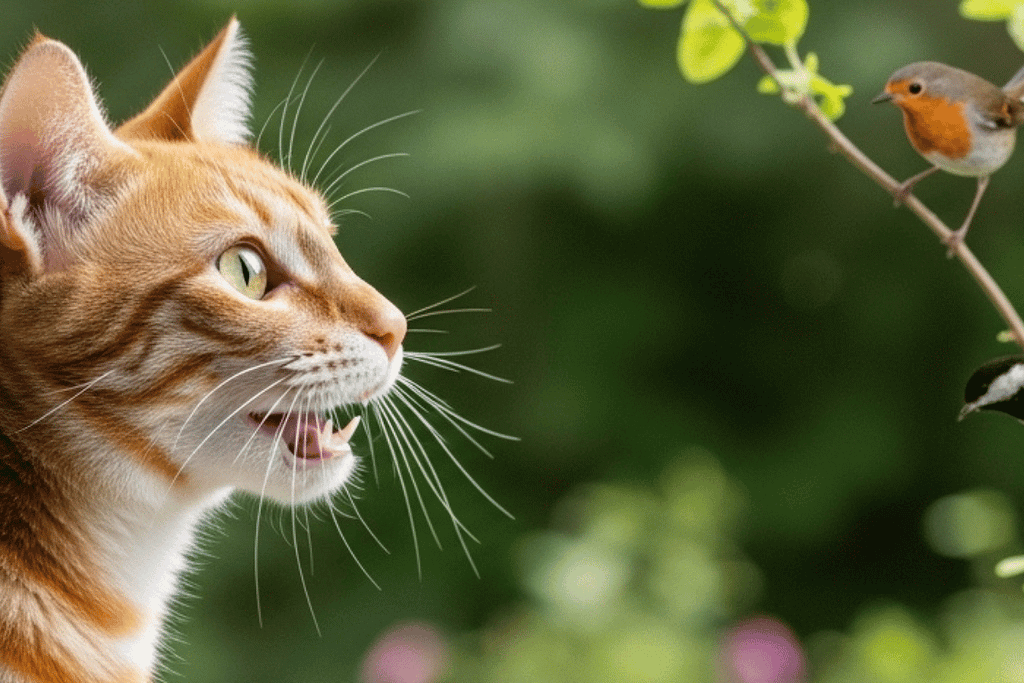
Many cat owners have witnessed a strange sound while their cat watches birds through the window.
The cat sits perfectly still, eyes locked on movement.
Then suddenly, it begins making a rapid clicking or chattering sound with its teeth — a behavior often described as cat chirping at birds.
This behavior may seem unusual — but in reality, it is a natural expression of instinct. Understanding the cat clicking sound meaning helps explain how this behavior connects directly to hunting responses.
🧬 Cat Hunting Instincts Behind Chattering Behavior
Cats evolved as highly specialized hunters of small prey such as birds, rodents, and insects.
When a cat detects movement, its brain activates cat hunting instincts, triggering the prey drive in cats and preparing the body for action.
This process includes:
- visual focus on movement
- muscular tension
- preparation for pouncing
Chattering often appears at this stage of intense focus.
It may reflect the activation of motor patterns used during hunting.
⚡ Excitement and Frustration in Cats
One of the most accepted explanations is that chattering reflects a mix of:
- excitement
- anticipation
- frustration
The cat sees prey.
The hunting system activates.
But the action cannot continue.
This interruption creates internal tension.
The chattering sound may be a release of that built-up energy.
🎯 The Cat Predation Sequence and Chattering
Chattering is closely linked to the cat predation sequence.
This sequence includes:
- detecting prey
- stalking
- focusing
- preparing to strike
When the sequence is interrupted — for example, by a window — the behavior cannot be completed.
Chattering may be the result of this incomplete cycle.
🧠 The “Practice Bite” Theory
Some researchers suggest that chattering mimics the motion of the killing bite.
During hunting, cats use a precise jaw movement to capture prey.
The rapid jaw motion seen during chattering may be a form of motor rehearsal.
While not fully proven, this explanation aligns with known hunting mechanics.
🐦 Why Birds Trigger Cat Chattering
Birds are one of the strongest triggers for this behavior.
Their movement is:
- fast
- unpredictable
- highly stimulating
A cat’s brain interprets this exactly as it would real prey.
This explains the intense focus and prolonged observation.
🏠 Why Indoor Cats Chatter More at Birds
Indoor cats often display chattering more frequently.
They experience:
- strong visual stimulation
- no physical outlet
This creates repeated activation of the hunting system without completion.
Providing structured play can help release this energy.
I’ve observed this behavior in my own cats many times — especially when birds appear just beyond reach.
If you want to understand this further, Why Indoor Cats Still Need to Hunt explores how instinct works indoors.
🎮 Chattering During Play and Toy Interaction
Some cats chatter while playing.
This happens when toys mimic prey movement.
Examples include:
- feather wand toys
- toy birds
- fluttering ribbons
These stimuli activate the same neural systems used in real hunting.
🔗 How Cat Chattering Fits into Cat Behavior Evolution
Chattering is not an isolated behavior.
It connects with:
- hunting instincts
- prey tracking
- motor preparation
- neurological reward systems
According to International Cat Care, predatory behaviors in cats can be triggered purely by visual stimuli, even without physical interaction.
If you want to understand how these systems evolved, Cat Behavior Evolution: Why Instinct Still Rules explores the full behavioral framework.
🌿 What Cat Chattering at Birds Really Means
Although it may seem unusual, chattering is completely normal.
It does not indicate stress or illness.
It is simply the expression of a hunting system that cannot be completed.
Once you understand why cats chatter at birds, the behavior becomes clear — and even fascinating.
This article is based on Sissi’s lifelong experience living with cats, shaped by years of observation and ongoing guidance from licensed veterinarians. For any medical concerns, always consult a qualified vet.
? faq
Why do cats chatter at birds?
Cats chatter at birds because their hunting instinct is activated when they see prey they cannot reach. This creates a mix of excitement and frustration, triggering the rapid clicking sound as part of the predatory response.
Is cat chattering normal?
Yes, cat chattering is completely normal. It is a natural expression of hunting instinct and does not indicate stress or illness, especially when triggered by birds, insects, or moving objects.
Do cats chatter only at birds?
No, cats may chatter at any type of perceived prey, including insects, small animals, or even toys. Any movement that mimics prey can activate this instinctive response.
Is chattering a sign of frustration in cats?
Partly. Chattering often reflects both excitement and frustration, especially when a cat can see prey but cannot physically reach it, such as through a window.

With the sensitivity of one who loves deeply, Sissi writes stories celebrating the animal world. Her felines Estrela and Safira illuminate her days, while Pete and Gabrich live eternally through her words. Every piece she writes is a love letter to the companions who make life truly meaningful.