
Energy Economy in Cats: Why Nothing Is Wasted
Energy economy in cats is the biological system through which cats conserve, organize, and release energy in short, efficient bursts rather than spreading activity continuously throughout the day. Long periods of rest maintain readiness for rapid activation, movement, and recovery.
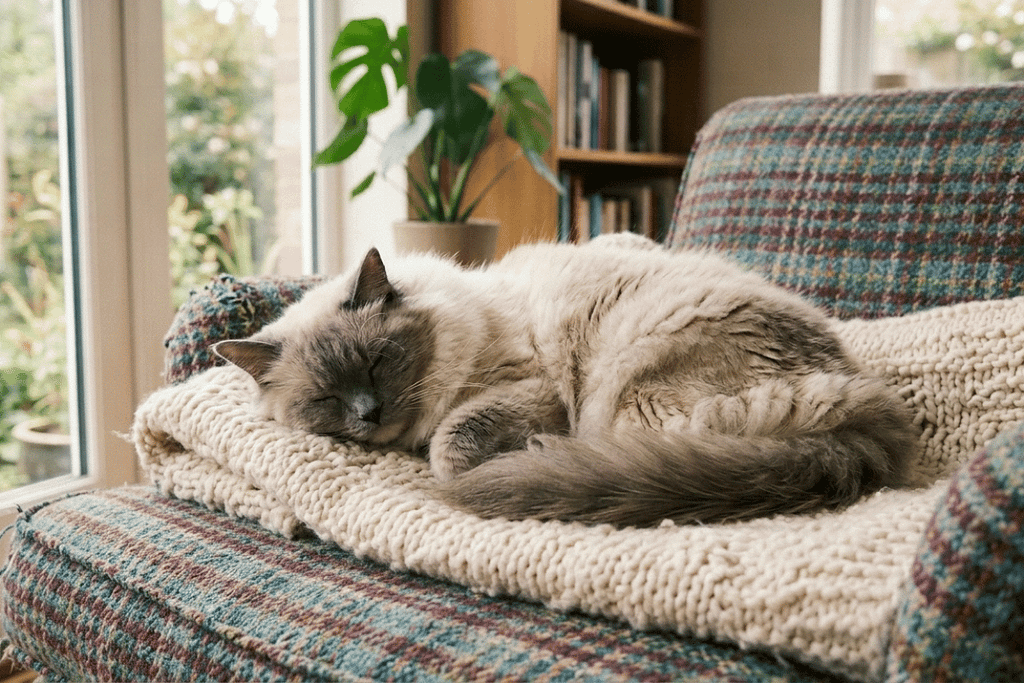
Many cat owners notice the same pattern.
A cat rests quietly for long periods, suddenly becomes intensely active, and then returns to stillness almost as quickly as the burst began.
At first, this behavior can feel inconsistent.
But what looks like inactivity is often energy organization in progress.
Cats do not distribute energy evenly throughout the day. Instead, feline physiology is designed to conserve energy, maintain readiness, and release activity in short, efficient bursts when stimulation reaches the right threshold.
Understanding energy economy in cats helps explain why rest, sudden movement, and rapid disengagement are all parts of the same biological system.
🔄 Energy Economy in Cats: Why Energy Is Gathered Instead of Spread
Humans often think of energy as something continuous.
A little movement here.
A little activity there.
Steady engagement over time.
Cats do not function this way.
Energy economy in cats means energy is gathered, conserved, and released precisely when needed.
This strategy developed through small predator physiology, where unnecessary movement wasted valuable metabolic resources.
Instead of remaining moderately active all day, cats:
- conserve energy during long recovery periods,
- remain environmentally aware while resting,
- release energy rapidly during brief activation windows.
Cat energy conservation is not passivity — it is the foundation of how cats balance rest, activity, and readiness.
This becomes easier to recognize in Cat Energy Cycles Explained, where activation and recovery alternate throughout the day.
⚡ Cat Activity Thresholds: Why Bursts Happen Suddenly
Every cat has a stimulation threshold — the point where accumulated readiness shifts into visible action.
This is why a cat may appear calm one moment and suddenly sprint across the room the next.
If you’ve ever wondered why does my cat have so much energy then do nothing, the answer is that bursts and stillness belong to the same activation system.
The nervous system does not stay equally activated all the time.
Instead, stimulation gradually builds until it reaches a threshold that triggers:
- running,
- play bursts,
- rapid movement,
- focused engagement.
Once the activation peak resolves, the system quickly returns to recovery.
What appears random externally is often a highly organized release of accumulated energy.
💤 Why Cats Rest So Much Between Activity Bursts
Rest is one of the most important parts of feline energy economy.
According to the Cornell Feline Health Center, cats commonly spend between 12 and 16 hours per day resting — an adaptation that helps maintain explosive muscle capacity for rapid predatory movement.
Cat rest and readiness exist simultaneously.
Even during stillness, cats often remain highly responsive to environmental stimulation.
You may notice:
- ear movements during rest,
- immediate responsiveness after sleeping,
- rapid shifts from stillness to alertness.
Why do cats sleep so much but still have energy bursts? Because recovery periods are what make intense bursts possible.
Rest is not separate from activity.
It prepares the next activation phase.
🎯 Feline Energy Efficiency: Why Cats Stop Playing Suddenly
From a human perspective, cats sometimes seem to disengage unexpectedly.
Play begins intensely — and then suddenly ends.
But feline energy efficiency is based on completion, not prolonged output.
Cats are designed for:
- short bursts of focused activity,
- rapid stimulation peaks,
- quick recovery after exertion.
Why does my cat stop playing and walk away? Because the energy allocated for that activity has already been used.
The nervous system completed the activation cycle and shifted back toward recovery.
I used to interpret this as disinterest when my own cats walked away mid-play. Over time, I realized the interaction had not failed — the cycle had simply resolved.
This is one reason cats often stop activity even when stimulation continues.
The system prioritizes efficiency over duration.
🌙 How Energy Economy Connects to Biological Rhythms
Energy economy does not operate independently from the rest of the feline behavioral system.
It connects closely to:
- biological rhythms,
- energy cycles,
- environmental timing,
- anticipatory behavior.
Cats naturally organize activity around periods when energy becomes more biologically available — especially during dawn, dusk, and quieter environmental windows.
This is why many cats become suddenly active at night or early in the morning.
These patterns are explored further in Feline Biological Clock, where internal rhythms regulate timing, alertness, and activity throughout the day.
🌿 Why Energy Economy Makes Cat Behavior Easier to Understand
Once feline energy economy becomes visible, many behaviors start to feel less confusing.
The stillness is not emptiness.
The burst is not randomness.
The quick disengagement is not rejection.
All are parts of the same biological system:
- conservation,
- activation,
- release,
- recovery.
Cats are not built for constant output.
They are built for metabolic efficiency — conserving resources until the right moment for precise action arrives.
To understand how these systems connect across behavior, timing, and recovery, Why Do Cats Get Bursts of Energy — Then Suddenly Go Still? explores the broader organization of feline activity and rest.
This article reflects Sissi’s lifelong experience living with cats, informed by years of observation and veterinary-guided behavioral understanding. Through A Cat With Story, she explores how instinct, neurobiology, and environment shape everyday feline behavior.
❓ FAQ
What is energy economy in cats?
Energy economy in cats is the biological strategy of conserving energy during long recovery periods and releasing it in short, efficient bursts of activity.
Why does my cat have bursts of energy and then do nothing?
Because activation and recovery are part of the same cycle. After intense activity, the nervous system shifts back into recovery and energy conservation.
Why does my cat stop playing and walk away suddenly?
Cats are designed for short periods of focused activity rather than continuous engagement. Once the activation cycle resolves, recovery begins.
Why do cats sleep so much if they have so much energy?
Long rest periods help maintain the rapid muscle activation and neurological readiness required for sudden bursts of movement.

With the sensitivity of one who loves deeply, Sissi writes stories celebrating the animal world. Her felines Estrela and Safira illuminate her days, while Pete and Gabrich live eternally through her words. Every piece she writes is a love letter to the companions who make life truly meaningful.