
Cat Predation Sequence: Stalking, Pouncing and Biting Explained
The cat predation sequence is a hardwired chain of instinctive behaviors — stalking, chasing, pouncing, and biting — that evolved to capture prey with maximum efficiency. Every stage activates automatically in response to movement, forming one of the most refined hunting systems in the animal kingdom, still fully intact in every domestic cat today.
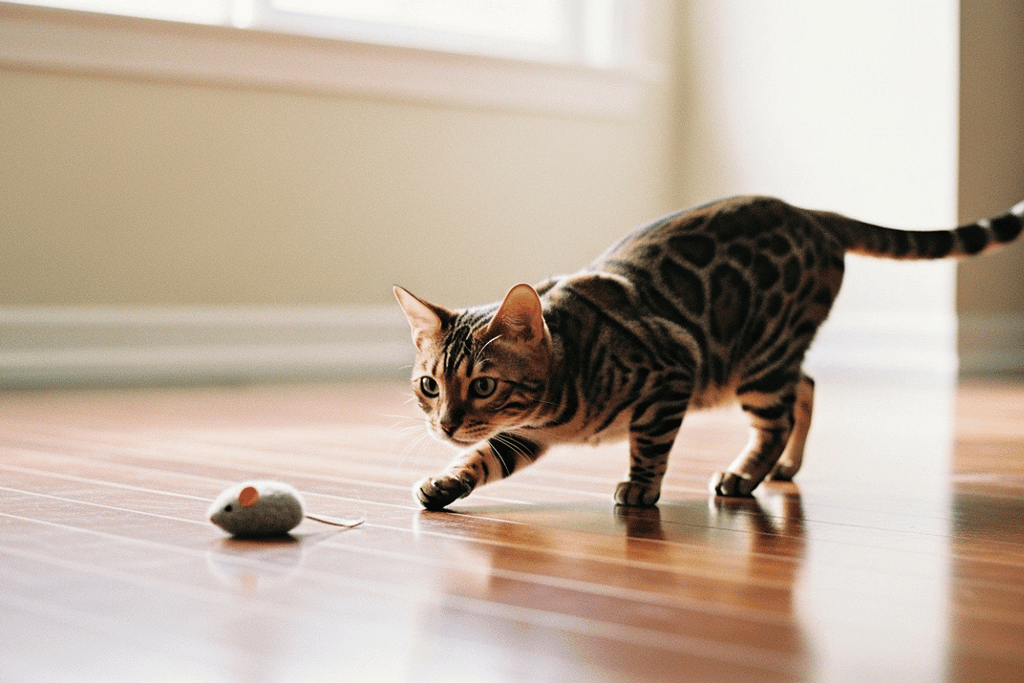
A feather toy moves across the floor — and your cat freezes instantly.
Its body lowers toward the ground, eyes fixed on the target.
The tail becomes still.
A moment later, the cat explodes into motion.
This pattern is not random.
It is the cat predation sequence — a highly refined behavioral chain that evolved to help cats capture prey with precision and efficiency.
Even domestic cats that have never hunted real animals still perform this sequence during play.
🐾 What Is the Cat Predation Sequence?
The cat predation sequence refers to a series of instinctive behaviors that occur when a cat hunts prey.
These actions follow a predictable order that maximizes hunting success.
The sequence typically includes:
- detecting prey movement
- stalking the target
- chasing
- pouncing
- delivering the killing bite
Each step prepares the body and brain for the next stage of the sequence.
According to the Cornell Feline Health Center, the predatory sequence in cats is a neurologically fixed pattern of behavior — meaning each stage activates the next automatically, independent of learning or training.
This is what makes the cat predation sequence so consistent across individuals — it is not learned, it is wired.
👁️ Step 1: How the Cat Predation Sequence Begins — Detection
The cat predation sequence begins with detection.
Cats are highly sensitive to movement. Their vision and hearing evolved to detect small, quick motions made by animals such as rodents or birds.
Even tiny movements can trigger the first stage of the cat predation sequence.
Common triggers include:
- a moving toy
- insects crawling across the floor
- birds outside a window
- shadows shifting across a wall
Cat stalking behavior begins the moment movement is detected — and once the sequence starts, it follows its own momentum.
The brain has already committed to the hunt.
🐆 Step 2: Stalking — The Stealth Stage of the Predation Sequence
Stalking is the most visually distinctive stage of the cat predation sequence.
During this stage, the cat lowers its body and moves slowly toward the target. This crouched posture minimizes the cat’s visible profile while maximizing readiness for the strike.
Characteristics of cat stalking behavior include:
- crouched, low posture
- slow, controlled movement
- intense, unblinking visual focus
- tail held low or still
If you’ve ever wondered why does my cat crouch and stare before jumping, you are watching this stage of the cat predation sequence in real time — stealth built into every movement.
This explains why cats crouch before jumping — it maximizes precision and minimizes the chance of detection by prey.
I’ve watched my own cats hold this position for minutes at a time — completely still, completely focused, completely committed.
⚡ Step 3: The Chase — Explosive Speed in the Predation Sequence
If the prey begins moving away, the cat predation sequence shifts immediately into the chase.
This stage is often very brief.
Cats evolved to capture prey in short, explosive bursts rather than long endurance pursuits.
Their muscles are designed for maximum acceleration over short distances.
This is why the chase stage of the cat predation sequence looks so sudden and intense — it is designed to be over in seconds.
🎯 Step 4: The Pounce — Why Cats Wiggle Before They Leap
The pounce is the most dramatic moment of the cat predation sequence.
Cats launch themselves toward the target using powerful hind legs. During this movement, the front paws extend forward to trap the prey.
That distinctive wiggle before the leap is a critical part of the cat predation sequence — the body loading energy, aligning the hind legs, and calibrating balance for maximum precision.
Why do cats wiggle before they pounce? Because the neurological system requires that final moment of preparation before committing to the explosive leap.
From repeated observation, this wiggle consistently appears as a moment of intense motor preparation.
Even small errors at this stage could allow prey to escape. The pounce demands precision.
🦷 Step 5: The Killing Bite — The Final Stage of the Cat Predation Sequence
The killing bite is the final and most instinctively driven stage of the cat predation sequence.
In the wild, this involves a precise bite to the neck of the prey — damaging the spinal cord and quickly immobilizing the animal.
Why do cats bite toys after catching them? Because the killing bite is the stage the cat predation sequence demands for completion. Without it, the sequence feels neurologically unfinished.
This explains why cats bite during play — they are not being aggressive. They are completing the final stage of an ancient and deeply wired behavioral chain.
🌿 The Bigger System Behind the Cat Predation Sequence
The cat predation sequence is one part of a larger evolutionary system that shapes all feline behavior.
These instincts connect with hunting motivation, play patterns, vigilance, and territorial awareness.
To understand how the cat predation sequence fits into the complete evolutionary picture, explore How Cat Behavior Evolved: Instinct, Vigilance and Exploration.
This article reflects Sissi’s lifelong experience living with cats, informed by years of observation and regular consultations with licensed veterinarians. For medical concerns about your cat, always consult a qualified vet.
❓ FAQ
What is the cat predation sequence?
The cat predation sequence is a hardwired chain of five instinctive behaviors — detection, stalking, chasing, pouncing, and biting — that activates automatically when a cat detects movement resembling prey. It is neurologically fixed, meaning each stage triggers the next independently of learning or hunger.
Why does my cat crouch and stare before jumping?
This is the stalking stage of the cat predation sequence. Crouching lowers the cat’s profile to avoid detection while the intense stare locks onto the target’s movement pattern. The cat is calculating timing and distance before committing to the pounce — a process that can last seconds or minutes.
Why do cats wiggle before they pounce?
The pre-pounce wiggle is the body loading energy for the explosive leap — the final preparatory stage of the cat predation sequence. The cat is aligning its hind legs, calibrating balance, and building muscular tension for maximum precision at the moment of launch.
Why do cats bite their toys after catching them?
Because the killing bite is the final stage of the cat predation sequence — and the neurological system demands completion. Without it, the sequence feels unfinished. Cats that consistently cannot complete the full sequence during play may show signs of frustration or restlessness.

With the sensitivity of one who loves deeply, Sissi writes stories celebrating the animal world. Her felines Estrela and Safira illuminate her days, while Pete and Gabrich live eternally through her words. Every piece she writes is a love letter to the companions who make life truly meaningful.