
Why Do Cats Play With Prey Before Killing? The Instinct Explained
Why do cats play with prey before killing? Because it is a survival strategy, not cruelty. By releasing and recapturing prey, cats reduce the risk of injury, assess the animal’s strength, and refine the precise timing required for a clean kill. This behavior evolved over thousands of years as a way to maintain control during the most dangerous stage of the hunt.
Many cat owners have witnessed a moment that can feel confusing.
A cat catches an insect, a small animal, or even a toy — and then lets it go.
Moments later, it captures it again.
To us, this can look like teasing or playing. But for cats, the behavior is rooted in instinct and survival.
If you’ve ever wondered why cats play with prey before killing, the answer reveals how deeply hunting behavior is woven into feline biology.
🐾 Why Cats Play With Prey Before Killing: The Evolutionary Root
Long before cats shared our homes, they survived as solitary hunters.
Their ancestors hunted small animals such as rodents and birds — prey that could bite, scratch, or escape.
To reduce risk during capture, cats evolved strategies that allowed them to maintain control throughout the hunt.
One of the most misunderstood of these strategies is the release-and-recapture behavior.
By briefly releasing prey and catching it again, a cat can:
- monitor the prey’s movement,
- maintain a safer distance,
- gradually weaken the animal over time.
According to International Cat Care, this behavior is not play in the human sense, but an instinctive risk-management process that helps the cat stay in control during one of the most dangerous moments of the hunt.
What appears to be playful behavior is, in reality, a precise and controlled hunting strategy.
🎯 Why Cats Let Prey Go: Risk Management Before the Kill
Small prey can still defend itself.
Rodents, for example, may bite if cornered. Birds may flap and attempt to escape.
Why cats let prey go before finishing the hunt comes down to one thing: risk management.
Allowing the prey to move briefly gives the cat time to judge the safest moment to finish the hunt. This strategy evolved to protect the cat from injury during the final stages of capture.
If you’ve ever wondered why does my cat let the mouse go and catch it again, the answer is survival strategy — not cruelty.
Through repeated observation, this pattern becomes clear — once you understand what’s happening, it no longer looks like cruelty.
From an evolutionary perspective, avoiding injury was extremely important.
🧠 Why Cats Bat at Prey Instead of Killing It Immediately
Hunting is not just about strength — it depends on precise coordination between vision, muscle control, and reflex timing.
Before delivering a final bite, cats often interact repeatedly with their prey. This behavior allows them to refine movement, adjust timing, and maintain control over an unpredictable target.
What may appear to humans as hesitation or play is, in fact, a controlled process of motor calibration.
Each contact helps the cat improve accuracy, positioning, and reaction speed — all essential for a successful and efficient capture.
This pattern is especially common in young or inexperienced cats, but it remains present in adults as part of a deeply ingrained neurological system.
Rather than acting randomly, the cat is fine-tuning the exact timing required to complete the hunt with precision.
🔗 How Playing With Prey Fits the Cat Predation Sequence
This behavior often occurs during the later stages of the cat predation sequence, the natural hunting pattern that includes:
- detecting movement
- stalking
- chasing
- capturing
- delivering the final bite
The capture-and-release moment happens between stages four and five, as the cat maintains control over the prey before committing to the kill.
To learn more about this process, see Cat Predation Sequence: Stalking, Pouncing and Biting Explained.
🎮 Why Cats Play With Toys the Same Way They Play With Prey
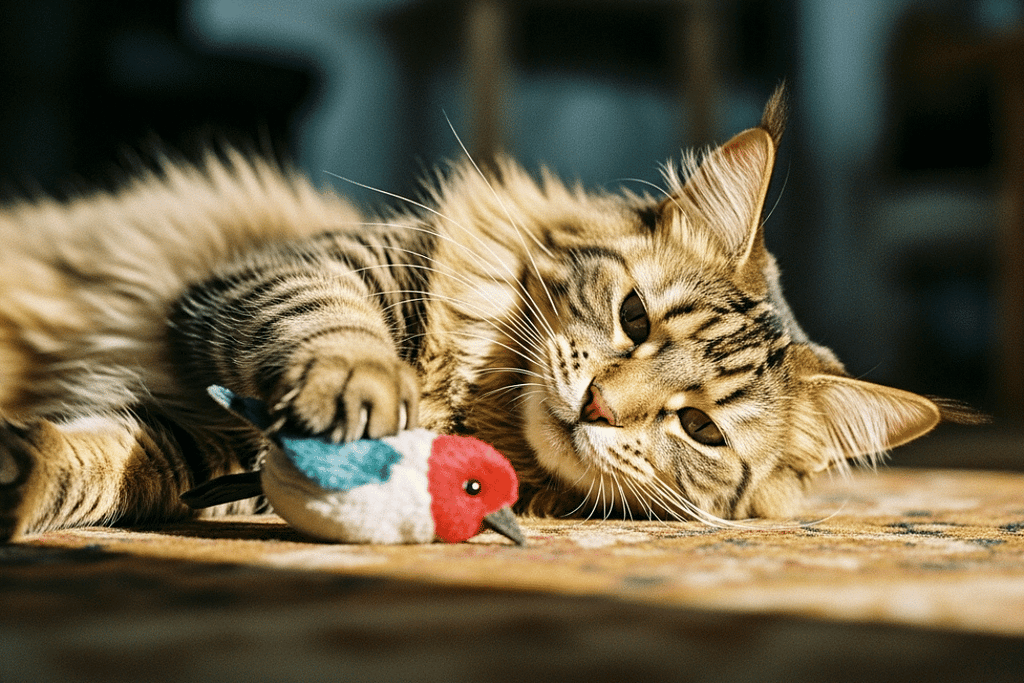
Domestic cats often behave the same way with toys.
For example, a cat might:
- capture a toy mouse
- release it
- pounce again
Cats play with toys the same way they play with prey because the same neurological system is driving both behaviors.
Play allows cats to express their hunting instincts in a safe environment — and the catch-and-release pattern appears just as naturally with a toy as with real prey.
🏠 Indoor Cat Hunting Behavior: Why It Still Appears
Even cats that have never hunted real prey may display similar behaviors.
When indoor cats interact with toys, they may repeat the same capture-and-release pattern seen in wild hunting.
This happens because the instinctive hunting system is still present, even without real prey.
Providing toys and interactive play helps cats express these instincts in healthy ways.
You can learn more about this topic in Why Indoor Cats Still Need to Hunt.
🌿 The Bigger System Behind Why Cats Play With Prey
What might look strange or unnecessary to humans is often a reflection of ancient instincts.
Cats evolved as highly specialized hunters, and many of their behaviors still follow patterns shaped by thousands of years of survival in the wild.
Understanding why cats play with prey before killing helps us see our feline companions not as cruel or indifferent — but as precisely wired survivors.
To understand how this behavior fits into the complete evolutionary picture, explore How Cat Behavior Evolved: Instinct, Vigilance and Exploration.
❓ FAQ
Why do cats play with prey before killing it?
Cats do this as a survival strategy. By releasing and recapturing prey, they reduce the risk of injury, assess movement, and maintain control before delivering the final bite.
Why does my cat let a mouse go and catch it again?
This behavior allows the cat to manage risk. Letting the prey move briefly helps the cat judge timing, distance, and the safest moment to complete the hunt.
Why do cats bat at prey instead of killing it immediately?
Batting helps refine coordination and reaction timing. Each interaction improves precision, ensuring the final capture is controlled and efficient.
Is this behavior cruel or just instinct?
It is instinctive, not cruelty. Cats are following a hardwired hunting pattern shaped by evolution, designed to keep them safe while capturing prey.
This article reflects Sissi’s lifelong experience living with cats, informed by years of observation and regular consultations with licensed veterinarians. For medical concerns about your cat, always consult a qualified vet.

With the sensitivity of one who loves deeply, Sissi writes stories celebrating the animal world. Her felines Estrela and Safira illuminate her days, while Pete and Gabrich live eternally through her words. Every piece she writes is a love letter to the companions who make life truly meaningful.