
Neurobiology of Cat Behavior : Why Cats Respond Differently
The neurobiology of cat behavior explains how brain systems regulate attention, sensitivity, and behavioral thresholds. These internal processes determine why cats respond differently to the same environment and why behavior varies across situations.
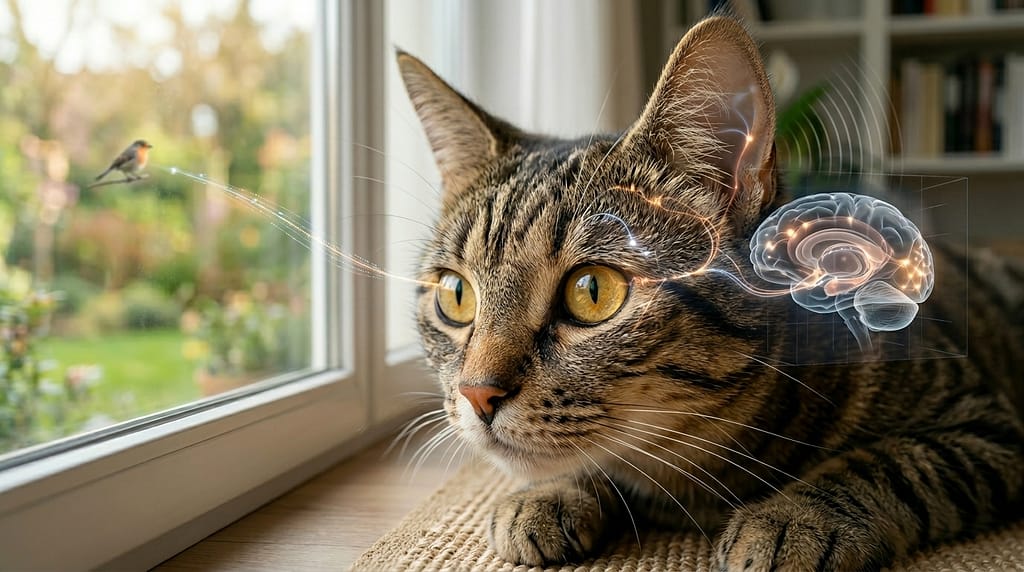
Differences in cat behavior often become noticeable in simple situations.
The same environment can produce very different responses — one cat reacts immediately, while another remains still. Even the same cat may respond differently depending on the moment.
These variations are not random. They reflect how internal systems regulate attention, sensitivity, and response thresholds.
Words like personality, mood, or temperament describe what you see.
The neurobiology of cat behavior explains what produces it.
🧠 What Controls Cat Behavior: The Neurobiology Behind It
Behavior does not begin when it becomes visible.
Before a cat approaches, reacts, or ignores something, internal systems are already determining:
- how much attention a stimulus receives,
- whether it crosses the threshold for action,
- how much stimulation the cat can tolerate.
These systems regulate three key processes:
Sensitivity — how easily the cat detects a stimulus.
A highly sensitive cat may respond to subtle changes that others do not register.
Behavioral thresholds — how much stimulation is required before a response occurs.
Some cats react immediately, while others require stronger input.
Behavioral inhibition — the system that determines when not to act.
What appears as hesitation or distance is often regulation — the threshold for action has not been reached.
Together, these processes explain a central principle:
the environment may be identical, but the internal state is not.
According to research from the Cornell Feline Health Center, feline behavior is influenced by neurological systems that regulate response and sensitivity.
🔍 Why Cats Respond Differently to the Same Environment
Differences in feline behavior are not random.
They reflect variations in how each cat’s nervous system processes stimuli — how quickly it activates, how strongly it responds, and how long it remains engaged before returning to baseline.
This is why:
- one cat reacts to subtle sounds while another ignores them,
- one recovers quickly while another remains alert,
- behavior that appears inconsistent follows internal patterns.
Over time, these patterns become recognizable and begin to form consistent behavioral profiles — explored further in Feline Temperament Explained.
🌿 What Is the Difference Between Cat Temperament and Personality
These patterns are what we call temperament — the consistent way a cat’s system responds to the world.
Temperament is not a label such as “friendly” or “shy.” It describes how the system operates: sensitivity level, activation threshold, and recovery speed.
Personality is how that pattern is interpreted.
It is shaped by experience, context, and the observer’s expectations.
The same cat may be described in different ways depending on who is observing — not because the behavior changes, but because interpretation does.
Understanding this distinction shifts how behavior is perceived:
- withdrawal is not rejection,
- hesitation is not indifference,
- strong reactions are not flaws.
They are expressions of how the system is organized.
⚙️ What Are Behavioral Thresholds in Cats and Why They Matter
A stimulus alone does not produce behavior.
For a response to occur, a threshold must be crossed.
Behavioral thresholds determine:
- when a cat reacts,
- when it pauses,
- when no visible response occurs.
This explains why the same situation can produce different outcomes across cats — or even in the same cat at different moments.
The environment may remain constant. The internal threshold does not.
🛑 Why Cats Pause Before Acting or Choose Not to React
What appears as hesitation is often regulation.
Behavioral inhibition controls:
- delaying action,
- maintaining distance,
- conserving energy.
In daily life, this often appears as:
- watching without approaching,
- stopping before completing an action,
- choosing not to engage.
This does not indicate disinterest.
It reflects that the threshold for action has not been reached.
⚖️ Why Cats Behave Differently From Each Other
Differences between cats reflect variations in:
- sensitivity,
- reactivity levels,
- behavioral thresholds.
These differences explain why:
- one cat reacts to minimal stimuli,
- another requires stronger input,
- one remains alert longer,
- another returns quickly to calm.
Over time, these patterns form what we describe as personality.
But at their core, they are expressions of how behavior is regulated — not traits assigned to the cat.
This becomes more visible when comparing styles such as those explored in Bold vs Cautious Cats.
🎯 What Makes a Cat React — or Ignore a Situation
A stimulus does not guarantee a response.
Behavior occurs only when internal conditions allow it.
This depends on:
- current sensitivity levels,
- internal state,
- prior activation.
That is why a cat may:
- react immediately in one moment,
- observe quietly in another,
- ignore the same stimulus later.
The difference is not always in the environment — it is in the system responding to it.
🔄 Why Cat Behavior Changes Across Environments and Contexts
Behavior is not fixed.
The same cat may move confidently in a familiar space and hesitate in a new one.
Temperament provides the baseline.
Context shapes how that baseline is expressed.
Understanding this distinction makes behavior easier to interpret — not as inconsistency, but as adaptation.
These variations become clearer when explored further in Why Cat Behavior Shifts Across Environments and Contexts.
🌿 A Clearer Way to Understand Your Cat’s Behavior
Behavior does not begin where it becomes visible.
It begins within systems that regulate attention, sensitivity, and response.
Once you recognize this, behavior becomes easier to read:
- not as randomness,
- not as inconsistency,
- but as structured responses shaped by internal processes.
The question shifts from:
“Why is my cat acting this way?”
to:
“What conditions are shaping this response?”
And that shift changes how behavior is understood.
To see how these internal systems fit into a broader framework, Understanding Cat Behavior: The Evolutionary Blueprint Explained explores how feline behavior is shaped by deeper evolutionary patterns.
This article is based on Sissi’s long-term experience living closely with cats, combined with continuous observation of feline behavior and insights informed by consultations with veterinary professionals. For any health-related concerns, always seek guidance from a qualified veterinarian.
❓ FAQ
What is the neurobiology of cat behavior?
It refers to how brain systems regulate attention, sensitivity, and behavioral thresholds — the internal processes that shape how a cat perceives and responds to its environment before any visible behavior occurs.
What is the difference between cat temperament and cat personality?
Temperament describes the consistent pattern of how a cat’s system responds — sensitivity, activation speed, recovery. Personality is how that pattern is interpreted by the observer over time. Temperament is the mechanism; personality is the narrative built around it.
Why do cats respond differently to the same situation?
Because each cat has a different sensitivity level and behavioral threshold. These differences affect how strongly a cat reacts, how quickly it activates, and how long it stays affected.
Why does the same cat behave differently on different days?
Temperament is stable, but its expression varies with context. Internal state, environmental familiarity, and prior activations all influence how the system responds in any given moment.

With the sensitivity of one who loves deeply, Sissi writes stories celebrating the animal world. Her felines Estrela and Safira illuminate her days, while Pete and Gabrich live eternally through her words. Every piece she writes is a love letter to the companions who make life truly meaningful.