
Feline Temperament Explained: The Pattern Behind Cat Personality
Feline temperament describes the consistent way a cat’s nervous system responds to the world. It is not a personality label — it is the underlying pattern that personality is built from.
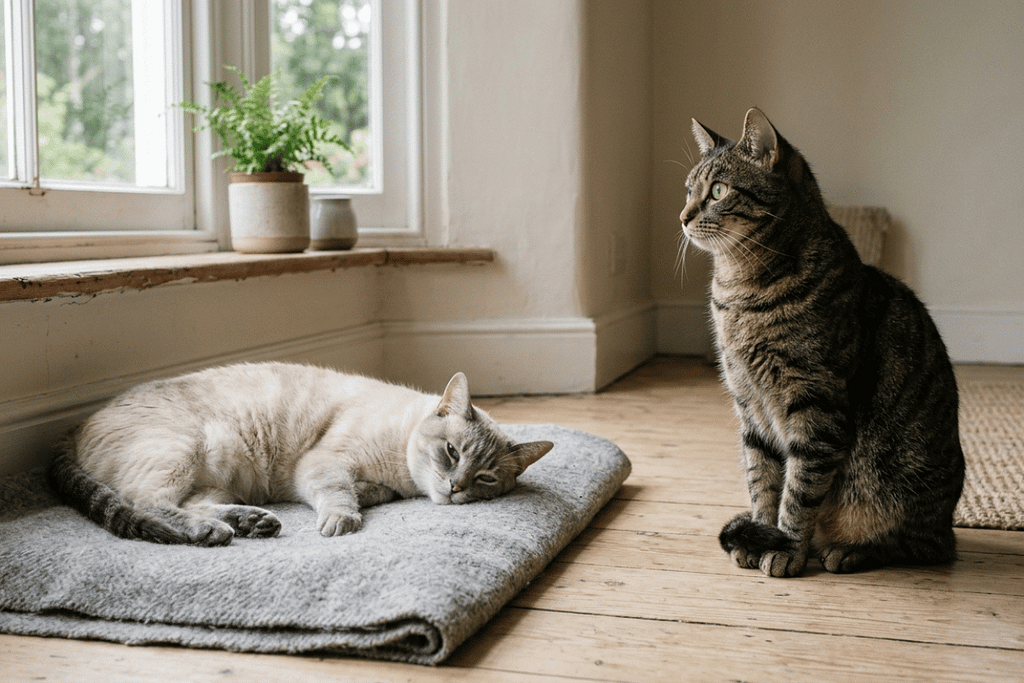
Some cats react the moment something changes.
Others watch first.
Some approach immediately. Others take time.
Some settle quickly after stimulation. Others stay activated for a long time.
These differences feel like personality. And in a sense, they are — they are recognizable, consistent, and specific to each cat.
But they begin somewhere else.
🧠 What Is Feline Temperament in Cats?
Feline temperament refers to consistent patterns in how a cat:
- detects changes in the environment,
- responds once a threshold is reached,
- returns to baseline after activation.
These patterns are shaped by three core dimensions:
Sensitivity — how easily the cat detects a stimulus. A highly sensitive cat registers subtle changes that a less sensitive cat simply doesn’t notice.
Reactivity — how strongly the cat responds once activated. Two cats can notice the same stimulus but respond with very different intensity.
Recovery — how quickly the cat returns to baseline. Some cats settle within seconds, while others remain activated for much longer.
Together, these dimensions form a stable response profile that remains recognizable across situations. Over time, this is what gives behavior its consistency.
These patterns begin at a deeper level, as explored in neurobiology of cat behavior, where internal systems shape how cats respond to stimuli.
🐾 Temperament vs personality: why the distinction matters
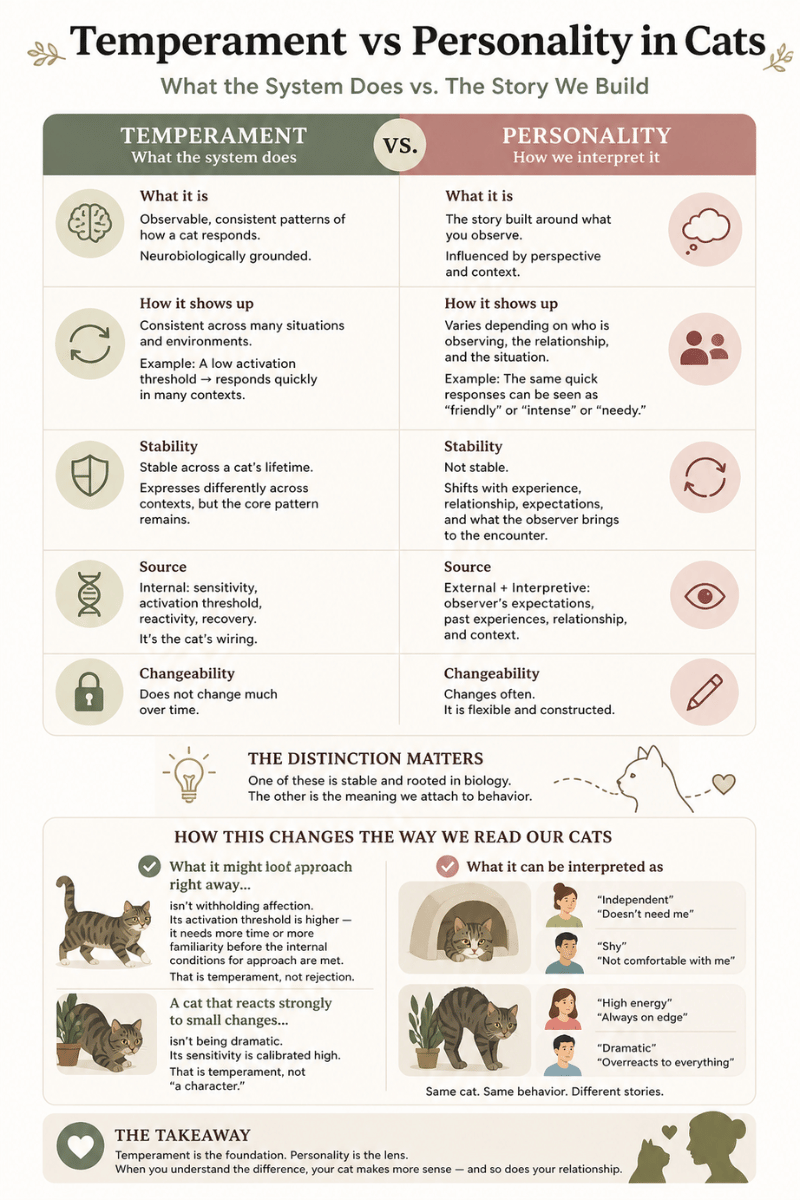
Temperament is what the system does. It is observable, consistent across situations, and rooted in how the nervous system is organized.
A cat with a low activation threshold will tend to respond quickly across many contexts. That pattern remains stable, even as situations change.
Personality, on the other hand, is how that pattern is interpreted.
he same cat may be described as:
- “friendly”
- “intense”
- “needy”
depending on who is observing, what they expect, and how they relate to the cat.
Two people can describe the same cat in completely different ways — not because the behavior changes, but because the interpretation does.
That is the key difference:
Temperament is the pattern.
Personality is the story built around it.
🐾 What cat temperament looks like in daily life
Temperament is visible in everyday situations.
A cat with high sensitivity may:
- react to subtle sounds or movements,
- remain alert to environmental changes,
- appear easily startled.
A cat with high reactivity may:
- respond quickly and intensely once stimulated,
- escalate behavior rapidly,
- disengage just as quickly once the moment passes.
A cat with slower recovery may:
- remain alert long after a stimulus is gone,
- take time to settle,
- appear “tense” or “anxious” from the outside.
None of these are problems. They are configurations of how the system operates.
⚖️ Why Feline Temperament Feels Like Personality
Temperament becomes recognizable because it repeats.
Across similar situations, the same patterns tend to emerge:
- similar reactions to familiar stimuli,
- consistent ways of approaching or avoiding interaction,
- predictable responses over time.
This consistency is what makes behavior feel personal and identifiable.
But what you are recognizing is not a fixed character — it is a recurring pattern.
⚙️ Why the same cat behaves differently across situations
Temperament is stable. Its expression is not.
The same cat may behave differently depending on:
- familiarity with the environment,
- level of stimulation,
- internal state at that moment.
A cautious cat may move freely in a familiar space and freeze in a new one. This is not inconsistency — it is the same underlying system responding to different conditions.
Understanding this helps explain why behavior shifts without assuming that the cat itself has changed.
🌿 When Your Interpretation Starts to Change
Once you understand feline temperament, the way you read behavior begins to shift.
A cat that doesn’t approach is not withholding affection. Its activation threshold is higher — it needs more time or familiarity before engaging.
A cat that reacts strongly to small changes is not being dramatic. Its sensitivity is calibrated high.
What once looked like intention becomes easier to see as pattern.
And that changes the interaction.
Instead of asking “Why is my cat like this?”, the question becomes:
“What kind of system am I observing?”
Sissi is the creator of A Cat With Story, where she explores feline behavior through real-life observation and practical insight. Her work connects everyday cat behavior to instinct, environment, and patterns informed by veterinary guidance.
❓ FAQ
What is feline temperament?
Feline temperament is the consistent pattern of how a cat’s nervous system responds to stimuli — including sensitivity, reactivity, and recovery speed. It is the underlying mechanism that shapes behavior across situations.
Is cat temperament the same as cat personality?
No. Temperament is the pattern of response — observable, consistent, and neurobiological. Personality is the interpretation of that pattern, constructed by the observer over time. The same temperament can be described as very different personalities depending on who is watching and what they expect.
Can a cat’s temperament change?
Temperament is relatively stable across a cat’s lifetime. What changes is how it expresses in different contexts — a familiar environment may allow a cautious temperament to appear more relaxed, while a new environment may activate the same caution more visibly.
Why does my cat always react strongly to small things?
High reactivity or high sensitivity is a temperament dimension, not a behavioral problem. The cat’s system is calibrated to detect and respond to subtle stimuli. Understanding this as a feature of how that system operates — rather than a flaw — changes how you respond to it.

With the sensitivity of one who loves deeply, Sissi writes stories celebrating the animal world. Her felines Estrela and Safira illuminate her days, while Pete and Gabrich live eternally through her words. Every piece she writes is a love letter to the companions who make life truly meaningful.