
Why Do Cats Like Tight Spaces? The Real Reason Behind It
Cats like tight spaces because these environments offer exactly what their instincts seek: safety, warmth, and a controlled view of their surroundings. Whether it’s a box, a bag, or a narrow corner, enclosed spaces allow cats to rest, observe, and feel protected — all at the same time.
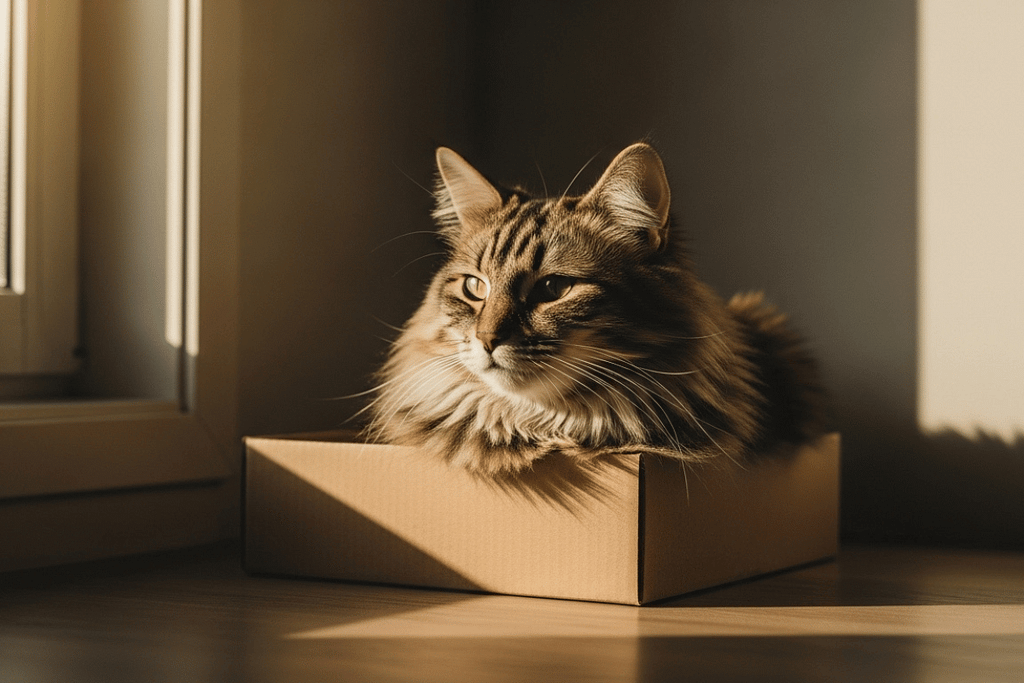
Cats are naturally drawn to tight spaces because these environments provide safety, reduced exposure, and a controlled view of their surroundings.
What may seem like a simple preference — jumping into a box or settling inside a bag — is actually part of cat enclosed spaces behavior, a structured response shaped by instinct.
Enclosed areas allow cats to rest, observe, and regulate their environment at the same time. They combine physical comfort with strategic positioning, which is why cats often enter them quickly and remain still once inside.
Understanding this behavior helps explain why tight spaces consistently attract cats — not as random choices, but as environments that align with how they naturally organize safety and awareness.
When a new space appears, your cat does not treat it as just another object.
It evaluates it quickly.
Instead of approaching cautiously, it may enter almost immediately — not because the behavior is impulsive, but because the structure of that space already matches familiar conditions: enclosure, stability, and reduced exposure.
From that point, the behavior becomes easier to recognize.
The cat is not simply inside the space.
It is using it — to observe, to settle, and to maintain control of its surroundings.
🧭 Why Cats Like Tight Spaces: It Goes Beyond Curiosity
At first, this behavior may look playful or accidental.
But entering enclosed spaces is not just curiosity. It is part of cat enclosed spaces behavior — a structured response shaped by instinct.
Enclosed spaces allow cats to explore without full exposure. They provide a balance between visibility and protection.
If you’ve ever wondered why my cat always sits in boxes, the explanation begins with instinct, not preference.
In daily life, this often looks like:
- entering a space quickly,
- remaining partially hidden,
- observing without moving much.
Nothing here is accidental. These patterns reflect how cats position themselves within their environment.
🌡️ The Physical Reason Cats Seek Out Small Spaces
This behavior is not only behavioral — it also has a physical component.
Cats naturally move toward environments that support energy balance. Tight spaces tend to be:
- slightly warmer,
- more stable,
- less exposed.
Enclosed areas create these conditions without effort.
According to International Cat Care, cats are naturally motivated to seek environments that reduce exposure and support their sense of control — and enclosed spaces fulfill both needs simultaneously.
The same instinct that explains why cats squeeze into tight spaces also explains why these areas feel regulating to their body.
In daily life, this often looks like:
- choosing tight spaces to rest,
- settling faster inside enclosed areas,
- remaining still for longer periods.
This does not mean cats feel uncomfortable outside these spaces. It simply shows that some environments align more easily with how their body regulates energy.
👁️ How Tight Spaces Give Cats a Safe Observation Point
Tight spaces are not used only for rest — they are also used for observation.
A cat inside a box is not withdrawn. It is positioned.
From this position, the cat can:
- observe without being exposed,
- stay still without losing awareness,
- respond quickly if something changes.
This vantage point reflects feline instinct in enclosed areas.
In daily life, this often looks like:
- quiet observation from inside a space,
- focused stillness,
- sudden movement after long pauses.
This does not mean the cat is hunting or afraid. It shows how enclosed spaces allow a balance between visibility and protection.
🔁 Why Cats Return to the Same Tight Spaces Again and Again
This behavior rarely happens only once.
Cats tend to return to the same spaces repeatedly because those environments become reliable.
When a space consistently provides:
- stability,
- predictability,
- efficient observation,
it becomes reinforced through experience.
In daily life, this often looks like:
- returning to the same spot,
- choosing similar types of spaces,
- favoring familiar enclosures.
This repetition reflects learned reliability rather than random preference.
🐾 Do All Cats Like Tight Spaces? Not Exactly
Not all cats respond in the same way.
Some enter immediately, while others hesitate or ignore the space entirely.
This variation reflects differences in cat hiding behavior in small spaces and individual sensitivity.
In daily life, this often looks like:
- quick entry versus hesitation,
- long stays versus brief visits,
- frequent use versus occasional interest.
These differences are normal and do not indicate a problem.
⚡ Why Cats Enter Tight Spaces So Quickly and Automatically
Sometimes the response appears immediate.
A space appears, and the cat enters without hesitation.
This is not impulsive behavior. It reflects a fast recognition of familiar environmental conditions.
Enclosed spaces combine:
- predictability,
- structure,
- reduced exposure.
These elements match patterns the cat already recognizes as safe.
In daily life, this often looks like:
- immediate entry,
- quick settling,
- focused stillness.
Because this happens quickly and quietly, it can be easy to overlook how structured the behavior actually is.
🌿 When Your Cat’s Love of Tight Spaces Finally Makes Sense
At some point, the interpretation shifts.
The question changes from “Why does my cat like boxes?” to “What does this space allow my cat to do?”
This shift matters because it changes how behavior is understood.
Instead of seeing preference, you begin to see function.
Enclosed spaces allow cats to:
- regulate exposure,
- maintain awareness,
- organize their interaction with the environment.
Your cat is not simply entering a space.
It is using it.
And once you recognize that, the behavior becomes clear and consistent rather than random.
To understand how this behavior fits into a broader system, see how cat behavior evolved through instinct, vigilance, and exploration.
Sissi is the creator of A Cat With Story, where she explores feline behavior through real-life observation and practical insight. Her work connects everyday cat behavior to instinct, environment, and patterns informed by veterinary guidance.
❓ FAQ
Why do cats like tight spaces so much?
Cats are drawn to tight spaces because they provide warmth, security, and a controlled environment that supports both comfort and instinctive behavior.
Why does my cat always sit in boxes or bags?
Boxes and bags create enclosed environments that match your cat’s instinct for protection and observation, making them naturally attractive.
Should I be worried if my cat hides in small spaces?
Occasional hiding is normal. It only becomes a concern if the behavior increases suddenly or is accompanied by signs of stress or illness.
Do all cats like tight spaces the same way?
No. Some cats use them frequently, while others show little interest. This reflects individual differences in behavior and sensitivity.

With the sensitivity of one who loves deeply, Sissi writes stories celebrating the animal world. Her felines Estrela and Safira illuminate her days, while Pete and Gabrich live eternally through her words. Every piece she writes is a love letter to the companions who make life truly meaningful.