
Why Cats React to Changes in Their Environment Before Accepting Them
Cats respond to environmental changes by inspecting them before accepting them as safe. This behavior is part of cat exploration behavior, helping them detect differences, reduce uncertainty, and update their internal map of the environment.
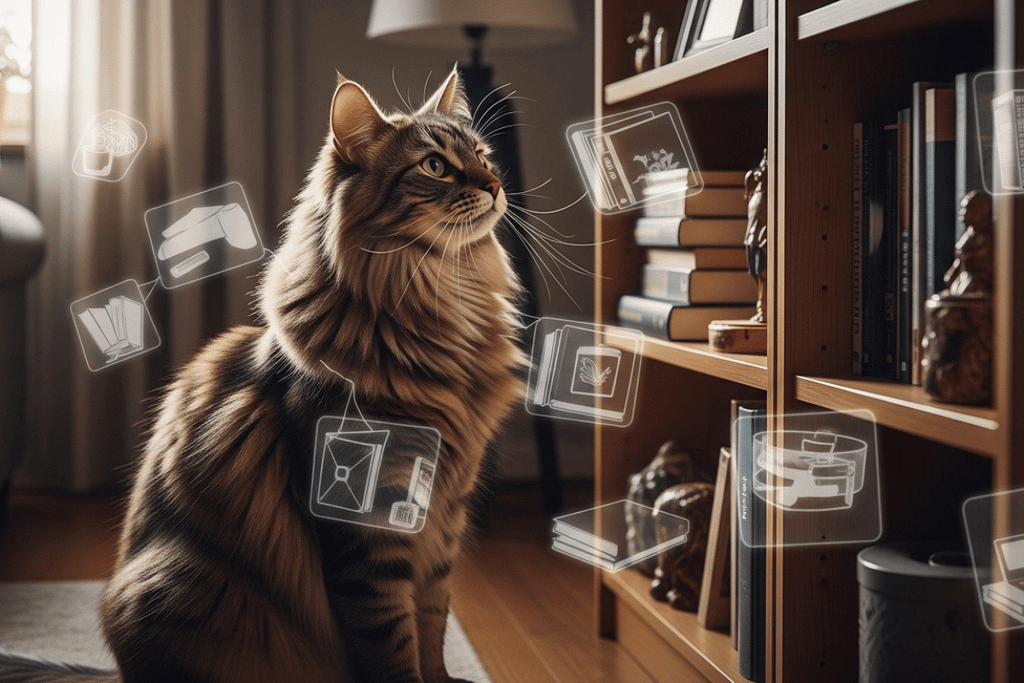
There’s a moment that feels almost invisible… but happens all the time.
You move something slightly.
A chair.
A bag.
An object on a table.
Nothing major.
Nothing dramatic.
And yet…
Your cat notices.
Pauses.
Looks.
Approaches.
Inspects.
Sometimes slowly.
Sometimes immediately.
And only after that…
They relax again.
And the question appears quietly:
Why does my cat always need to check things before accepting them?
It can feel excessive.
But it isn’t.
? Change interrupts stability — and cats need to resolve it
Cats rely on environmental stability more than we usually notice.
A space is not just a place.
It is something that is known.
When something changes…
Even slightly…
That stability is interrupted.
And cat exploration behavior is activated.
Not out of curiosity.
But out of necessity.
In daily life, this often looks like:
- noticing small changes immediately
- approaching altered objects or positions
- pausing before moving normally again
This is not sensitivity in the emotional sense.
It is sensitivity to difference.
This is usually where people pause.
Because something subtle becomes consistent.
? Inspection comes before acceptance
Cats don’t immediately trust change.
They process it.
Before something becomes normal again…
It must be inspected.
This process follows a quiet sequence:
change detected
attention focused
inspection begins
evaluation happens
acceptance (or continued caution)
In daily life, this often looks like:
- sniffing objects that were moved
- circling before approaching
- observing before interacting
This doesn’t mean your cat is anxious.
And it doesn’t mean they resist change.
This doesn’t take anything away from their adaptability.
It simply shows that acceptance is not automatic.
It is built.
? Why cats don’t assume things are safe
Humans often assume continuity.
If something looks the same… it is the same.
Cats don’t rely on that assumption.
They verify.
Cat exploration behavior is designed to confirm:
- that something still belongs there
- that it has not changed in a meaningful way
- that it is safe to ignore
In daily life, this often looks like:
- rechecking familiar objects after movement
- reacting to subtle positional changes
- pausing in places that should feel normal
This connects directly to how cats build and maintain environmental understanding, as explored in Evolutionary Architecture of Cat Behavior.
? Why even small changes matter
Sometimes the change feels too small to matter.
Barely noticeable.
But for a cat, scale is not the point.
Difference is.
Even a slight shift can represent:
- something new
- something moved
- something unknown
In daily life, this often looks like:
- inspecting objects moved just a few centimeters
- reacting to new items placed in familiar spaces
- revisiting areas after subtle changes
This is not overreaction.
It is precision.
This is usually where people pause again.
Because the behavior stops feeling exaggerated…
and starts feeling exact.
⚖️ Not all cats respond to change the same way
Some cats approach immediately.
Others observe first.
Some inspect quickly.
Others take time.
This doesn’t mean one is better adapted.
It reflects differences in:
- sensitivity thresholds
- caution levels
- individual temperament
In daily life, this often looks like:
- direct inspection vs distance observation
- quick acceptance vs gradual approach
- repeated checking vs single inspection
This variation connects to how exploration and caution interact, as seen in Exploration vs Fear in Cats.
? When inspection becomes faster over time
Not all inspection is equal.
Sometimes it’s long.
Sometimes it’s brief.
As an environment becomes more predictable…
Inspection becomes faster.
More efficient.
In daily life, this often looks like:
- quicker acceptance of repeated changes
- shorter inspection periods
- reduced need for repeated checking
This doesn’t mean the behavior disappears.
It means it becomes more refined.
The system remains.
It just adapts.
? When inspection stops feeling excessive
At some point, something shifts.
What once felt like:
overchecking
overreacting
unnecessary attention
Begins to feel like:
verification
adjustment
environmental awareness
This is usually where people pause.
Because the question changes.
From:
Why is my cat so sensitive to change?
To:
What difference is my cat trying to resolve right now?
And that shift matters.
Because it removes a subtle pressure:
the need to correct behavior
the assumption that change should be ignored
the expectation that adaptation should be immediate
You don’t need to stop this process.
You don’t need to speed it up.
You only need to recognize:
your cat is not resisting change…
They are integrating it.
And once you start seeing that…
Even the smallest inspection begins to make sense.
Nothing here asks you to change your cat’s response.
Only to see that what feels excessive…
is often how they maintain stability.
Nothing here asks you to feel less.
Only to feel with less pressure.

With the sensitivity of one who loves deeply, Sissi writes stories celebrating the animal world. Her felines Estrela and Safira illuminate her days, while Pete and Gabrich live eternally through her words. Every piece she writes is a love letter to the companions who make life truly meaningful.