
Why Sudden Movements Trigger Cats: The Reflex System Behind Instant Reactions
Sudden movements trigger cats because their brains use fast reflex pathways that bypass conscious decision-making. This allows instant reactions to potential prey or danger before the cat has time to assess the situation.
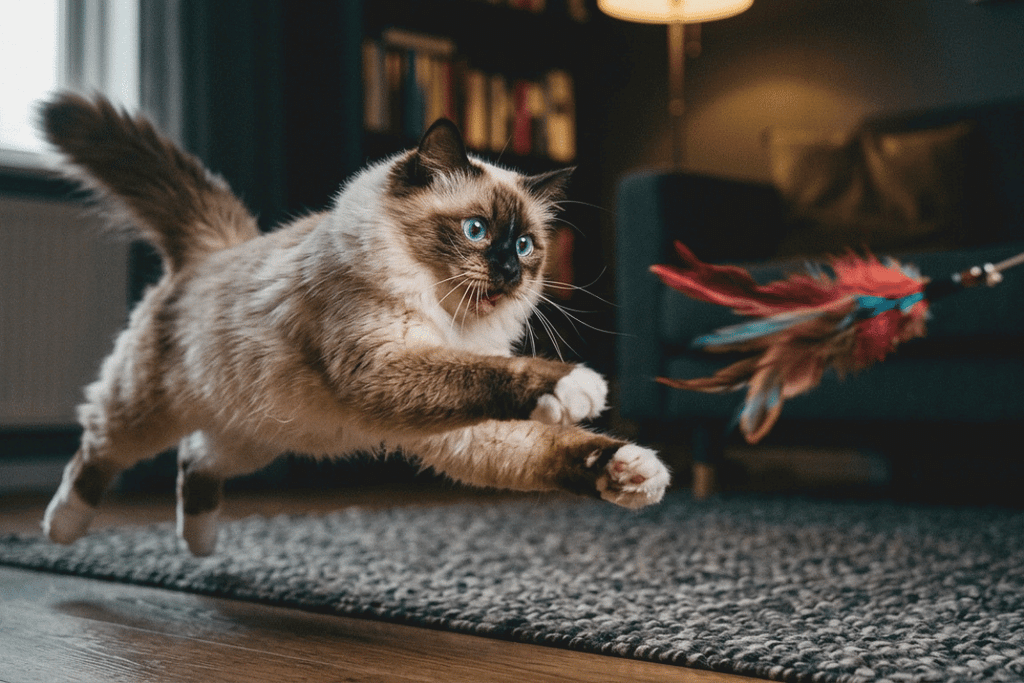
You’ve seen it happen in an instant.
A shadow flickers.
A toy jerks suddenly.
A small movement breaks the stillness.
And your cat reacts immediately.
No pause.
No hesitation.
No visible thinking.
Understanding why sudden movements trigger cats reveals a completely different side of feline behavior — one that operates without analysis, without delay, and without conscious control.
Because sometimes, cats don’t think first.
They react first.
⚡ Sudden Movements Trigger Cats Through a Different System
At first, this behavior may seem contradictory.
In some situations, cats freeze before acting.
In others, they react instantly.
So which one is correct?
Both are correct — because cats rely on two separate systems:
- a slow system — freezing and assess risk
- a fast system — instant reaction to sudden movement
Sudden movements trigger cats through the second system. This is not a thinking system. It is a reflex system. To understand the slower system — how cats freeze and assess risk before acting — read Why Cats Freeze Before Acting: How They Assess Risk Without Moving.
🧠 The Cat Reflex System: Acting Before Thinking
When movement is sudden, the brain does not follow the usual decision-making process.
Instead, it activates a fast neural pathway designed for speed.
This is the cat reflex system — fast, automatic, and completely bypassing conscious thought.
This mechanism:
- bypasses detailed analysis
- skips prediction
- triggers immediate motor response
In simple terms: the body moves before the brain fully understands what happened.
This allows cats to react in fractions of a second.
According to American Veterinary Medical Association, cats possess highly specialized neural pathways that trigger immediate motor responses to sudden stimuli — a survival adaptation that operates faster than conscious thought.
If you’ve ever wondered why does my cat jump at sudden movements, the answer is in the reflex pathway — not the thinking brain.
Cat instant reaction to movement follows a neural pathway designed purely for speed.
🎯 Why the Feline Startle Response Favors Speed Over Accuracy
One of the most important reasons why sudden movements trigger cats is evolutionary pressure.
In the wild:
- prey escapes quickly
- predators attack suddenly
A delayed reaction could mean losing food or losing safety
Because of this, evolution favored speed over accuracy.
It is better to react to something harmless than to ignore something dangerous.
👁️ Why Cats React to Fast Movement — Not to Objects
Cats are not primarily triggered by objects.
They are triggered by movement patterns.
Specifically:
- sudden acceleration
- unpredictable direction
- rapid changes
This is why cats react to fast movement but ignore objects that remain perfectly still.
A still toy is ignored. The same toy, moved suddenly, becomes irresistible.
Why do cats react to things that aren’t there? Because the brain responds to movement patterns, not to objects.
I’ve tested this countless times with my own cats — a toy sitting still gets ignored completely, but the moment it moves unpredictably, the reaction is immediate and total.
The brain is wired to detect change, not stability.
⚡ Sudden Movements Trigger Cats Before the Brain Catches Up
One key concept that explains why sudden movements trigger cats is this: reaction comes before interpretation.
For example, a cat may:
- jump at a falling object
- swipe at a moving string
- react to a shadow
Only after reacting does the brain evaluate:
- Was it prey?
- Was it dangerous?
- Was it nothing?
This sequence is the opposite of how humans behave.
Sometimes, the reaction is not about hunting at all — it is about alertness, defensive readiness, or sensory overload. This explains why cats may jump and then retreat, react and then ignore, engage briefly and disengage.
The initial trigger is the same. The outcome depends on what the brain determines afterward.
🏠 Why Indoor Environments Constantly Trigger Cats
In a natural environment, movement signals something meaningful.
But in modern homes, movement is everywhere.
Examples include:
- reflections from glass
- TV screens
- phone light flickers
- shadows from cars
- moving curtains
To a cat’s brain, these are still interpreted as potential prey or danger. This creates a constant stream of activation for the reflex system — which is why indoor cats can seem perpetually alert even in completely safe environments.
The cat nervous system triggers are never fully switched off — even during apparent rest.
😤 Cat Overstimulation Behavior: When Too Much Triggers Too Much
Because indoor environments contain many artificial triggers, the cat’s nervous system can become overloaded.
Cat overstimulation behavior appears when the reflex system receives too many triggers at once.
This may lead to:
- sudden bursts of energy
- unexpected swatting or biting
- rapid mood shifts
Why does my cat randomly go crazy and run around? Often it’s the reflex system responding to accumulated triggers it can no longer ignore.
This is not aggression. It is a nervous system reacting to too many stimuli at once.
Not all cats respond the same way — highly active cats show stronger reactions, while more cautious cats may show brief reactions followed by withdrawal. But the reflex system itself exists in all cats.
🎮 Why Sudden Movement Makes Play So Effective for Cats
Understanding how sudden movements trigger cats explains why certain toys are more effective than others.
The best toys:
- move unpredictably
- change speed suddenly
- mimic prey behavior
This activates the reflex system directly.
And when used correctly, it allows cats to release energy, express natural instincts, and stay mentally engaged.
Play that incorporates sudden, unpredictable movement satisfies the same system that evolution built for real hunting — making it the most effective form of enrichment for cats of any age.
To understand how this reflex system fits into the complete evolutionary picture, explore How Cat Behavior Evolved: Instinct, Vigilance and Exploration.
This article reflects Sissi’s lifelong experience living with cats, informed by years of observation and regular consultations with licensed veterinarians. For medical concerns about your cat, always consult a qualified vet.
❓ FAQ
Why do sudden movements trigger cats so strongly?
Because cats have a dedicated reflex pathway that bypasses conscious thought entirely. When movement is sudden, the brain activates an instant motor response before any analysis occurs. This system evolved to ensure that neither prey nor predators could escape detection through speed alone.
Why does my cat jump at sudden movements even when relaxed?
Because the reflex system never fully switches off. Even during apparent rest, the cat’s nervous system continuously scans for movement. A sudden trigger activates the fast pathway instantly — regardless of the cat’s previous state. Relaxation does not disable the system.
Why do cats react to things that aren’t really there?
This happens because the brain responds to movement patterns, not to objects. A flickering reflection, a shifting shadow, or a light movement on the wall activates the same reflex as real prey. The brain identifies the movement signature and reacts — only afterward determining whether the source was real or not.
Why does my cat randomly go crazy and run around the house?
This is often cat overstimulation behavior — the reflex system responding to an accumulation of triggers it can no longer contain. Indoor environments are full of artificial movement signals that activate the reflex pathway repeatedly. When the system reaches a threshold, the energy releases all at once in what cat owners commonly call the zoomies.

With the sensitivity of one who loves deeply, Sissi writes stories celebrating the animal world. Her felines Estrela and Safira illuminate her days, while Pete and Gabrich live eternally through her words. Every piece she writes is a love letter to the companions who make life truly meaningful.