
Cat Hunting Instincts: Why Your House Cat Still Thinks Like a Wild Hunter
Cat hunting instincts are the reason your house cat stalks, chases, and pounces — even when completely fed and safe. These ancient predatory systems evolved over thousands of years as essential survival tools and remain fully active in every modern domestic cat, expressing themselves through daily behaviors that look like play but feel like survival.
Your cat may spend most of the day sleeping in warm sunlight or waiting patiently for dinner.
But inside that quiet body lives the brain of a highly specialized predator shaped by thousands of years of evolution.
Even the most relaxed house cat still carries powerful hunting instincts — ancient behavioral systems that once determined survival in the wild.
Understanding these instincts helps explain many of the mysterious behaviors cats display every day.
🐾 Why Cats Have Hunting Instincts: The Evolutionary Blueprint
Long before cats shared human homes, they survived as solitary hunters.
Unlike pack animals that rely on teamwork, cats evolved as independent ambush predators. Their survival depended on patience, silence, and precise bursts of movement.
These evolutionary pressures shaped the natural hunting behavior in cats that we still observe today.
Every successful hunt required:
– exceptional sensory perception
– silent stalking ability
– explosive bursts of speed
– precise capture techniques
According to the Cornell Feline Health Center, the predatory behavior observed in domestic cats today is neurologically identical to that of their wild ancestors — driven by hardwired brain circuits, not environmental learning.
Although domestic cats now live comfortably indoors, their predatory instincts remain deeply embedded in their brains.
🧠 Do Cats Still Have Predatory Instincts Today?
Evolution moves slowly.
While human environments have changed dramatically over thousands of years, the neurological systems responsible for feline hunting instincts remain remarkably similar to those of their wild ancestors.
Your home may look nothing like a natural hunting ground. But the brain controlling your cat’s behavior still operates according to ancient survival programs.
This is why even calm indoor cats suddenly react to:
– fluttering insects
– moving toys
– small shadows
– birds outside the window
These movements activate the neural circuits responsible for predatory behavior in domestic cats.
The feline predatory drive operates independently from hunger — which is why a cat that has just eaten will still chase a moving toy with complete focus and intensity.
To understand the complete evolutionary system behind these instincts, explore Hhttps://acatwithstory.com/how-cat-behavior-evolvedow Cat Behavior Evolved: Instinct, Vigilance and Exploration.
Cat Hunting Instincts: Why Your House Cat Still Thinks Like a Wild Hunter
Several instinctive systems shape how cats interact with their environment.
Hunting Behavior
Cats evolved to hunt small prey through stealth and ambush.
This explains why many cats:
- stalk moving objects
- chase insects around the house
- pounce on toys
- watch birds through windows
Territorial Awareness
Territory plays an important role in hunting success.
In the wild, controlling territory increases access to prey and safety.
Domestic cats still express this instinct through:
– scent marking
– scratching surfaces
– quiet patrols around the home
What looks like casual wandering may actually be environmental monitoring.
Sensory Precision
Successful hunting depends heavily on sensory awareness.
Cats possess specialized adaptations that support their natural predator behavior, including:
- hearing capable of detecting ultrasonic sounds
- whiskers that sense tiny air movements
- vision optimized for detecting motion
This explains why cats chase moving objects even when they show no interest in stationary ones — and why they sometimes appear to stare at nothing.
👁️ The Moment Your Cat’s Hunting Instinct Activates
Almost every cat owner has seen the moment.
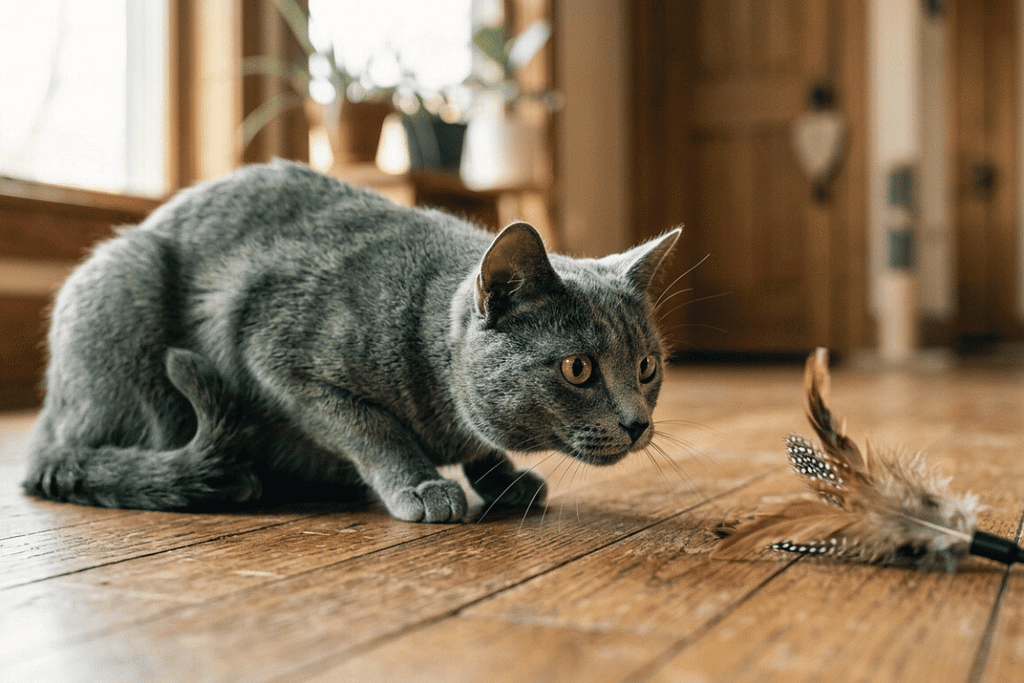
A toy slides across the floor.
Your cat freezes.
Its body lowers slowly toward the ground.
The tail becomes still.
The eyes lock onto the target.
In that quiet moment, you are not just watching a pet play.
You are witnessing the same behavioral patterns that once helped wild cats capture prey.
Why does my cat stalk me around the house? It’s the same stalking system — just redirected toward you. When cats lack other hunting outlets, they naturally redirect their predatory drive toward the most interesting moving thing in their environment.
🏠 How to Satisfy Cat Hunting Instinct Indoors
Indoor environments remove real prey, but they do not remove the instinct to hunt.
The indoor cat hunting instinct doesn’t disappear just because real prey is absent.
Without opportunities to express these behaviors, some cats may experience:
– boredom
– frustration
– destructive behavior
– nighttime hyperactivity
The question of how to satisfy cat hunting instinct indoors is simpler than it sounds.
Cat play and hunting instinct are the same system expressed in a safe environment.
Helpful enrichment includes:
– interactive wand toys
– puzzle feeders
– climbing shelves
– short daily play sessions
These activities simulate the hunting cycle that cats instinctively expect. A fulfilled instinct is often a calmer instinct.
🌿 The Ancient Predator Your House Cat Still Is
Modern homes may seem far removed from the environments where cats evolved.
Yet every silent stalk, sudden pounce, and focused stare still reflects the instincts of a small predator.
The cat sleeping peacefully beside you is not just a companion animal.
It is the descendant of a remarkably efficient hunter.
And those ancient instincts — the reason why cats have hunting instincts at all — remain quietly alive, even in the comfort of your living room.
This article reflects Sissi’s lifelong experience living with cats, informed by years of observation and regular consultations with licensed veterinarians. For medical concerns about your cat, always consult a qualified vet.
Cat Hunting Instincts: Why Your House Cat Still Thinks Like a Wild Hunter
Because hunting instincts are neurological, not nutritional. The brain circuits that drive stalking, chasing, and pouncing evolved independently from hunger and remain active regardless of whether a cat has just eaten. Food satisfies hunger — but it doesn’t satisfy the predatory drive.
Cat Hunting Instincts: Why Your House Cat Still Thinks Like a Wild Hunter
Cat stalking behavior is triggered by movement, not by the identity of the target. Any object that moves like prey — a toy, an insect, a shadow — activates the same neural circuits used during real hunting. This is why cats chase moving objects even when they show no interest in stationary ones.
Cat Hunting Instincts: Why Your House Cat Still Thinks Like a Wild Hunter
Your movements trigger the same stalking system your cat uses with prey. It’s not aggression — it’s redirection. When cats lack other hunting outlets, they naturally redirect their predatory drive toward the most interesting moving thing in their environment. Which is often you.
Cat Hunting Instincts: Why Your House Cat Still Thinks Like a Wild Hunter
The most effective way is to simulate the full predatory sequence: stalk, chase, pounce, capture. Interactive wand toys, puzzle feeders, and short daily play sessions that end with a “catch” help cats complete the cycle their instincts expect.

With the sensitivity of one who loves deeply, Sissi writes stories celebrating the animal world. Her felines Estrela and Safira illuminate her days, while Pete and Gabrich live eternally through her words. Every piece she writes is a love letter to the companions who make life truly meaningful.