
Cat Comforting Behavior: How to Tell Presence From Distance
Understanding intent without disappointment
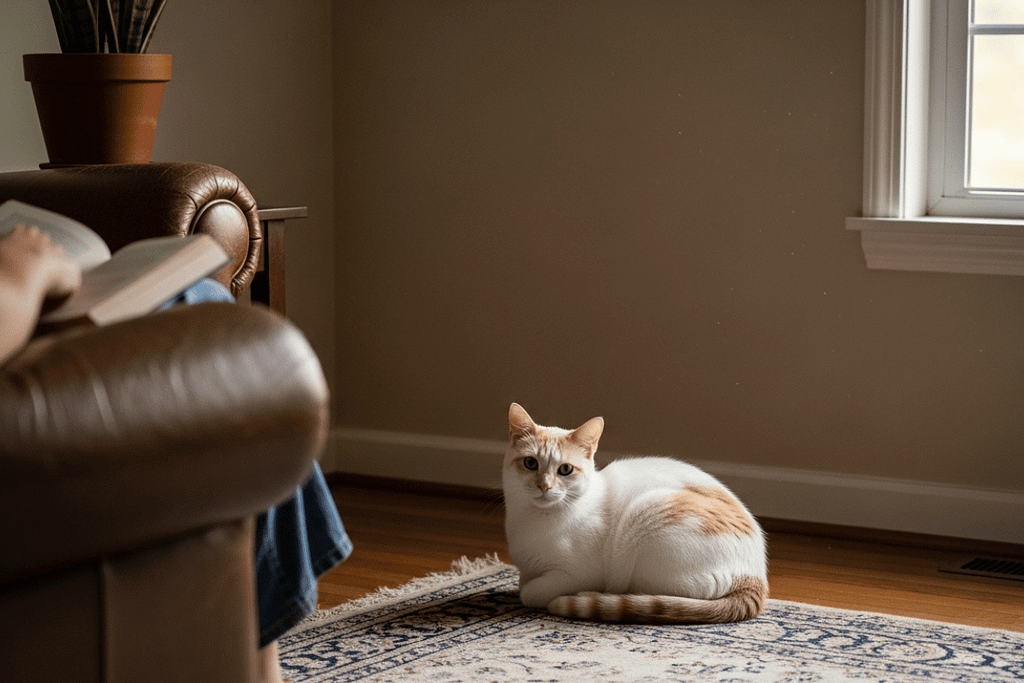
Cat comforting behavior can be subtle — and sometimes hard to distinguish from simple distance. Learning how to read comfort versus regulation helps prevent disappointment and keeps the bond grounded in choice, not expectation.
There are moments when interpretation happens instantly.
Your cat sits nearby while you’re quiet.
Or watches from across the room.
Or leaves just when you hoped they’d stay.
And the question appears almost automatically:
“Is this comfort — or are they pulling away?”
This article isn’t about deciding which one is true.
It’s about learning how to read cat comforting behavior without turning every moment into a test.
? Why This Question Is So Common
Humans are meaning-makers.
When emotions are present, the mind looks for response — especially from someone familiar and silent. Cats rarely explain themselves, and that silence invites interpretation.
But not every behavior is a message.
And not every response is about you.
Understanding this difference protects the relationship.
? Comfort and Distance Are Not Opposites
One of the biggest misunderstandings is treating comfort and distance as opposing signals.
From a human perspective:
- closeness = care
- distance = withdrawal
From a cat’s perspective:
- closeness = choice
- distance = regulation
Both can exist without emotional intention.
A cat can share space without offering comfort.
A cat can keep distance without rejecting connection.
? What Cat Comforting Behavior Looks Like — When It Happens
When a cat is offering something that feels like comfort, it usually looks quiet and low-key.
Common signs of cat comforting behavior include:
- choosing to stay nearby without being prompted
- settling calmly rather than pacing
- relaxed posture and breathing
- accepting presence without tension
What matters here isn’t the behavior alone —
it’s that the cat isn’t changing themselves to meet a demand.
Comfort, when it happens, grows out of stability.
? What Distance Often Means Instead
Distance is often misread as emotional withdrawal.
But more often, it reflects:
- the need to observe rather than engage
- a response to emotional intensity
- self-regulation through space
When a cat is keeping distance, they aren’t “doing nothing.”
They are actively managing comfort.
This connects directly to learning how to respect your cat’s boundaries during emotionally charged moments.
? The Key Difference: Who Initiates the Shift
One of the simplest ways to read the moment is to notice who initiates change.
- If the cat chooses proximity and remains relaxed → comfort may be present
- If the cat creates distance as intensity rises → regulation is likely
- If closeness only follows repeated attention → pressure may be involved
This isn’t about labeling behavior.
It’s about noticing choice versus reaction in cat behavior during emotional moments.
? Why Interpretation Often Leads to Disappointment
Disappointment usually comes from expectation, not behavior.
When closeness is expected to mean comfort —
and distance is expected to mean rejection —
every interaction becomes emotionally loaded.
This creates a quiet loop:
- expectation → interpretation
- interpretation → disappointment
- disappointment → tension
Breaking that loop requires stepping back from meaning and returning to observation — a skill explored further in Which Cat Behaviors Are Often Mistaken for Emotional Sensitivity?
? A More Helpful Question to Ask
Instead of asking:
“Is my cat comforting me?”
Try asking:
“Does my cat seem comfortable right now?”
That shift reframes how you read cat comforting behavior and reduces emotional pressure on both sides.
? What This Teaches About Cat Emotional Support
Healthy cat emotional support doesn’t come with certainty.
It is:
- inconsistent
- subtle
- shaped by context
- grounded in choice
Sometimes it looks like quiet presence.
Sometimes it looks like respectful distance.
Both can belong to a healthy bond.
? Letting Meaning Stay Light
You don’t need to strip moments of meaning.
You just don’t need to lock meaning in place.
When closeness happens, you can appreciate it.
When distance happens, you can allow it.
Neither needs to prove anything.
Often, the bond feels strongest when cat comforting behavior isn’t forced to explain itself.
? When Understanding Replaces Disappointment
Learning how to read cat comforting behavior — and how to recognize when a cat is simply keeping distance — isn’t about choosing one interpretation.
It’s about recognizing that cats don’t organize relationships around reassurance.
They organize them around safety, familiarity, and choice.
When we read their behavior through that lens, disappointment softens — not because the bond means less, but because it no longer carries expectations it was never meant to hold.

With the sensitivity of one who loves deeply, Sissi writes stories celebrating the animal world. Her felines Estrela and Safira illuminate her days, while Pete and Gabrich live eternally through her words. Every piece she writes is a love letter to the companions who make life truly meaningful.