
Cats Help With Depression: A Story of Healing through a Cat’s Purr
Discover the touching story of Olivia, a teenager who finds strength in her cat Pete’s purr to overcome depression and seek professional help. Understand how cats can become important allies in mental health.
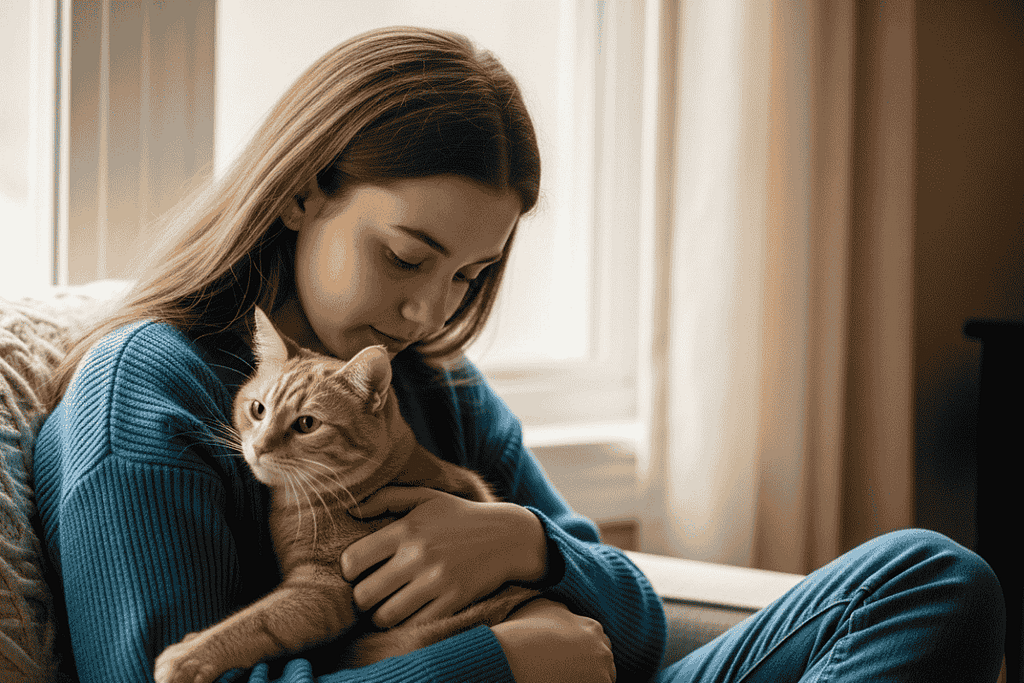
How Cats Help with Depression: Olivia and Pete’s Story of Healing
Olivia was fifteen. Like many teenagers, she lived in a world where image was everything. The problem was that her own reflection in the mirror never seemed good enough. The girls at school and on social media displayed confidence and beauty that made her feel invisible, like an off-key note in a perfect melody.
Her nose seemed too big. Her legs, awkward and short. Her hair? Never straight enough or long enough to reach her waist. This constant comparison, and the insecurity it generated, slowly became a shadow that covered everything, wrapping her in a dense fog of depression.
It was a silent pain, one she hid from everyone — even her parents — ashamed that she couldn’t be “normal” or “happy” like the other girls seemed to be. The days dragged on, each heavier than the last. Olivia’s once vibrant room became a refuge for her sadness. The curtains stayed shut. Her phone buzzed occasionally, but she had no interest in checking it.
Her parents, worried and loving, tried to help. They suggested therapy, offered support, and tried to reach her. But Olivia refused. She felt broken, and the idea of talking to someone about it only made her feel more exposed.
The Unexpected Comfort: How Cats Help with Depression
Then came Pete.
Pete was a stray cat rescued by Olivia’s mother. He had orange fur with tiger stripes and deep green eyes. His arrival wasn’t planned, and her mother hadn’t read any articles about how cats help with depression. She just saw a lonely animal and brought him home.
At first, Olivia barely noticed Pete. She was too lost in her pain. But Pete noticed her. He meowed softly outside her door, waited patiently, and eventually pushed his way in. One day, as Olivia lay crying on her bed, Pete jumped up beside her. He didn’t ask for attention. He simply curled up next to her and began to purr.
The Healing Power of a Cat’s Purr
It wasn’t just any purr. It was deep, rhythmic, and soothing. Olivia had never paid attention to a cat’s purr before, but this one felt different. The vibrations traveled through her arm and into her chest, calming her racing thoughts. For the first time in weeks, she felt a flicker of comfort.
That moment marked the beginning of a quiet transformation. Pete became Olivia’s companion, her silent supporter. He seemed to sense when she was struggling and would appear beside her, purring gently, reminding her she wasn’t alone.
Emotional Support and Connection: Why Cats Help with Depression
Over time, Olivia began to leave her door open for Pete. She started petting him, talking to him softly, and even smiling. His presence gave her a sense of stability. She began to research why cats help with depression, and discovered that feline companionship can reduce anxiety, lower blood pressure, and provide emotional grounding.
Pete’s purring wasn’t just comforting—it was healing. Olivia found herself breathing more deeply, sleeping more peacefully, and slowly reconnecting with the world around her.
Taking the Next Step: From Feline Comfort to Professional Help
Encouraged by Pete’s silent love and her mother’s support, Olivia finally agreed to see a psychiatrist. It was a difficult step, but one she was ready to take. Therapy and medication became part of her healing journey, but Pete remained her anchor.
Each therapy session helped Olivia peel back layers of pain. She learned to understand her emotions, challenge her negative thoughts, and rebuild her self-esteem. Pete was there through it all, purring beside her after tough days, reminding her of the progress she was making.
Rediscovering Self-Love: A Cat’s Role in Recovery
Olivia still had moments of insecurity, especially when scrolling through social media. But the critical voice in her head was no longer so loud. She had tools to manage it—and she had Pete.
She realized that true beauty wasn’t about fitting into someone else’s mold. It was about finding peace within herself. Pete’s purr had become the soundtrack of her recovery, a gentle reminder that love and healing can come from the most unexpected places.
Conclusion: Cats Help with Depression in Profound Ways
Olivia’s story is fictional, but it reflects a truth many people experience: cats help with depression not just through companionship, but through their quiet, intuitive presence. Whether it’s the soothing sound of a purr, the warmth of a curled-up body, or the simple act of being there, cats offer emotional support that can make a real difference.
If you or someone you love is struggling, consider the healing power of a feline friend. Sometimes, the path to recovery begins with a paw on your chest and a purr in your ear.
When Cats Help, but the Journey Needs Professional Support
While having cats can be a meaningful support in the battle against depression, it’s essential to seek professional help for a complete treatment, just as Olivia did. Pets are valuable allies in the healing process but can never replace medical and psychological care.
f Olivia and Pete’s story touched your heart, you’ll love learning new ways to deepen that same kind of connection. ?
Discover 7 proven ways to bond with your cat — gentle steps that bring more trust, love, and healing to both of you.
? Read: How to Bond with Your Cat — 7 Proven Ways
How do cats purr?
Purring happens when the muscles of a cat’s larynx (where the vocal cords are) rapidly contract while the cat inhales and exhales. All of this is controlled by signals that come from the cat’s central nervous system.
What is the frequency of the vibrations?
This vibration occurs between 25 and 150 times per second (Hertz), a rhythm so fast that no human could imitate it. Also, unlike other sounds, purring is continuous, happening both during inhalation and exhalation.
What are the variations in purring?
Almost all domestic cats are born with this ability, and kittens purr while nursing. However, some cats only produce very gentle vibrations that can barely be felt. If a cat does not purr loudly, it doesn’t mean it isn’t happy; it may communicate in other ways.
Why do cats purr?
Cats purr for different reasons. Of course, they purr when they are happy and relaxed (when being petted, on someone’s lap, expecting food), but they can also purr in stressful situations, in pain, during labor, or at the vet’s office. In these cases, purring may work as a self-soothing mechanism.
Can purring really help with people’s depression?
Studies suggest that the vibrational frequencies of purring can indeed have therapeutic benefits. The sound and vibration of purring have a calming effect on people. Petting a purring cat can reduce stress and anxiety, help lower blood pressure, and bring a sense of comfort and well-being. This shows how cats and mental health are interconnected.

With the sensitivity of one who loves deeply, Sissi writes stories celebrating the animal world. Her felines Estrela and Safira illuminate her days, while Pete and Gabrich live eternally through her words. Every piece she writes is a love letter to the companions who make life truly meaningful.