
Why Cat Behavior Shifts Across Environments and Contexts
Cat behavior shifts across environments because a stable temperament interacts with changing conditions. Differences in familiarity, stimulation, and internal state explain why the same cat can behave very differently in different situations.
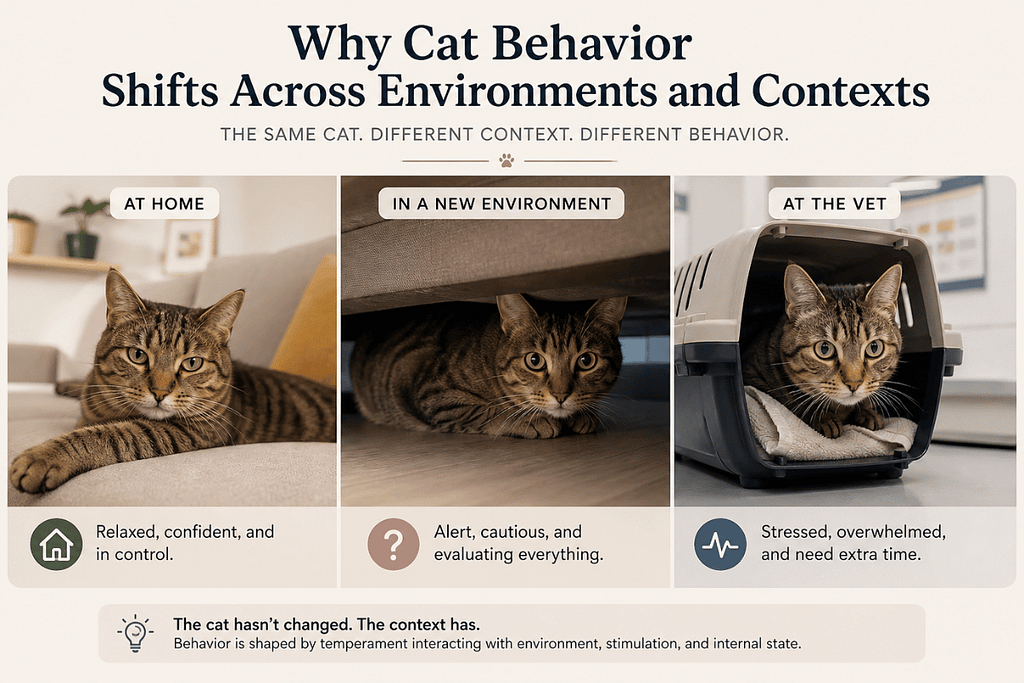
Cat behavior can change dramatically depending on the environment.
The same cat that moves calmly through your home may become alert, withdrawn, or hesitant in a new place. In other situations, a cat that seems distant may become relaxed and engaged under the right conditions.
These changes are not signs of inconsistency.
They reflect how a stable temperament interacts with changing environments, internal states, and levels of stimulation.
🔄 Why Cat Behavior Changes Across Environments
Temperament remains stable over time.
It defines how a cat detects, responds to, and recovers from stimulation.
But behavior is not temperament alone. It is temperament interacting with context.
This is why:
- the same cat behaves differently at home and at the vet,
- familiar spaces feel predictable while new ones trigger caution,
- behavior shifts even when the cat itself has not changed.
The system is the same. The conditions are not.
This reflects the neurobiology of cat behavior, where response thresholds and sensitivity are regulated.
⚙️ What Changes When a Cat Enters a New Environment
When a cat enters a new environment, several internal dynamics shift at once.
1. Sensory thresholds become more active
In familiar spaces, many stimuli are already categorized as safe.
In new environments, everything requires evaluation.
👉 Example:
A cat may walk freely around the house but pause at every step in a new room, scanning before moving.
2. Previous stimulation carries forward
The system does not reset instantly.
👉 Example:
After a car ride or vet visit, a cat may remain alert or reactive even back at home. What looks like “lingering stress” is often unresolved activation.
3. Internal state affects response capacity
Energy level, rest, and health influence how the system responds.
👉 Example:
A well-rested cat in a familiar routine engages easily. The same cat, tired or overstimulated, may withdraw or react more strongly.
🧠 Why the Same Behavior Means Different Things in Different Contexts
The same behavior does not always reflect the same internal process.
A cat that withdraws:
- in a new environment → may be responding to unfamiliar stimuli,
- at home → may be regulating overstimulation,
- with a specific person → may be reacting to interaction style.
This is why personality labels can be misleading.
A cat is not “selective” or “moody” in a fixed sense.
It is responding to the conditions present in that moment.
🔍 How to Understand Your Cat’s Behavior Across Contexts
To understand behavior, you need to look at patterns across situations.
Instead of focusing on a single reaction, observe:
- what environments trigger certain responses,
- how long activation lasts,
- how quickly your cat returns to baseline.
Over time, patterns become visible:
- this cat hesitates more in unfamiliar spaces,
- this cat recovers slowly after intense stimulation,
- this cat relaxes under specific conditions.
These are not personality traits.
They are patterns of how a specific temperament expresses across contexts.
⚖️ Cat Personality vs Behavioral Pattern: What Actually Matters
Personality suggests something fixed.
What you are actually observing is something dynamic:
- a stable temperament
- expressed differently depending on context
Understanding this distinction changes how behavior is interpreted.
Instead of asking:
“Why is my cat acting differently?”
You begin to ask:
“What changed in the environment or internal state?”
That question leads to more accurate understanding — and more effective responses.
🌿 A Clearer Way to Read Behavioral Shifts
Once you recognize how context shapes behavior, the pattern becomes easier to see.
A cat that withdraws in a new space is not becoming distant.
A cat that reacts strongly after stimulation is not being difficult.
The system is responding to input.
And when the input changes, behavior changes with it.
The cat remains the same.
The conditions are what shift.
Sissi is the creator of A Cat With Story, where she explores feline behavior through real-life observation and practical insight. Her work connects everyday cat behavior to instinct, environment, and patterns informed by veterinary guidance.
? faq
Why does my cat behave differently at the vet?
Because the environment is unfamiliar and highly stimulating. The cat’s system must evaluate everything, increasing sensitivity and lowering thresholds for response.
Is my cat acting out when behavior changes suddenly?
Usually not. Sudden changes often reflect accumulated stimulation, a shift in internal state, or a change in environment.
Why is my cat more relaxed with certain people?
Some people provide lower-stimulation interaction — slower movement, quieter presence — allowing the cat’s system to remain closer to baseline.
Can I change how my cat behaves in different environments?
You cannot change temperament, but you can influence how it expresses by adjusting conditions such as familiarity, routine, and stimulation levels.

With the sensitivity of one who loves deeply, Sissi writes stories celebrating the animal world. Her felines Estrela and Safira illuminate her days, while Pete and Gabrich live eternally through her words. Every piece she writes is a love letter to the companions who make life truly meaningful.