
Difference Between Cat Personality and Behavior: Trait vs State in Cats
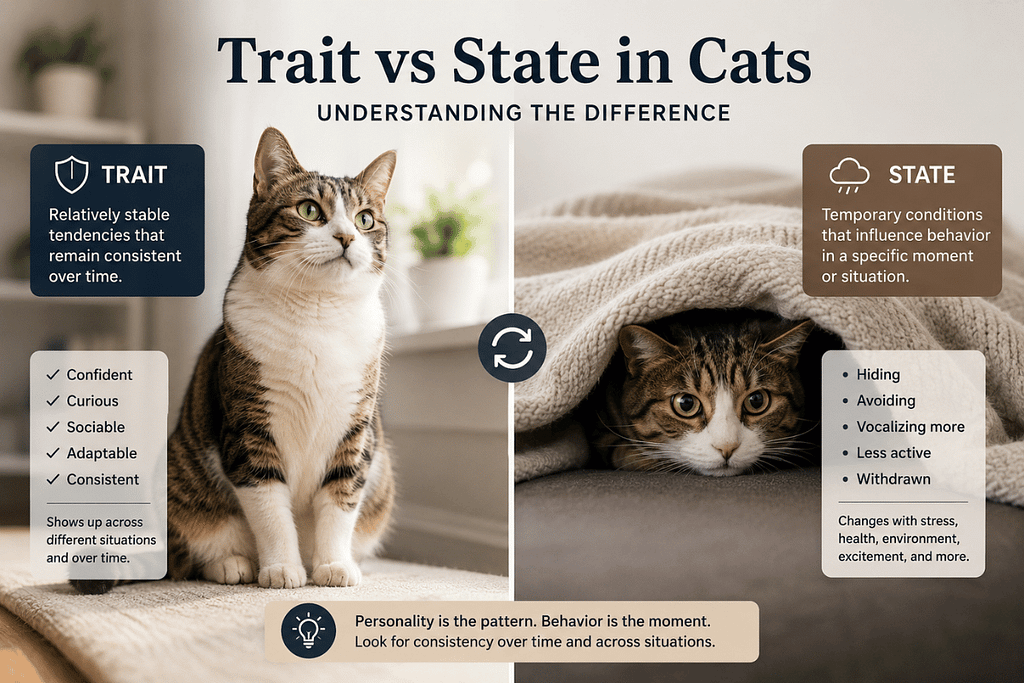
The difference between cat personality and behavior is that personality reflects relatively stable tendencies, while behavior reflects actions that may change in response to context, stress, health, environment, and temporary circumstances.
Not every shy behavior comes from a shy cat.
Not every confident behavior comes from a confident cat.
And not every behavioral change reflects a change in personality.
One of the most common mistakes people make when interpreting feline behavior is assuming that a single behavior reveals who a cat truly is.
A cat hides under the bed and suddenly seems fearful.
A cat avoids interaction and suddenly seems independent.
A cat becomes unusually vocal and suddenly seems more demanding.
Yet behavior and personality are not the same thing.
Understanding the difference between cat personality and behavior is essential if you want to interpret feline behavior accurately.
Some actions reflect long-term personality traits.
Others reflect temporary reactions to circumstances.
Learning to distinguish between the two can completely change the way you understand your cat.
🧠 Difference Between Cat Personality and Behavior: Why It Matters
The difference between cat personality and behavior is one of the most important concepts in feline behavior.
Cat personality refers to relatively stable tendencies that influence how an individual typically responds to the world.
Behavior refers to what a cat is doing in a specific moment.
A personality trait may involve:
- confidence,
- sociability,
- curiosity,
- adaptability,
- caution.
A behavior may involve:
- hiding,
- approaching,
- vocalizing,
- exploring,
- avoiding interaction.
The important distinction is that behavior changes constantly.
Personality usually changes much more slowly.
This is why a single observation rarely provides enough information to understand a cat’s true personality.
🐾 Difference Between Cat Personality and Behavior: What Is a Trait?
A trait is a relatively stable tendency that appears repeatedly across different situations and over long periods of time.
For example, a confident cat may consistently:
- approach unfamiliar objects,
- investigate new environments,
- recover quickly from surprises,
- show curiosity toward visitors.
Not every single time.
But often enough that a recognizable pattern emerges.
Traits are not fixed rules.
They are recurring tendencies.
When a behavior appears consistently across different contexts, it is more likely to reflect personality than circumstance.
This is why personality traits in cats are identified through patterns rather than isolated events.
🐾Why Repeated Observations Matter
A single observation rarely provides enough information to identify a personality trait.
Any cat can behave unusually under unusual circumstances.
Reliable personality assessment requires repeated observations across multiple situations and over time.
The more consistently a behavior appears, the more likely it reflects a stable trait rather than a temporary state.
Patterns reveal personality.
Moments reveal circumstances.
🌿 Cat Temperament vs Behavior: What Is a Temporary State?
A state is a temporary condition that influences behavior for a limited period of time.
States may be influenced by:
- stress,
- excitement,
- illness,
- fatigue,
- fear,
- environmental changes,
- social situations.
For example:
A normally social cat may hide after moving to a new home.
A confident cat may become cautious during a veterinary visit.
A reserved cat may become unusually active during play.
These situations illustrate an important principle.
The behavior changes.
The personality may not.
Understanding cat temperament vs behavior helps prevent temporary reactions from being mistaken for permanent personality traits.
👁️ Why Cat Personality and Behavior Are Often Confused
One reason people struggle to understand the difference between cat personality and behavior is that behavior is visible while personality is inferred.
You can see a cat hiding.
You can see a cat approaching a visitor.
You can see a cat avoiding interaction.
But you cannot directly observe personality.
Instead, personality is inferred from repeated behavioral patterns.
This creates opportunities for misunderstanding.
A fearful moment becomes a fearful cat.
A confident moment becomes a confident cat.
Yet behavior is always influenced by context.
Without considering context, it becomes easy to misinterpret what a cat is actually communicating.
🏠 Why Cat Behavior Changes Without a Cat Personality Change
Many apparent personality changes are actually behavior changes caused by circumstances.
A cat may behave differently because of:
- a new environment,
- unfamiliar visitors,
- routine disruption,
- physical discomfort,
- stress,
- changes within the household.
These factors can alter behavior dramatically.
Yet the underlying personality may remain largely unchanged.
This is why cat behavior changes do not automatically indicate a cat personality change.
The same individual may behave very differently under different conditions while retaining the same core personality traits.
Sometimes the situation changes while the personality remains remarkably stable.
This distinction becomes even more important when owners believe their cat has fundamentally changed. Explore this question further in Did Your Cat’s Personality Really Change — or Just the Context?.
⚡ Why Stress Often Looks Like a Personality Change
Stress is one of the most common reasons people misinterpret feline behavior.
Stress can influence:
- activity levels,
- social interaction,
- exploration,
- appetite,
- vocalization.
A normally confident cat may appear fearful.
A social cat may become withdrawn.
A curious cat may stop exploring.
These changes can be dramatic enough to make owners wonder whether their cat’s personality has changed.
In many cases, however, what they are observing is a temporary state rather than a true personality shift.
This is one of the clearest examples of why understanding the difference between cat personality and behavior is so important.
🚶 How To Assess Cat Personality More Accurately
If you want to understand your cat’s personality, focus on patterns rather than moments.
Ask questions such as:
- What behaviors appear repeatedly?
- Which tendencies remain visible over months or years?
- How does my cat typically respond to unfamiliar situations?
- Which reactions remain consistent across different contexts?
A single behavior tells very little.
Repeated tendencies reveal much more.
This approach forms the foundation of accurate cat personality assessment.
Personality reveals itself through consistency.
Behavior reveals itself through the moment.
🐱 Why Personality and Behavior Both Matter
Some people focus entirely on personality.
Others focus entirely on behavior.
In reality, both perspectives matter.
Personality helps explain long-term tendencies.
Behavior helps explain immediate circumstances.
Understanding the difference between cat personality and behavior allows you to see both levels simultaneously.
The stable individual.
And the temporary situation.
Together, they provide a much more complete understanding of feline behavior.
Understanding the difference between cat personality and behavior is only the first step. To understand why some cats are naturally cautious, social, confident, or independent, explore Individual Differences in Cats: Why Your Cat Is So Different From Others
⚖️ A Behavior Is Not Always a Personality Trait
Perhaps the most important lesson is this:
A fearful behavior is not always evidence of a fearful personality.
A confident behavior is not always evidence of a confident personality.
A social behavior is not always evidence of a social personality.
What matters is consistency.
Patterns observed repeatedly over time are far more informative than isolated moments.
Once you begin interpreting behavior through this lens, many apparent contradictions start to make sense.
🌱 Looking Beyond the Moment
Cats change from day to day.
Sometimes from hour to hour.
Their behavior responds to the environment, physical condition, emotional state, and current circumstances.
Yet beneath those fluctuations, personality often remains surprisingly stable.
Understanding the difference between cat personality and behavior helps separate temporary reactions from long-term traits.
It helps explain why cat behavior changes occur without necessarily indicating a cat personality change.
And it reminds us that understanding a cat requires more than observing a single moment.
A behavior is temporary.
A personality is a pattern.
Learning the difference is one of the most valuable steps toward understanding the individual cat behind the behavior.
❓ FAQ
What is the difference between cat personality and behavior?
The difference between cat personality and behavior is that personality refers to relatively stable tendencies, while behavior refers to actions occurring at a specific moment or in a specific situation.
Can cat behavior change without a personality change?
Yes. Stress, illness, excitement, environmental changes, and life circumstances can alter behavior without affecting underlying personality traits.
How can I tell if my cat’s personality is changing?
Look for long-term patterns rather than isolated behaviors. True personality changes tend to develop gradually and remain visible across different situations.
Why is my cat behaving differently all of a sudden?
Sudden behavior changes are often linked to temporary states such as stress, illness, environmental changes, or routine disruptions rather than personality changes.
About the Author
Through A Cat With Story, Sissi explores the intersection of feline behavior, evolutionary biology, and human-cat relationships. Her work focuses on helping cat owners understand the instinctive and environmental factors behind everyday behaviors, making scientific concepts accessible without losing their complexity.

With the sensitivity of one who loves deeply, Sissi writes stories celebrating the animal world. Her felines Estrela and Safira illuminate her days, while Pete and Gabrich live eternally through her words. Every piece she writes is a love letter to the companions who make life truly meaningful.