
How Cats Learn: Why Some Behaviors Adapt Easily While Others Resist Change
Cats learn throughout their lives through experience, routines, and environmental associations. However, learning works alongside instinct, which is why some behaviors change easily while others remain surprisingly resistant to modification.
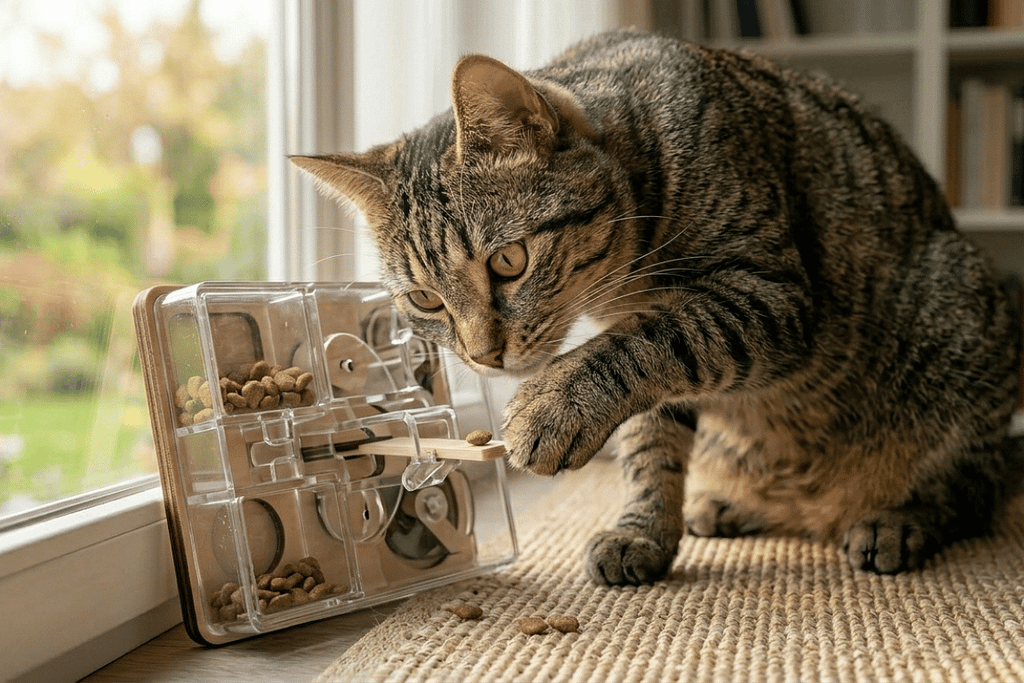
Your cat already knows a surprising number of things.
Where food appears.
Which sounds matter.
What time you usually wake up.
The difference between a familiar visitor and a stranger.
And yet, that same cat may continue scratching a place you’ve redirected dozens of times.
Continue chasing movement that serves no obvious purpose.
Continue repeating behaviors that seem impossible to change.
This contradiction sits at the center of how cats learn.
Some behaviors adapt remarkably quickly.
Others remain surprisingly resistant to change.
Understanding why begins with a simple realization:
Learning is only part of the story.
To understand how cats learn, we need to look beyond training itself. Learning is shaped by instinct, experience, environment, personality, and the biological systems that organize feline behavior from the very beginning.
🧠 How Cats Learn: Learning Doesn’t Start From Zero
When people think about learning, they often imagine a blank slate.
Something completely flexible.
Something that can be shaped in any direction through enough repetition.
Cats don’t work that way.
Before any learning occurs, a behavioral foundation already exists.
Cats arrive in the world with systems that evolved long before domestic life:
- attention to movement,
- environmental exploration,
- territorial behavior,
- scratching tendencies,
- defensive reactions,
- sensitivity to unfamiliar sounds.
These behaviors don’t appear because they were taught.
They appear because they are part of the biological organization that learning builds upon.
This is one of the most important principles in understanding how cats learn.
Learning does not begin from nothing.
It develops on top of instincts that already shape attention, motivation, and behavior.
Understanding this distinction helps explain why some behaviors adapt easily while others remain strongly influenced by instinctive constraints.
Related reading: What Can Cats Be Taught? Understanding Learning Limits in Cats
🔄 How Cats Learn Through Association and Experience
One of the most important things to understand about how cats learn is that learning often happens without formal training.
Some behaviors develop almost effortlessly.
Your cat learns where food appears.
Learns daily routines.
Learns which sounds predict something important.
Learns where comfort and safety can be found.
Because these changes happen gradually, people often overlook how much learning is taking place.
Research in animal cognition suggests that cats constantly form associations between experiences, outcomes, and environmental cues.
This process is known as associative learning.
For example:
- a can opener may predict food,
- a carrier may predict a veterinary visit,
- a familiar chair may predict comfort,
- a particular sound may predict playtime.
In daily life, this often looks like:
- waiting near a feeding area before mealtime,
- recognizing household routines,
- returning to preferred resting locations,
- avoiding places associated with unpleasant experiences.
Learning is happening continuously.
It simply doesn’t always look like training.
Many of the most important things cats learn are never intentionally taught.
Many of these associations are strengthened through rewards, which is why positive reinforcement plays such an important role in feline learning.
Related reading: Positive Reinforcement for Cats: How It Works in the Feline Brain
⚖️ Why Some Behaviors Resist Change
This is where confusion usually begins.
Because the same cat that quickly learns one thing can appear completely resistant to another.
Think about habits people struggle to change.
Checking a phone automatically.
Following familiar routines.
Reacting without conscious thought.
Knowing something should change doesn’t automatically make change easy.
Cats operate even closer to that automatic layer.
Some behaviors remain connected to systems that evolved long before modern domestic environments.
In daily life, this often appears as:
- continued hunting behavior despite regular feeding,
- persistent scratching in preferred locations,
- strong attention to moving objects,
- repeated territorial routines.
This doesn’t mean learning has failed.
It means learning is working within biological boundaries.
Recognizing those boundaries doesn’t reduce what cats are capable of learning.
It simply clarifies why some behaviors are easier to shape than others.
This distinction becomes even clearer when examining the biological and behavioral boundaries explored in Cat Training Limits: When Training Is Not the Answer.
🌿 Why Learning Works Best When It Follows Natural Behavior
One of the biggest misconceptions about training is the belief that successful learning replaces existing behavior.
Cats rarely work that way.
Progress usually happens when learning works alongside natural tendencies rather than trying to eliminate them.
In practice, this often means:
- redirecting scratching instead of stopping it,
- channeling hunting behavior into interactive play,
- shaping routines instead of forcing compliance,
- rewarding behaviors that already align with natural motivations.
This helps explain why reward-based approaches tend to outperform punishment-based approaches.
Learning becomes more effective when it follows the structure that already exists.
The goal shifts from control to guidance.
And behavior change becomes far more realistic.
🏠 How Environment Influences How Cats Learn
How cats learn is heavily influenced by the environment in which learning takes place.
A cat never learns in isolation.
Learning happens within an environment.
The same cat may behave differently depending on:
- familiarity,
- predictability,
- resource placement,
- environmental complexity,
- stress levels.
In daily life, this often appears as:
- different behavior in different rooms,
- behavioral changes after environmental adjustments,
- increased engagement in supportive environments,
- reduced engagement in overwhelming situations.
Sometimes the most effective intervention is not changing the cat.
It’s changing the conditions surrounding the cat.
Environment influences learning opportunities, emotional regulation, and behavioral flexibility more than many people realize.
🐾 Why Different Cats Learn Differently
Another important part of how cats learn is individual variation.
Not all cats learn in the same way.
And this difference is not simply about intelligence.
It often reflects variation in:
- sensitivity,
- confidence,
- emotional regulation,
- stress responsiveness,
- comfort with novelty.
In daily life, this may look like:
- one cat adapting quickly,
- another requiring more time,
- one responding strongly to rewards,
- another progressing more gradually.
What appears to be a learning problem is sometimes a difference in temperament.
The behavior may be similar.
The learning process may not be.
This becomes easier to understand in Does Personality Affect How Cats Learn?, where individual differences in feline learning are explored in greater depth.
🌱 When Learning Isn’t the Right Question
Sometimes the real issue isn’t whether a cat can learn.
It’s whether learning is the correct tool for the situation.
A behavior may continue not because learning failed, but because the behavior still serves an important function.
This is often the moment when the question changes.
Not:
“Why won’t my cat learn?”
But:
“What purpose is this behavior serving?”
That shift changes everything.
Because not every behavior needs to disappear.
Some behaviors need to be redirected.
Some need to be accommodated.
And some need to be understood before meaningful change becomes possible.
This is often where training reaches its practical limits and understanding behavior becomes more valuable than attempting to eliminate it.
🌍 How Cats Learn: Where Instinct and Experience Meet
Understanding how cats learn requires looking at both instinct and experience together rather than treating them as separate systems.
They work together continuously.
Cats learn through experience, repetition, environmental cues, reinforcement, and emotional consequences.
But instinct still influences what captures attention, what feels important, and which behaviors remain deeply rooted.
Learning explains part of feline behavior.
Instinct explains the rest.
Neither system works alone.
Instinct provides the foundation.
Experience shapes expression.
Behavior emerges from the interaction between both.
Understanding that relationship creates more realistic expectations, more effective training strategies, and often a better relationship with the cat itself.
This article reflects Sissi’s lifelong experience living with cats, informed by years of observation and veterinary-guided behavioral understanding. Through A Cat With Story, she explores how instinct, neurobiology, learning, and environment shape everyday feline behavior.
❓ FAQ
Can cats really learn everything?
No. Cats can learn many behaviors through repetition and reinforcement, but instinctive survival systems still influence how behavior is expressed and limited.
What behaviors can cats learn?
Cats can learn routines, environmental associations, behavioral patterns, and reinforced responses connected to predictable outcomes.
Why do some cat behaviors never fully disappear?
Some behaviors are strongly connected to instinctive systems such as territoriality, fear responses, and stress regulation, making them more resistant to change.
Does personality affect how cats learn?
Yes. Temperament, sensitivity, stress responsiveness, and confidence thresholds strongly influence feline learning behavior and adaptability.

With the sensitivity of one who loves deeply, Sissi writes stories celebrating the animal world. Her felines Estrela and Safira illuminate her days, while Pete and Gabrich live eternally through her words. Every piece she writes is a love letter to the companions who make life truly meaningful.