
Wet vs Dry Senior Cat Food: What Older Cats Really Need for Health, Hydration, and Comfort
Wet food is often helpful for senior cats because it provides more moisture and may be easier to eat, while dry food offers convenience and calorie control. The best choice depends on your cat’s hydration, dental health, appetite, body condition, and medical needs. Many cats can eat either format or a combination of both.
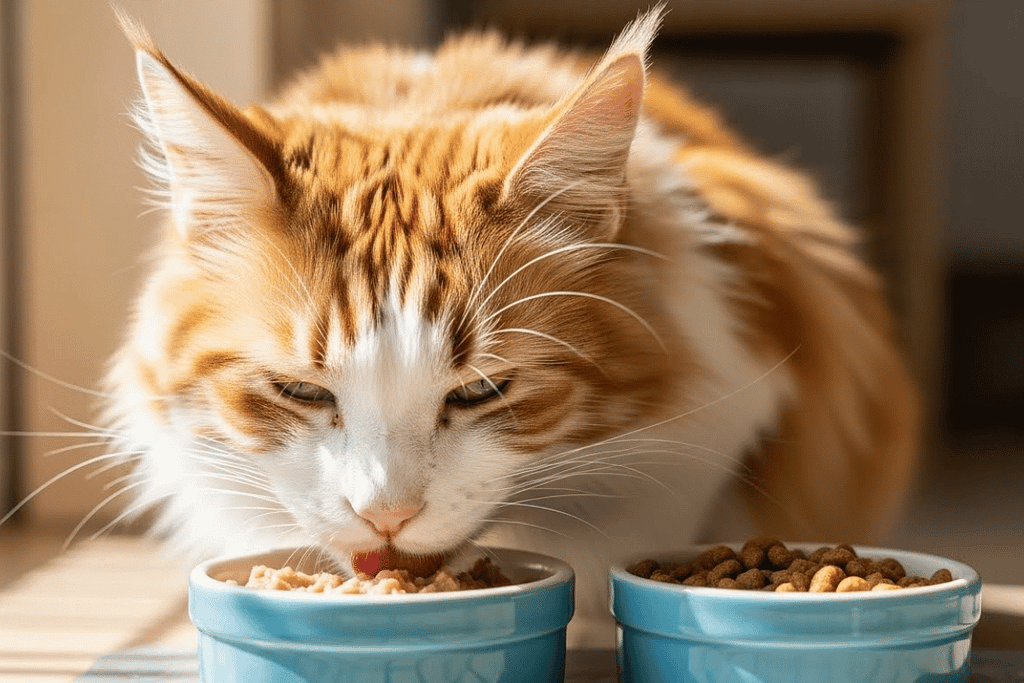
Choosing between wet vs dry senior cat food is not simply a matter of preference. As cats grow older, changes in appetite, hydration, body weight, muscle condition, and oral health can influence how comfortably and consistently they eat.
Wet food provides substantially more moisture and may be easier to eat for cats with certain dental problems. Dry food is convenient, easy to portion, and often more economical. Both formats can support a healthy senior cat when the food is nutritionally appropriate and the feeding plan matches the cat’s individual needs.
The best choice depends on your cat’s health, eating habits, and body condition—not just the number of candles on the birthday cake.
In this guide, you’ll learn how wet and dry food compare, when mixed feeding makes sense, how to transition an older cat safely, and which signs may indicate that a change in diet or a veterinary assessment is needed.
🐾 Why Food Choices Matter More as Cats Age
Aging does not affect every cat in the same way. Some older cats remain active and maintain a healthy weight, while others develop dental problems, lose muscle, become less interested in food, or need additional support for a chronic condition.
These changes can influence which food texture and feeding routine work best.
💧 Hydration and Water Intake
Cats naturally obtain some of their water from food. Wet cat food commonly contains approximately 70–80% moisture, whereas dry kibble typically contains around 6–10%, although the exact amount varies by product.
This difference can be significant for cats that drink little water.
Wet food increases total dietary water intake and may help produce more dilute urine. This can be particularly relevant for cats with certain urinary conditions. However, wet food alone does not prevent or treat every urinary or kidney problem.
Practical tip: Offer fresh water in several accessible locations, keep bowls clean, and consider a water fountain if your cat prefers moving water. Wet food can complement these measures.
🦷 Dental Health and Chewing Comfort
Older cats may develop periodontal disease, tooth resorption, broken teeth, or other painful oral conditions. Some continue eating despite discomfort, making dental problems easy to overlook.
Soft wet food may be more comfortable for a cat with oral pain, especially when chewing hard kibble becomes difficult. However, changing food texture does not treat the underlying dental problem.
Also, ordinary dry kibble should not automatically be considered a dental-cleaning solution. Some specially formulated dental diets have demonstrated benefits, but their effects depend on the product and its design.
Practical tip: If your cat drops food, chews on one side, drools, paws at the mouth, or approaches the bowl and then walks away, arrange a veterinary examination rather than assuming it is simply a normal part of aging.
🍽️ Appetite, Smell, and Food Texture
Some senior cats become more selective about food. Changes in smell, nausea, discomfort, illness, or reduced mobility may affect their willingness to eat.
Wet food often has a stronger aroma than dry kibble. Gently warming it to approximately room temperature or slightly warmer may make it more appealing, provided it is not hot.
Texture also matters. Some cats prefer pâté, while others respond better to shredded meat or chunks in gravy.
Remember: A sudden or persistent decline in appetite is not something to dismiss as ordinary aging. It can be an early sign of an underlying health problem.
⚖️ Muscle Loss and Unintentional Weight Changes
Older cats can become overweight if calorie intake exceeds their needs. Others lose weight and muscle as they age or develop chronic disease.
These situations require different feeding strategies.
A calorie-controlled diet may help an overweight cat, while a cat losing weight may need a more energy-dense, highly palatable food and a veterinary assessment to identify the cause.
The objective is not simply to keep the number on the scale stable. It is to maintain an appropriate body condition and preserve muscle mass.
🔍 Wet vs Dry Senior Cat Food: The Main Differences
The most useful comparison considers what each format offers in everyday feeding—not which one is universally superior.
💧 Moisture Content
Wet food supplies much more water per serving than dry food. This can be useful for cats that have low voluntary water intake or benefit from increased dietary moisture.
Dry food contains less water, so cats eating it need to obtain more of their daily fluid intake from drinking and other food sources.
Neither format should replace an individualized hydration plan when a veterinarian has diagnosed kidney disease, urinary disease, or another condition that affects fluid balance.
🥩 Nutritional Value and Protein
Wet food is not automatically more nutritious than dry food, and dry food is not automatically too high in carbohydrates or too low in protein.
Nutritional value depends on the specific formulation, its nutrient profile, energy density, digestibility, and whether it provides complete and balanced nutrition for the intended life stage.
Protein deserves particular attention in senior cats because maintaining muscle is important. However, a cat with diagnosed kidney disease may need a therapeutic diet with carefully managed phosphorus and other nutrients.
Do not restrict protein or switch to a kidney diet solely because your cat is old. These decisions should be based on veterinary assessment and the cat’s nutritional needs.
🍗 Palatability and Texture
Wet food offers a range of textures and often has a stronger aroma. This may help some cats eat more consistently, especially when appetite or chewing comfort becomes an issue.
Dry food is convenient to serve and may work well for cats that prefer its texture.
Individual preferences vary. A senior cat that refuses one type of wet food may readily accept another, so texture and flavor can matter as much as the wet-versus-dry distinction.
⚖️ Calories and Portion Control
Wet food generally contains fewer calories per gram because it contains more water. Dry food is more calorie-dense, which means a relatively small portion can provide a substantial amount of energy.
This difference can make dry food easy to overfeed when portions are not measured. On the other hand, a cat with poor appetite may struggle to consume enough calories if the chosen wet food is not energy-dense enough.
Compare calories per serving or per gram, and consider the amount your cat actually eats.
💰 Cost, Storage, and Convenience
Dry food is often less expensive per calorie, easier to store, and simpler to use with automatic feeders.
Wet food usually requires more frequent purchasing, careful portioning, and refrigeration after opening according to the manufacturer’s instructions. Uneaten portions should not remain at room temperature indefinitely.
For many households, the practical solution is not choosing one format exclusively but creating a feeding routine that balances nutritional needs, budget, and convenience.
📊 Wet vs Dry Senior Cat Food: Side-by-Side Comparison
| Category | Wet Food | Dry Food |
|---|---|---|
| Moisture | High; contributes substantially to daily water intake | Low; more water must come from drinking and other food |
| Calorie density | Usually lower per gram | Usually higher per gram |
| Texture | Soft options may be easier for cats with chewing difficulties | Hard kibble may be uncomfortable for some cats with oral pain |
| Appetite | Aroma and texture may encourage some selective eaters | Convenient, but acceptance depends on individual preference |
| Portion control | Requires measuring the amount offered | Easy to measure, but calorie-dense portions can be overfed |
| Storage | Opened portions generally require refrigeration | Usually easier to store; follow package instructions |
| Cost | Often more expensive per calorie | Often more economical per calorie |
| Hydration support | Provides considerable dietary moisture | Provides relatively little dietary moisture |
| Dental considerations | May be more comfortable with oral pain | Ordinary kibble should not be assumed to clean teeth |
| Best use | Useful when dietary moisture, texture, or palatability is a priority | Useful when convenience, measured portions, or preference favors kibble |
The takeaway: Both formats can be appropriate. The best option is the one that provides complete and balanced nutrition, meets your cat’s energy needs, and can be eaten comfortably and consistently.
🥫 Wet Food for Senior Cats: When It Can Help
Wet food can be particularly useful when its moisture content, texture, or palatability addresses a specific need.
💧 When Increasing Dietary Moisture Is Helpful
A wet-food-based feeding plan can increase total water intake without relying entirely on drinking.
This may be beneficial for some cats with urinary conditions or cats that naturally drink little. For cats with chronic kidney disease, however, the appropriate diet depends on the stage of disease, laboratory findings, appetite, and veterinary recommendations.
A therapeutic renal diet may offer benefits beyond moisture alone, including specific adjustments to phosphorus and other nutrients.
🦷 When Chewing Becomes Uncomfortable
Soft pâtés and other tender textures may allow cats with dental discomfort to eat more comfortably.
If your cat has missing teeth or struggles with kibble, try an appropriate soft food while arranging a dental evaluation. Do not assume that a softer diet eliminates the need for treatment.
😺 When Appetite Becomes Less Predictable
A more aromatic food, a preferred texture, or smaller, more frequent meals may encourage a cat to eat.
You can also try offering small portions of fresh food rather than leaving a large serving untouched.
If your cat repeatedly refuses food, eats much less than usual, or loses weight, contact your veterinarian promptly. Food changes alone may not resolve the underlying problem.
🥣 Dry Food for Senior Cats: When It Makes Sense
Dry food remains a valid option for many older cats. Age alone is not a reason to eliminate it.
⚖️ When Measured Portions Help Manage Weight
Because dry food is calorie-dense, it can be portioned precisely to support a calorie-controlled feeding plan.
The key is to measure the amount rather than repeatedly topping up the bowl. Check the calorie information on the package and adjust portions according to your cat’s body condition and weight trend.
For an overweight senior cat, a veterinarian can help establish a safe weight-loss plan that protects muscle mass.
🏡 When Convenience Supports a Consistent Routine
Dry food can be practical for households with multiple cats, busy schedules, or automatic feeders.
However, free-feeding is not ideal for every cat. It can make calorie intake difficult to monitor and may allow one cat to eat another cat’s portion.
In multi-cat homes, separate feeding stations or microchip-activated feeders may help control access and monitor intake.
🦷 When Dental Health Needs Extra Attention
A cat with healthy teeth may eat dry food comfortably. But hard kibble is not suitable for every cat with dental disease, and ordinary kibble should not be relied upon to prevent periodontal disease.
If chewing appears painful, prioritize comfort and arrange a veterinary examination.
🐈 Is Mixed Feeding the Best Option for Senior Cats?
For many households, combining wet and dry food provides a useful balance of dietary moisture, convenience, and portion control.
Mixed feeding is not automatically better than an all-wet or all-dry diet, but it can work well when the total daily intake is planned correctly.
🌅 Option 1: Wet Food in the Morning and Evening, Measured Dry Food During the Day
This routine may suit cats that enjoy wet meals but also eat dry food comfortably.
It allows you to provide dietary moisture while using measured kibble portions for convenience.
🕒 Option 2: Several Small Meals Throughout the Day
Some senior cats prefer smaller meals rather than one or two large servings.
You can divide the daily food allowance into several portions, using wet food at selected meals and dry food when appropriate.
This can also make it easier to notice changes in appetite.
💧 Option 3: Primarily Wet Food
An all-wet feeding plan may be useful when a cat needs more dietary moisture, prefers soft textures, or readily accepts wet food.
However, cats with kidney disease, diabetes, urinary disorders, or other medical conditions may need a specific nutritional plan. A standard wet food is not necessarily a substitute for a prescribed therapeutic diet.
🥣 Option 4: Dry Food With Added Water
Some cats accept kibble softened with a little warm water. This can help with texture and add moisture, but acceptance varies.
Once water has been added, treat the food as perishable. Prepare small portions and discard leftovers promptly rather than leaving moistened kibble out for extended periods.
📏 How to Calculate Portions When Mixing Foods
The main mistake in mixed feeding is adding wet food to the usual dry-food allowance without reducing the total calories accordingly.
For example, if your cat’s planned daily intake is 200 calories and the wet food provides 80 calories, the remaining allowance is 120 calories from dry food or other permitted food sources.
The actual daily calorie target should be individualized. Feeding guides on packages are starting points, not exact requirements for every senior cat.
🔄 How to Transition an Older Cat to New Food
A gradual transition often improves acceptance and reduces the risk of digestive upset.
For a healthy cat that tolerates dietary changes, you can use this general seven-to-fourteen-day schedule:
| Period | New Food | Previous Food |
|---|---|---|
| Days 1–3 | 25% | 75% |
| Days 4–6 | 50% | 50% |
| Days 7–9 | 75% | 25% |
| Days 10–14 | 100% | 0% |
Percentages refer to the portions being replaced, ideally calculated on a consistent basis rather than mixing equal volumes of foods with different calorie densities.
Some cats need a slower transition, especially when they are sensitive to dietary changes. If vomiting, diarrhea, or food refusal develops, slow down and seek veterinary guidance as appropriate.
Important: Do not force a prolonged transition if your cat stops eating. In cats, inadequate food intake can become medically serious, particularly when they are overweight or already ill. Contact your veterinarian promptly if your cat refuses food or eats substantially less than usual.
🌿 Tips to Make the Transition Easier
- Introduce one meaningful change at a time.
- Offer small, fresh portions in a quiet location.
- Try a different wet-food texture if your cat rejects the first option.
- Warm refrigerated wet food slightly before serving, checking that it is not hot.
- Keep feeding bowls clean and easy to reach.
- Monitor appetite, stool quality, body weight, and overall behavior.
Never withhold a familiar food simply to make a cat accept a new one.
🩺 Choosing Food for Different Senior Cat Needs
The right wet-versus-dry balance depends on the individual cat. These examples illustrate how the decision can change with different circumstances.
💧 Scenario 1: A Cat With Kidney Disease
A cat with chronic kidney disease may benefit from a veterinary therapeutic renal diet, which is formulated to manage nutrients such as phosphorus and may provide other disease-specific nutritional adjustments.
Wet food can increase water intake, but moisture alone does not treat kidney disease. The appropriate diet depends on the cat’s clinical condition, laboratory results, appetite, and ability to maintain body weight.
Best next step: Ask your veterinarian whether a renal diet is indicated and which food format your cat will reliably eat.
⚖️ Scenario 2: An Overweight Senior Cat
An overweight cat may benefit from carefully measured portions, an appropriate calorie target, and regular weight monitoring.
Wet food may help some cats feel satisfied with a larger food volume per calorie, while measured dry food can also fit a weight-management plan.
Avoid rapid or unsupervised weight loss, as inadequate nutrition can put cats at risk of serious complications.
Best next step: Establish a target weight and feeding plan with your veterinarian, including a strategy to preserve muscle mass.
🦷 Scenario 3: A Cat With Dental Pain or Missing Teeth
Soft wet food may be easier to eat, especially if chewing hard kibble appears uncomfortable.
However, missing teeth do not automatically mean a cat must eat only wet food. The decision depends on comfort, oral health, food texture, and individual preference.
Best next step: Arrange a dental examination and choose a texture that allows comfortable eating.
🍽️ Scenario 4: A Cat With a Reduced Appetite
Offer a familiar, palatable food in small portions and observe how much your cat actually eats.
Wet food may help because of its aroma and texture, but reduced appetite can also signal nausea, pain, dental disease, or another medical condition.
Best next step: Contact your veterinarian if the appetite change is sudden, persistent, or accompanied by weight loss or other symptoms. Do not wait for a food change to solve the problem.
🐾 Scenario 5: A Healthy Senior Cat With Stable Weight
If your cat eats well, maintains an appropriate body condition, and has no special dietary requirements, either wet food, dry food, or a combination may be suitable.
There is no universal rule that every cat must switch to wet food after a particular birthday.
Best next step: Choose a complete and balanced diet your cat enjoys, measure portions appropriately, and reassess nutritional needs during regular veterinary checkups.
✅ A Simple Five-Step Guide to Choosing Wet vs Dry Senior Cat Food
Use these questions to make a practical decision.
1. Does your cat need more dietary moisture?
If increasing water intake is a priority, wet food can be a useful part of the plan. Keep fresh drinking water available regardless of food format.
2. Is chewing comfortable?
If your cat struggles with hard kibble, consider a softer texture and arrange a dental assessment.
3. Is your cat maintaining a healthy weight and muscle condition?
Unexpected weight loss or gain deserves attention. Adjust portions according to individual needs rather than age alone.
4. Is your cat eating enough consistently?
Food acceptance matters. A theoretically ideal diet is not useful if your cat refuses to eat it.
5. Does your cat have a diagnosed medical condition?
Kidney disease, diabetes, urinary disorders, and other conditions can change nutritional priorities. Ask your veterinarian whether a therapeutic diet is needed.
💚 The Practical Rule
- Choose wet food when its moisture, texture, or palatability better meets your cat’s needs.
- Include measured dry food when it suits your cat’s preferences, calorie requirements, and feeding routine.
- Consider mixed feeding when it provides a practical balance without exceeding the daily calorie target.
- Follow veterinary guidance when a medical condition requires a specific nutritional approach.
📚 Helpful Resources for Senior Cat Nutrition
For reliable information about aging cats, nutrition, and health monitoring, consult veterinary sources such as:
- Cornell Feline Health Center: Educational resources on feline health and common medical conditions.
- Your veterinarian: Individualized recommendations based on your cat’s examination, body condition, medical history, and laboratory findings.
If you are comparing particular foods, also check whether each product is labeled as complete and balanced for the appropriate life stage or meets the nutritional requirements specified by your veterinarian.
❓ FAQ: Wet vs Dry Senior Cat Food
Is wet food better than dry food for senior cats?
Not always. Wet food provides more dietary moisture and may be easier to eat for some cats, while dry food is convenient and calorie-dense. The better option depends on the cat’s health, nutritional requirements, appetite, and preferences.
Should all senior cats eat wet food?
No. A healthy senior cat can eat an appropriate complete and balanced dry diet, wet diet, or combination. Wet food can be particularly useful when increased dietary moisture or a softer texture is desirable.
Is dry food bad for senior cats’ kidneys?
Dry food is not inherently bad for the kidneys of every healthy cat. It provides less moisture than wet food, so total water intake deserves attention. Cats with kidney disease may need a specific therapeutic diet prescribed according to their condition.
Can senior cats eat both wet and dry food?
Yes. Mixed feeding can work well if both foods are nutritionally appropriate and the total daily calories are controlled. Remember to account for the calories from each format rather than adding wet food on top of the usual dry-food allowance.
Does wet food help senior cats stay hydrated?
Yes. Because wet food contains substantially more water than dry food, it can increase total dietary water intake. However, it does not replace access to fresh water or veterinary treatment when a medical condition affects hydration.
Should I switch my older cat to senior-specific food?
Not necessarily. Some senior-formulated foods can be appropriate, but the word “senior” on the package does not guarantee that a product is the best choice for every older cat. Consider nutritional adequacy, calorie needs, body condition, and any diagnosed medical conditions.
How many times a day should I feed my senior cat?
Many cats do well with several small meals throughout the day, but there is no single schedule that suits every cat. Meal frequency should accommodate appetite, household routines, medical needs, and the total daily food allowance.
What if my senior cat suddenly stops eating dry food?
A sudden change may indicate dental pain, nausea, or another health problem. Offer a comfortable, familiar food if your cat will accept it, and contact your veterinarian promptly rather than assuming the cat has simply become picky.
🐈 Helping Your Senior Cat Eat Comfortably
Choosing between wet vs dry senior cat food is not about declaring one format the winner. It is about understanding how moisture, texture, calories, appetite, and medical needs influence your cat’s daily wellbeing.
Wet food can be valuable for increasing dietary moisture and offering a softer, more aromatic meal. Dry food can provide convenience and make measured calorie portions easier to manage. A combination can bring together useful features of both.
Observe your cat’s eating habits, monitor changes in body weight and muscle condition, and review nutritional needs regularly as your cat ages. When health concerns arise, use veterinary guidance to determine whether a food change is appropriate.
Small, thoughtful adjustments can help make mealtimes more comfortable while supporting the nutritional needs of your aging companion.
More senior cat resources:
- Senior Cat Care Guide (10+ Years): The Complete Blueprint for Aging Cats
- Senior Cat Vet Visit Checklist: Prepare for Your Next Appointment

With the sensitivity of one who loves deeply, Sissi writes stories celebrating the animal world. Her felines Estrela and Safira illuminate her days, while Pete and Gabrich live eternally through her words. Every piece she writes is a love letter to the companions who make life truly meaningful.