
Cat Exploration Behavior: Curiosity as an Evolutionary Tool
Cat exploration behavior is the process by which cats gather information about their environment. Through slow movement, repetition, and observation, cats monitor safety, detect changes, and maintain awareness of their surroundings.
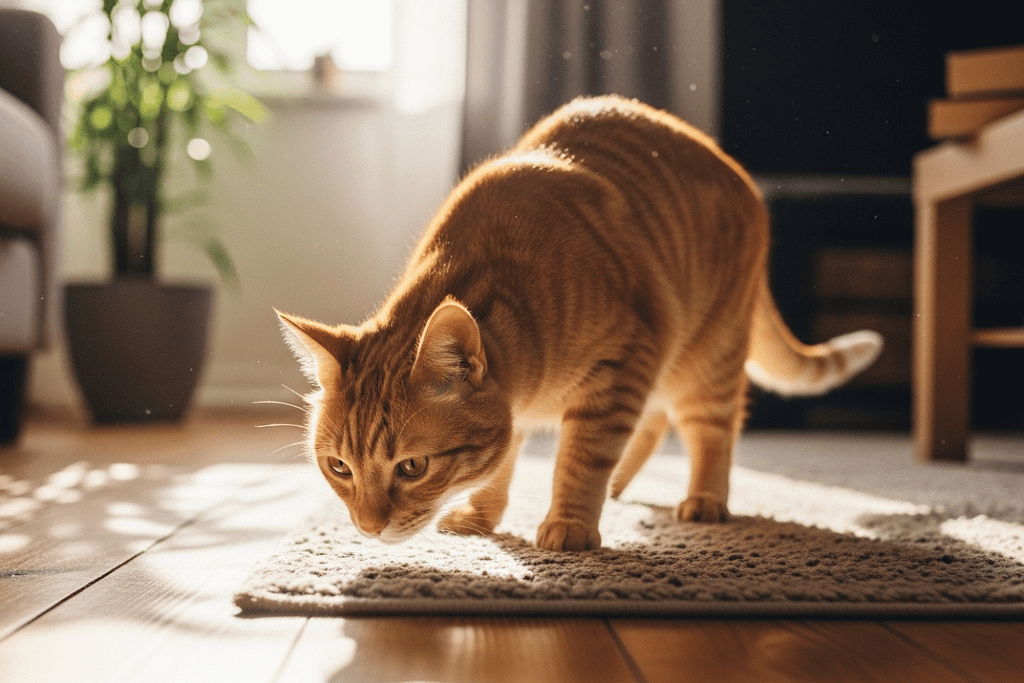
You’ve probably seen this without thinking much about it.
Your cat walks into a room…
and doesn’t go straight to anything.
They slow down.
Take a few steps.
Pause.
Look — not at everything, but at something specific.
Then move again.
Quietly.
Nothing here looks urgent.
Nothing looks important.
And that’s exactly why it’s easy to miss.
This is usually where people hesitate.
Because it doesn’t feel like curiosity the way we imagine it.
It doesn’t look playful.
It doesn’t look expressive.
It looks… precise.
And that’s where cat exploration behavior begins to reveal itself.
🔍 Cat Exploration Behavior Is Not Wandering — It Is Information Gathering
At first glance, it can seem like your cat is simply moving without direction.
But there is structure here.
Your cat is not just moving through space — they are collecting information about it.
About things like:
- what feels stable
- what has changed
- what might matter later
- what needs to be monitored
If you’ve ever wondered why my cat walks around the house slowly, you’re watching cat exploration behavior in its most precise form.
This explains why cats investigate their surroundings so methodically — they are not wandering, they are working.
In daily life, this often looks like:
- slow, deliberate movement
- brief pauses in very specific locations
- revisiting the same area more than once
- noticing objects most people ignore
This is not idle curiosity.
This is how your cat stays oriented in their environment.
🧠 Cat Exploration Is Not Personality — It Is Structural
It’s common to describe cats as curious, shy, or bold.
And those differences are real.
But underneath those variations, cat exploration behavior is not optional — it’s structural.
Feline environmental awareness is not a personality trait — it is a biological requirement.
Cats evolved in a way that requires continuous environmental feedback. They don’t simply react when something happens. They monitor what might happen.
According to International Cat Care, exploratory behavior in cats is not merely curiosity — it is a biological drive that allows cats to maintain continuous awareness of their environment, resources, and potential threats.
This doesn’t mean your cat is analyzing things the way humans do, nor does it take anything away from your bond.
In daily life, this often looks like:
- checking the same place multiple times
- noticing subtle changes you didn’t see
- reacting to something that seems insignificant
To understand how this connects to the complete evolutionary framework, explore How Cat Behavior Evolved: Instinct, Vigilance and Exploration.
🔁 Why Exploration Includes Repetition
One of the most misunderstood aspects of cat behavior is repetition.
The same path. The same object. The same pause. Repeated.
This can feel unnecessary — but it isn’t.
Repetition is not redundancy. It is verification.
Cats do not assume stability.
They confirm it. Again and again.
This is how they maintain certainty in an environment that can change at any time.
⚖️ Curiosity and Caution Work Together — Not Against Each Other
Exploration is not driven by curiosity alone.
It is balanced by caution.
Every cat continuously adjusts between:
approaching,
pausing,
observing,
and deciding.
This balance is what makes exploration controlled rather than impulsive.
If you want to understand how this tension works in real situations, see Exploration vs Fear in Cats.
✨ Why Some Moments Trigger Immediate Exploration
Sometimes, this slow system shifts.
A new object appears —
and your cat moves toward it immediately.
No pause.
No hesitation.
This is not inconsistency.
It is how the exploration system responds to novelty.
To understand why this happens so quickly and intensely, see Why Cats Investigate New Objects Immediately.
🗺️ Exploration Builds an Internal Understanding of the Environment
As cats move, pause, and revisit spaces, they are not just reacting.
They are maintaining an internal understanding of their surroundings.
This ongoing process allows them to detect changes, recognize patterns, and stay oriented over time.
To explore how this mapping process works in depth — especially through scent and sensory input — see How Cats Map Their Environment Through Scent
🌿 When Cat Exploration Behavior Finally Makes Sense
At some point, something shifts.
What once felt like random movement, unnecessary repetition, and small, forgettable actions begins to feel like monitoring, updating
positioning.
Because the question changes.
From: Why is my cat doing this?
To: What is my cat noticing right now?
And that shift matters.
Because it removes a quiet pressure:
- the need to interpret behavior as random,
- the urge to interrupt or redirect,
- the expectation that curiosity should stop.
Your cat is not just moving through space. They are maintaining a relationship with it. And once you start seeing that… even the smallest pause begins to carry meaning.
This article reflects Sissi’s lifelong experience living with cats, informed by years of observation and regular consultations with licensed veterinarians. For medical concerns about your cat, always consult a qualified vet.
❓ FAQ
What is cat exploration behavior?
Cat exploration behavior is the continuous process through which cats gather information about their environment — monitoring changes, updating internal maps, and assessing safety. It is not random wandering but a structured biological drive that evolved to keep cats aware of their surroundings at all times.
Why does my cat walk slowly and pause frequently?
Because slow, deliberate movement is how cat exploration behavior operates at its most precise. Your cat is not wandering — it is collecting information, comparing what is present now with what was there before, and updating its internal map of the environment.
Why do cats repeat the same movements or paths?
Because repetition is a way of verifying stability. Cats return to the same places to confirm that nothing has changed.
Is curiosity in cats just personality?
No. While personality affects intensity, exploration itself is a biological requirement essential for survival and environmental awareness.

With the sensitivity of one who loves deeply, Sissi writes stories celebrating the animal world. Her felines Estrela and Safira illuminate her days, while Pete and Gabrich live eternally through her words. Every piece she writes is a love letter to the companions who make life truly meaningful.