
Not All Cats Cycle the Same Way: Individual Variation in Feline Energy
Individual variation in feline energy explains why some cats are naturally more active, reactive, or reserved than others. Although cats follow the same general energy cycles of rest, activation, and recovery, each cat expresses these patterns differently based on sensitivity, stimulation thresholds, experience, and neurological variation.
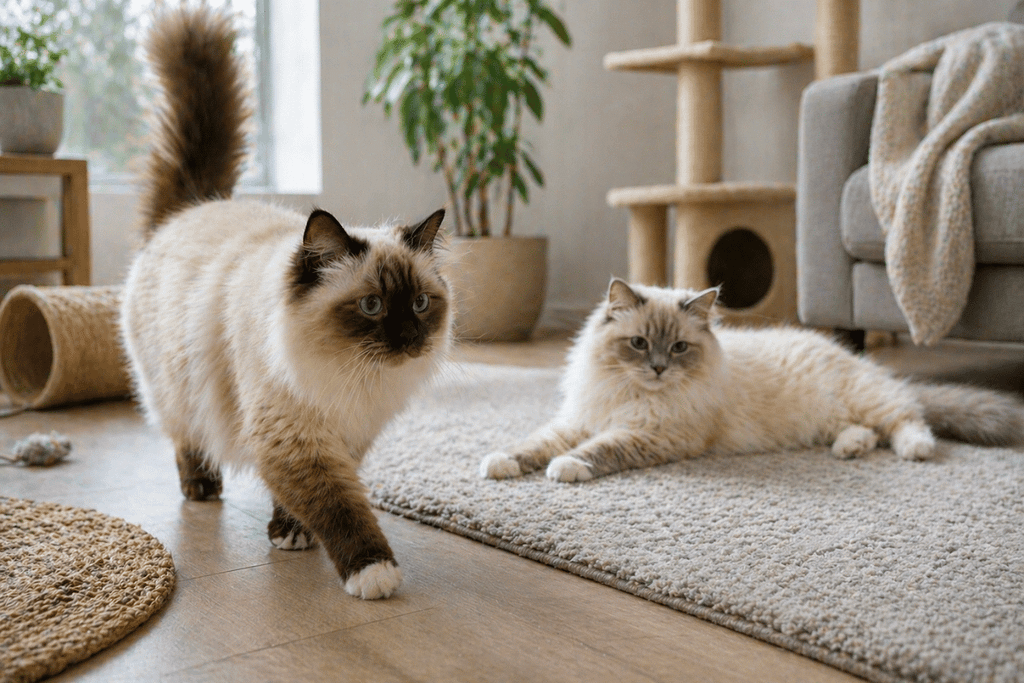
Many cat owners notice the difference immediately.
Two cats can live in the same home, experience the same environment, and still behave completely differently throughout the day.
One explores constantly.
Another prefers observation.
One reacts instantly to movement or sound.
Another responds slowly and cautiously.
At first, these differences can feel confusing.
Shouldn’t the same environment create similar behavior?
Not necessarily.
Cats share the same broader biological structure of activity, rest, and recovery — but individual cats express these energy cycles differently.
Understanding individual variation in feline energy helps explain why some cats are naturally more active, sensitive, cautious, or reserved than others without assuming something is wrong.
🌗 Why Some Cats Are More Active Than Others
Not all cats express energy the same way.
Some cats:
- move frequently throughout the day,
- react quickly to stimulation,
- engage rapidly with movement or play.
Others:
- pause longer before responding,
- observe before acting,
- remain inactive for longer periods.
These differences are part of natural variation in how feline nervous systems regulate activation and recovery.
One cat may have a lower activity threshold, meaning stimulation triggers action quickly. Another may require stronger or more sustained stimulation before engaging.
This is one reason why some cats seem highly energetic while others appear calm even in the same environment.
The cycle itself is shared.
The expression is individual.
🧠 What Shapes Individual Variation in Feline Energy
Individual variation develops through multiple interacting factors rather than a single cause.
These include:
- neurological sensitivity,
- stimulation thresholds,
- early experiences,
- adaptation to the environment,
- stress responsiveness,
- recovery style.
For example:
- one cat may react immediately to a door sound,
- another may barely respond,
- one may experience nightly zoomies frequently,
- another may rarely display sudden bursts of activity.
This does not mean one cat is more balanced or “better adjusted” than the other.
It simply reflects differences in how each nervous system processes stimulation, activation, and recovery.
Research in feline behavior suggests that even within the same species, behavioral sensitivity and response intensity can vary significantly between individuals.
🔄 How Different Cats Express the Same Energy Cycles
All cats move through the same broader biological structure: rest → alertness → activation → recovery
What changes is not the existence of the cycle — but how strongly and how often each phase is expressed.
Some cats:
- transition rapidly between states,
- display frequent bursts of movement,
- recover quickly after stimulation.
Others:
- maintain longer resting phases,
- show slower activation patterns,
- engage more selectively with their environment.
This becomes easier to understand in Cat Energy Cycles Explained, where feline behavior is organized through repeated shifts between activation and recovery.
The structure is shared.
The expression is individual.
👁️ Why Differences Become More Visible Over Time
At first, variation may seem subtle.
But as daily patterns repeat, differences become easier to recognize.
You may notice that:
- one cat consistently seeks interaction,
- another prefers distance,
- one becomes active during environmental changes,
- another remains calm and observant.
These patterns often become more visible through repetition rather than isolated moments.
This is why differences between cats frequently feel more permanent over time. Repeated behavior gradually reveals how each cat organizes energy, stimulation, and recovery differently.
This broader structure becomes easier to observe in Cat Daily Routines Explained, where recurring patterns organize feline behavior across the day.
⚖️ Why Different Energy Levels Are Not Imbalance
One of the biggest misunderstandings in feline behavior is assuming that calmer cats are disengaged or that highly active cats are excessive.
In reality, variation itself is part of normal feline organization.
A quieter cat is not necessarily lacking confidence.
A highly active cat is not necessarily hyperactive.
Different cats simply distribute energy differently across the same biological system.
Some conserve movement carefully.
Others express activation more frequently.
Neither pattern is inherently wrong.
Understanding this changes how behavior is interpreted.
The goal is not to make all cats behave the same way — but to recognize that individual variation is already part of how feline balance works.
To understand how these energy systems connect to broader feline behavior, Why Do Cats Get Bursts of Energy — Then Suddenly Go Still? explores how activation, recovery, and biological timing shape everyday cat behavior.
Sissi is the creator of A Cat With Story, where she explores feline behavior through real-life observation and practical insight. Her work connects everyday cat behavior to instinct, environment, and patterns informed by veterinary guidance.
❓ FAQ
Why are some cats more active than others?
Cats vary naturally in neurological sensitivity, stimulation thresholds, and behavioral response patterns, which affects how they express energy throughout the day.
Why is one of my cats calmer than the other?
Different cats regulate activation and recovery differently. A calmer cat is not necessarily unhealthy or disengaged — it may simply have a higher activation threshold.
Do all cats follow the same energy cycles?
Yes. Cats share the same general structure of rest, activation, and recovery, but individual cats express these cycles differently.
Why do cats respond differently to the same environment?
Behavioral variation develops through differences in sensitivity, experience, stress response, and how each nervous system processes environmental stimulation.

With the sensitivity of one who loves deeply, Sissi writes stories celebrating the animal world. Her felines Estrela and Safira illuminate her days, while Pete and Gabrich live eternally through her words. Every piece she writes is a love letter to the companions who make life truly meaningful.