
Why Cats Choose the Shortest Path to Their Goals
Why cats choose the shortest path is closely connected to spatial memory, movement efficiency, and energy conservation. Instead of moving randomly, cats tend to follow familiar routes that reduce uncertainty, avoid unnecessary effort, and make navigation smoother over time.
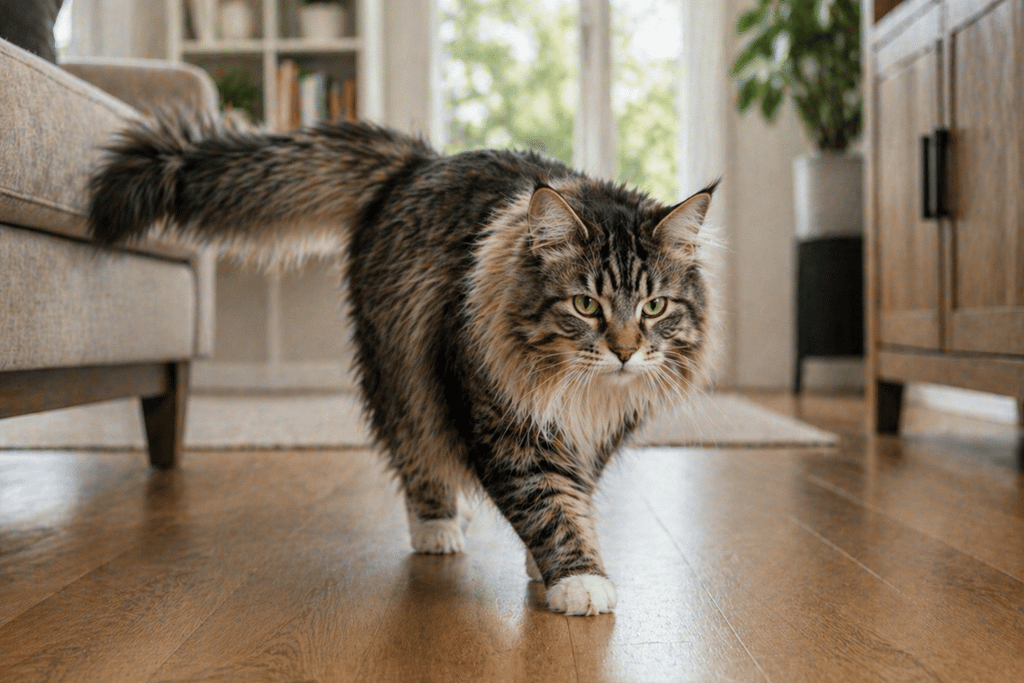
Many cat owners eventually notice the same thing.
A cat moves across the room and somehow avoids obstacles almost effortlessly. It follows the same route to the food bowl, jumps onto familiar surfaces with precision, or crosses the house using nearly identical paths every day.
The movement feels intentional.
Almost calculated.
But cats do not navigate space through conscious planning the way humans often imagine.
Instead, feline movement is strongly shaped by spatial familiarity, repeated routes, and energy-efficient navigation patterns developed through experience.
Understanding why cats choose the shortest path helps explain how feline behavior minimizes uncertainty, conserves energy, and organizes movement efficiently throughout familiar environments.
🧭 Why Cats Prefer Direct and Familiar Routes
Cats naturally tend to favor movement that is predictable and efficient.
Rather than constantly exploring new routes, they often repeat paths that already feel familiar and reliable.
This behavior helps reduce:
- unnecessary movement,
- environmental uncertainty,
- physical effort,
- repeated sensory evaluation.
If you’ve ever wondered why cats take the same routes every day, the answer is often rooted in spatial familiarity rather than conscious decision-making.
In daily life, this may look like:
- approaching the food bowl from the same direction,
- using the same hallway repeatedly,
- jumping across familiar furniture pathways,
- avoiding unnecessary detours around obstacles.
The more familiar a route becomes, the smoother and more automatic movement tends to feel.
🧠 How Spatial Memory Shapes Feline Movement
Cats develop strong spatial memory through repeated interaction with their environment.
Over time, the brain reinforces information about:
- distances,
- surfaces,
- obstacles,
- jumping points,
- safe movement routes.
This process is sometimes called route reinforcement — repeated movement gradually strengthens the familiarity of certain paths.
Instead of evaluating the environment from the beginning every time, cats begin relying on movement patterns already learned through experience.
This is one reason cats often move confidently through spaces even in low light or during rapid movement.
The environment becomes neurologically familiar.
⚡ Why Repeated Paths Become More Efficient Over Time
As routes repeat, movement often becomes faster, smoother, and more precise.
This is not because cats consciously calculate the “best” route step by step.
It happens because familiar movement reduces hesitation and lowers the need for constant environmental reassessment.
Over time, cats develop what could be described as low-uncertainty movement — navigation through spaces that already feel predictable.
You may notice:
- fewer pauses during movement,
- smoother turns,
- more direct walking patterns,
- reduced correction around obstacles.
What looks highly strategic is often repeated familiarity becoming physically efficient.
🔄 How Energy Efficiency Influences Movement
Feline movement is closely connected to energy economy.
Cats evolved as small predators that benefit from minimizing unnecessary effort whenever possible.
This is why movement often becomes highly selective:
- direct instead of excessive,
- efficient instead of continuous,
- purposeful instead of exploratory once familiarity is established.
Why do cats avoid unnecessary movement? Because energy conservation remains part of how feline behavior is organized.
Repeated routes reduce physical effort, environmental uncertainty, and sensory overload at the same time.
This connection becomes easier to recognize in Energy Economy in Cats, where movement efficiency supports broader patterns of recovery, readiness, and activation.
🌙 Why Cat Movement Sometimes Feels Intentional
Watching a cat move confidently through space can feel surprisingly deliberate.
They avoid obstacles smoothly.
They reach familiar destinations quickly.
They often seem to know exactly where they are going.
Part of this impression comes from how little hesitation exists once movement patterns become established.
The route no longer needs to be explored repeatedly because the environment has already been learned through experience.
This does not mean cats consciously map every movement in advance.
But it does show how spatial memory, repetition, and familiarity gradually shape highly fluid movement patterns.
🌿 How Familiar Spaces Shape Cat Behavior
The longer cats live within the same environment, the more organized their movement often becomes.
Repeated exposure strengthens:
- spatial familiarity,
- route reinforcement,
- movement confidence,
- environmental predictability.
Over time, navigation begins requiring less adjustment and less exploratory effort.
What initially feels mysterious becomes easier to understand:
Cats are not randomly crossing space.
They are moving through environments their nervous systems already know well.
To understand how these movement patterns connect to broader feline behavior systems, Why Do Cats Get Bursts of Energy — Then Suddenly Go Still? explores how energy conservation, timing, and behavioral efficiency shape everyday cat activity.
This article reflects Sissi’s lifelong experience living with cats, informed by years of observation and veterinary-guided behavioral understanding. Through A Cat With Story, she explores how instinct, neurobiology, and environment shape everyday feline behavior.
❓ FAQ
Why do cats choose the shortest path?
Cats often prefer familiar and efficient routes because repeated movement strengthens spatial memory and reduces unnecessary effort.
Do cats remember routes inside the house?
Yes. Cats develop strong spatial memory and often repeat familiar movement patterns throughout their environment.
Why do cats take the same route every day?
Repeated routes become neurologically familiar, making movement smoother, more predictable, and more energy efficient over time.
Do cats consciously plan their movement?
Not in the same way humans do. Most feline movement patterns develop through familiarity, repetition, and environmental learning rather than conscious route calculation.

With the sensitivity of one who loves deeply, Sissi writes stories celebrating the animal world. Her felines Estrela and Safira illuminate her days, while Pete and Gabrich live eternally through her words. Every piece she writes is a love letter to the companions who make life truly meaningful.