
Anticipatory Behavior in Cats: How Repetition Builds Expectation
Anticipatory behavior in cats develops through repetition and associative memory. When environmental cues repeat consistently, cats begin responding before events happen, creating behavioral timing that feels predictive but is built from experience and pattern recognition.
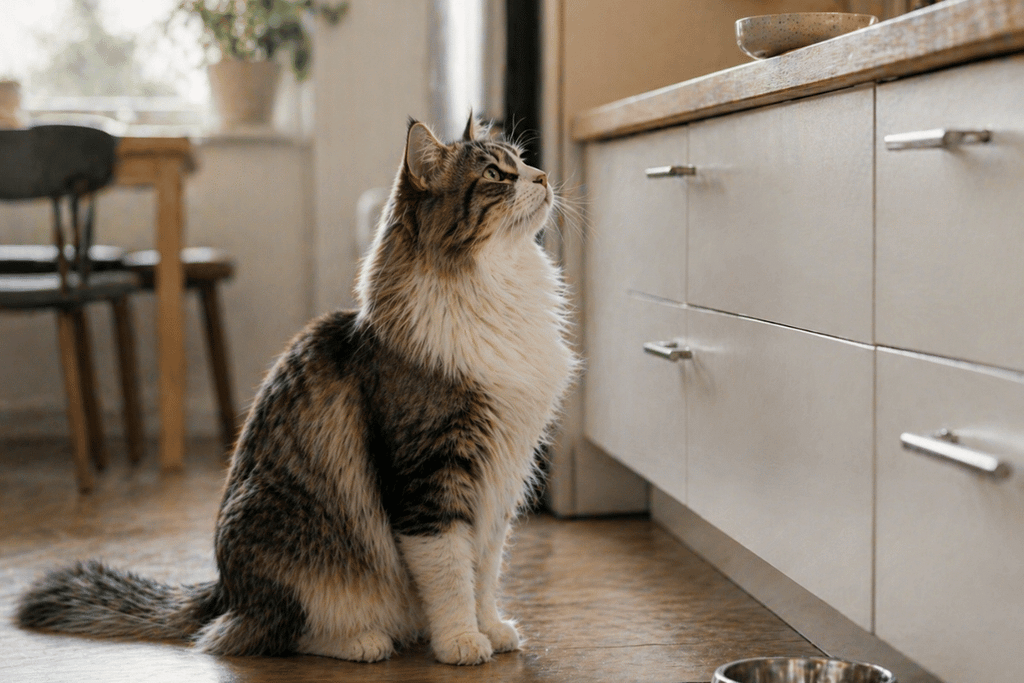
Many cat owners notice the same strange moment.
You walk toward the kitchen, and your cat is already waiting there before food appears. You reach for your shoes, and your cat reacts before you leave the house. Sometimes they even move toward the door before you arrive home.
At first, this behavior can feel almost predictive.
But anticipatory behavior in cats does not come from prediction or abstract understanding of time.
It develops through repetition, associative memory, and environmental cues that gradually teach the brain what usually happens next.
Over time, the response begins arriving before the event itself.
🔁 How Repetition Builds Anticipatory Behavior in Cats
Anticipatory behavior in cats begins with repeated sequences.
The same sounds.
The same locations.
The same events happening in similar ways over time.
Gradually, the nervous system starts connecting these patterns to expected outcomes.
This is exactly why cats wait for food before it appears — repetition has already mapped the sequence.
If you’ve ever wondered why does my cat wait for me in the same spot every day, the answer is anticipatory behavior built through repeated experience.
In daily life, this often looks like:
- waiting near feeding areas before meals,
- reacting to familiar household sounds,
- moving toward specific locations before routines begin.
The response no longer waits for the final event.
It begins earlier because the pattern itself has become recognizable.
🧠 Cat Pattern Recognition and Associative Memory
Cat pattern recognition is the neurological foundation behind anticipatory behavior.
According to the American Veterinary Medical Association, cats form associative memories that connect environmental cues to expected outcomes. Over time, these repeated associations allow behavior to activate before the event itself occurs.
This process is not formal training.
It is experience shaping response.
I’ve seen this with my own cats for years — Estrela positions herself near the kitchen several minutes before feeding begins. I never taught her that sequence directly. Repetition built it.
Environmental cues that commonly trigger anticipatory behavior include:
- footsteps,
- feeding sounds,
- light changes,
- repeated household movement,
- familiar daily timing.
Once these associations strengthen, the brain begins responding to the cues rather than waiting for the outcome itself.
⏱️ Why Cat Behavior Sometimes Feels Predictive
Part of what makes anticipatory behavior so noticeable is timing.
The response often appears just before the expected event.
A cat moves toward the feeding area before food appears. Waits near the door before someone arrives home. Becomes alert moments before interaction normally begins.
This timing creates the feeling that the cat somehow “knows” what is about to happen.
But what looks predictive is usually pattern completion happening slightly ahead of the final step.
The brain has simply learned that certain environmental cues reliably lead to a specific outcome.
🌙 How Anticipatory Behavior Connects to Daily Rhythms
Anticipatory behavior does not exist independently from the rest of the feline behavioral system.
It connects closely to:
- biological rhythms,
- recurring routines,
- energy cycles,
- environmental timing.
Why do cats get excited before feeding time? Because repeated daily patterns gradually shift activation earlier and earlier in the sequence.
Over time, anticipation itself becomes part of the behavioral rhythm.
This becomes easier to recognize in Cat Daily Routines Explained, where repeated environmental structure shapes daily behavior patterns.
Anticipatory behavior also connects closely to Cat Energy Cycles , where activation, recovery, and timing organize behavior throughout the day.
🌿 Why Cats Seem to Know When You’re Coming Home
One of the most recognizable examples of anticipatory behavior happens when cats appear near the door before someone arrives home.
It can feel remarkable.
But this behavior is usually built from hundreds of repeated associations involving:
- timing,
- environmental sounds,
- familiar movement patterns,
- recurring household rhythms.
This is not telepathy.
It is associative memory and pattern recognition becoming highly refined through repetition.
And that is part of what makes the behavior feel so meaningful: the pattern was built through shared experience over time.
To understand how these behavioral systems connect more broadly, Why Do Cats Get Bursts of Energy — Then Suddenly Go Still? explores how timing, activation, and recovery organize feline behavior throughout the day.
This article reflects Sissi’s lifelong experience living with cats, informed by years of observation and veterinary-guided behavioral understanding. Through A Cat With Story, she explores how instinct, neurobiology, and environment shape everyday feline behavior.
❓ FAQ
What is anticipatory behavior in cats?
Anticipatory behavior happens when cats begin responding before an expected event occurs, usually because repeated experiences have built strong behavioral associations.
Why does my cat wait for food before I prepare it?
Cats learn repeated feeding patterns and begin responding to environmental cues connected to the routine before the meal itself appears.
Why does my cat wait for me in the same spot every day?
Repeated experiences teach the brain to associate specific locations and timing patterns with expected interaction or arrival.
Do cats understand time?
Cats do not understand time abstractly like humans, but they respond strongly to biological rhythms, repetition, and recurring environmental cues.

With the sensitivity of one who loves deeply, Sissi writes stories celebrating the animal world. Her felines Estrela and Safira illuminate her days, while Pete and Gabrich live eternally through her words. Every piece she writes is a love letter to the companions who make life truly meaningful.