
Feline Domestication: Why Cats Are Different From Dogs
Feline domestication followed a different path than the domestication of many other animals. While cats adapted to living alongside humans thousands of years ago, they experienced less intensive selective breeding than dogs, helping explain why many ancestral feline behaviors remain visible today.

Cats and dogs are often grouped together as household pets.
They share our homes.
Depend on humans for food and shelter.
And have lived alongside people for thousands of years.
Yet anyone who has spent time with both species quickly notices an important difference.
Dogs often seem highly focused on human activity.
Cats often seem focused on their own.
A dog may look to its owner for guidance.
A cat may choose to investigate independently.
A dog may eagerly cooperate.
A cat may cooperate only when it finds the arrangement worthwhile.
These differences are not accidents.
They reflect two very different domestication histories.
Understanding feline domestication helps explain why cats often appear more independent than dogs and why many ancestral feline behaviors remain surprisingly visible today.
🧠 What Is Feline Domestication?
Feline domestication refers to the long-term evolutionary process through which cats adapted to living alongside humans.
Over thousands of years, domestic cats developed traits that allowed them to:
- tolerate human presence,
- reproduce successfully near people,
- thrive in human environments,
- benefit from resources created by human settlements.
Like all domesticated animals, cats experienced genetic and behavioral changes.
However, feline domestication unfolded differently from the domestication of many other species.
To understand why, it helps to compare cats with the domestic animal most people know best: dogs.
🐾 Why Cats and Dogs Followed Different Domestication Paths
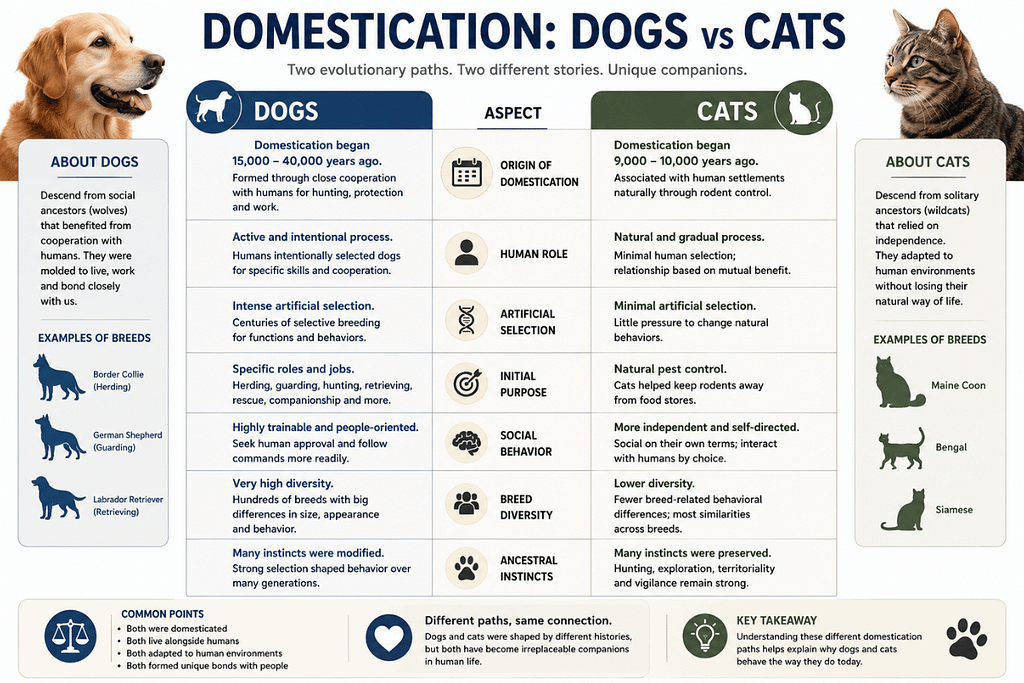
Dogs and cats did not become domestic animals for the same reasons.
Early dogs likely became associated with humans through cooperative relationships involving hunting, protection, and resource sharing.
Humans actively selected dogs that displayed desirable traits.
Over time, this process intensified.
Cats followed a very different route.
As agriculture spread, human settlements created ideal conditions for rodents.
Rodents attracted wild cats.
Cats gained access to reliable prey.
Humans benefited from natural pest control.
This relationship emerged through mutual advantage rather than intensive human management.
As a result, feline domestication involved far less direct behavioral shaping than dog domestication.
This difference became one of the defining features of the cat-human relationship.
🧬 Why Humans Changed Dogs More Than Cats
One of the biggest differences between cats and dogs involves artificial selection.
Humans intentionally bred dogs for specific purposes.
These purposes included:
- herding,
- guarding,
- retrieving,
- tracking,
- hunting,
- companionship.
Generations of selective breeding gradually shaped canine behavior.
Humans actively encouraged certain traits and reduced others.
Cats experienced much less of this process.
Most domestic cats were never required to perform specialized jobs.
Their existing abilities already suited the environments humans created.
As a result, humans had fewer reasons to dramatically alter feline behavior.
This helps explain why many cat behaviors still resemble those of their ancestors.
🐺 How Hunting History Shaped Both Species
The evolutionary history of each species also played an important role.
Dogs descend from ancestors that relied heavily on cooperation.
Working together increased hunting success and survival.
Cats evolved from largely solitary hunters.
Their ancestors depended more on individual skill than group coordination.
These different evolutionary backgrounds influenced how each species interacted with humans.
Dogs were already predisposed toward cooperative social behavior.
Cats were predisposed toward independence and self-reliance.
Domestication built upon these existing tendencies rather than replacing them.
👁️ Why Cat Behavior Remained More Independent
Many cat owners notice that cats often appear less dependent on human guidance than dogs.
This observation has deep evolutionary roots.
Cats did not need humans to coordinate hunting strategies.
They did not need humans to organize social groups.
They did not need extensive behavioral specialization to survive.
Instead, many ancestral skills remained effective even after cats adapted to human environments.
Environmental monitoring.
Territorial organization.
Exploration.
Resource assessment.
These behaviors continued serving useful functions.
As a result, feline domestication preserved a greater degree of behavioral independence.
This does not mean cats are less domesticated.
It simply means domestication shaped them differently.
🐕 Why Dog Breeds Became So Specialized
Dog domestication eventually produced hundreds of specialized breeds.
Some dogs were developed to herd livestock.
Others to retrieve game.
Others to guard property.
Others to track scents.
These specialized roles encouraged significant behavioral diversity.
Cat breeds tell a different story.
Although physical differences among cat breeds can be substantial, behavioral differences are generally less dramatic than those observed among dogs.
A Border Collie and a Mastiff may display very different instinctive tendencies.
Differences between cat breeds are usually far more subtle.
This reflects the relatively limited behavioral specialization that occurred during feline domestication.
🌿 What Feline Domestication Changed
Despite preserving many ancestral behaviors, feline domestication still produced important changes.
Domestic cats generally show:
- increased tolerance of humans,
- greater social flexibility,
- reduced fear of human environments,
- improved ability to live near people,
- greater tolerance of other cats in resource-rich environments.
These adaptations allowed cats to become one of the world’s most successful companion animals.
Without domestication, modern domestic life would not be possible.
The important point is that domestication modified cats without fundamentally redesigning their behavioral architecture.
🏠 How Feline Domestication Shapes Indoor Cat Instincts
Many owners are surprised when indoor cats continue displaying behaviors that seem unrelated to modern life.
Cats patrol rooms.
Monitor windows.
Seek elevated observation points.
Investigate unfamiliar objects.
Maintain hunting-related behaviors.
These actions are not evidence that domestication failed.
They are evidence of how feline domestication occurred.
Cats adapted to human environments while preserving many of the behavioral systems that had already proven successful throughout their evolutionary history.
Understanding how cats became domesticated helps explain why they behave differently from dogs. But it also reveals something larger: many ancient behavioral systems remain active inside modern homes. Explore this idea further in Indoor Cat Instincts: Why Ancient Behaviors Persist in Modern Homes.
⚡ Why Understanding Feline Domestication Matters
Many behaviors that confuse cat owners become easier to understand when viewed through the lens of domestication history.
A cat scratching furniture.
A cat climbing shelves.
A cat spending hours observing the environment.
A cat responding strongly to routine changes.
These behaviors are not signs of failure or disobedience.
They often reflect behavioral systems that remained useful throughout the domestication process.
The more we understand feline domestication, the easier it becomes to understand the animals who share our homes.
🌱 A Domestic Animal With a Different Evolutionary Story
Cats are fully domesticated animals.
That fact is not in doubt.
What makes them unique is how domestication happened.
Unlike dogs, cats adapted to life alongside humans without undergoing extensive behavioral redesign.
Many ancestral systems remained intact because they continued working effectively.
The result is a companion animal that feels both familiar and surprisingly independent.
A cat may spend the afternoon sleeping on a sofa.
Yet many of its decisions are still influenced by behavioral systems shaped long before modern homes existed.
Understanding feline domestication helps explain why cats are different from dogs—and why they remain one of the most fascinating domestic species on Earth.
Although domestication changed cats, many hunting-related behaviors remain remarkably intact. To see how these ancestral behaviors continue appearing in everyday life, continue with Wild Cat Behaviors Indoors: Why Domestic Cats Still Act Like Hunters.
❓ FAQ
What is feline domestication?
Feline domestication is the long-term process through which cats adapted to living alongside humans while undergoing genetic and behavioral changes that supported life in human environments.
Are cats fully domesticated?
Yes. Cats are domesticated animals, although their domestication history differs from that of species such as dogs.
Why do cats still behave like wild animals?
Many ancestral behavioral systems remained active throughout feline domestication, including instincts related to hunting, territory, and environmental awareness.
How is feline domestication different from dog domestication?
Dog domestication involved extensive human-directed breeding and behavioral specialization. Feline domestication relied more on gradual adaptation to human environments and preserved more ancestral behaviors.
🌿About the Author
Through A Cat With Story, Sissi explores the intersection of feline behavior, evolutionary biology, and human-cat relationships. Her work focuses on helping cat owners understand the instinctive and environmental factors behind everyday behaviors, making scientific concepts accessible without losing their complexity

With the sensitivity of one who loves deeply, Sissi writes stories celebrating the animal world. Her felines Estrela and Safira illuminate her days, while Pete and Gabrich live eternally through her words. Every piece she writes is a love letter to the companions who make life truly meaningful.