
Why Cats Rub Their Face on Things: The Science of Scent Marking
Cats rub their face on things to deposit scent signals from specialized glands located around the cheeks, chin, and forehead. This behavior helps create familiarity, reinforce territory, and communicate information about the environment without the need for vocalization or confrontation.
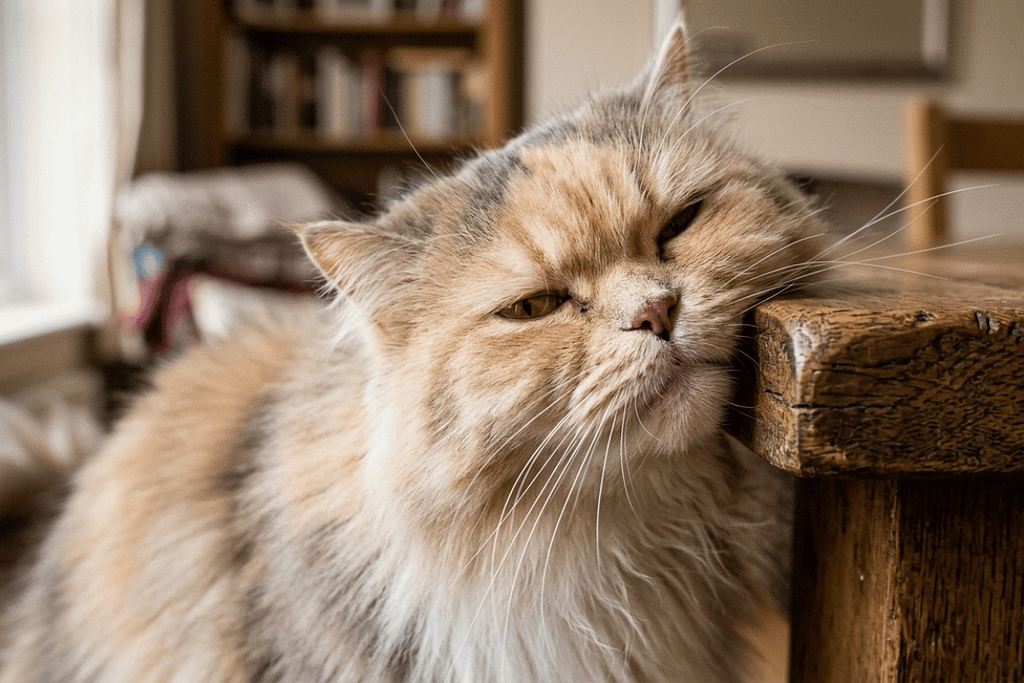
Most cat owners have seen it.
Your cat walks up to a chair.
A doorway.
A table leg.
Or even your hand.
Then comes the gentle rub.
The cheek.
The forehead.
Sometimes the entire side of the face.
At first, it looks like affection.
And sometimes it is connected to positive social interaction.
But there is something else happening as well.
A form of communication.
One that humans cannot easily see.
Understanding why cats rub their face on things begins with understanding how cats use scent to interact with the world around them.
🧠 Why Cats Rub Their Face on Things
Cats experience their environment differently than humans.
While people rely heavily on vision, cats gather large amounts of information through scent.
Specialized scent glands are located around:
- the cheeks,
- the chin,
- the lips,
- the forehead.
When a cat rubs these areas against an object, small scent signals are deposited on the surface.
These signals are often called pheromones.
The process is sometimes referred to as scent marking.
Unlike urine marking, facial scent marking is generally associated with familiarity and comfort rather than conflict.
👃 How Facial Scent Marking Works
The scent left behind during face rubbing is not designed to attract human attention.
In fact, people usually cannot detect it at all.
For cats, however, these chemical signals carry useful information.
They help identify:
- familiar locations,
- familiar individuals,
- frequently used objects,
- parts of the territory that feel safe.
Each time a cat repeats the behavior, those scent messages are reinforced.
Over time, the environment becomes increasingly familiar.
And familiarity contributes to security.
🏠 Why Cats Rub Furniture and Walls
One of the most common questions owners ask is:
Why do cats rub their face on furniture and walls?
The answer often relates to territory.
Large stationary objects become reliable reference points within the environment.
Door frames.
Corners.
Tables.
Shelves.
These locations remain stable over time.
By depositing scent on them, cats help create a territory that feels recognizable and predictable.
This behavior does not mean a cat is claiming ownership in the human sense.
Instead, the scent helps reinforce familiarity.
The environment begins to feel known.
And known environments tend to feel safer.
🐾 Why Cats Rub Against People
Many cats also rub their face against people.
This behavior often combines social and territorial functions.
When a cat rubs against:
- your hand,
- your leg,
- your face,
- your clothing,
the same scent-marking process occurs.
The cat is incorporating you into its familiar environment.
This does not mean the cat thinks you belong to it.
But it does suggest that your presence has become part of the cat’s trusted social and territorial world.
For many cats, this behavior is associated with comfort and positive relationships.
🌿 Scent Helps Create Territorial Stability
Territory is not maintained only through movement or observation.
It is also maintained through scent.
As cats move through their environment, they leave scent signals in locations that matter.
These signals help create continuity.
A familiar smell today is still familiar tomorrow.
That consistency reduces uncertainty.
And reducing uncertainty helps support emotional comfort.
This relationship between scent and territory is one reason many cats repeat facial rubbing behaviors throughout their lives.
🚶 Why Cats Revisit the Same Objects
If you watch closely, many cats repeatedly scent-mark the same locations.
The same chair.
The same corner.
The same doorway.
The same person.
This repetition is normal.
Scent signals gradually fade.
By revisiting familiar objects, cats help maintain the scent information that contributes to environmental familiarity.
What appears repetitive is actually part of an ongoing process of territorial maintenance.
🛡️ Is Face Rubbing Different From Urine Marking?
Yes.
Although both behaviors involve scent communication, they usually serve different functions.
Facial scent marking is generally associated with:
- familiarity,
- comfort,
- territorial stability,
- social bonding.
Urine marking is more commonly associated with:
- reproductive communication,
- territorial disputes,
- stress-related responses,
- environmental uncertainty.
Because of this distinction, face rubbing is typically considered a positive and normal behavior.
⚖️ Why Cats Rub Their Face on Things: More Than Affection
Many people interpret face rubbing as affection.
And that interpretation is not entirely wrong.
Cats often perform the behavior around individuals and locations they feel comfortable with.
But the behavior also serves a practical purpose.
It helps organize the environment through scent.
It reinforces familiarity.
It contributes to territorial stability.
And it helps create a world that feels predictable and secure.
The chair.
The wall.
The doorway.
The person.
Each becomes part of a familiar network of scent information.
And for a cat, that familiarity is valuable.
🌿 Seeing Territory Through a Cat’s Nose
Humans experience homes primarily through sight.
Cats experience them through a combination of sight, sound, touch, and scent.
Much of what makes a territory feel safe is invisible to us.
But not to them.
Every cheek rub.
Every scent mark.
Every familiar object.
Together, they help create an environment that feels known and predictable.
And once you begin seeing face rubbing through that lens, the behavior stops looking random.
It starts looking like communication.
To understand the biological foundations behind these behaviors, revisit Territorial Instincts in Cats: Why Territory Matters So Much.
❓ FAQ
Why do cats rub their face on things?
Cats rub their face on things to deposit scent signals from facial glands, helping create familiarity and reinforce territorial stability.
Do cats rub their face on people because they love them?
Often, yes. The behavior is commonly associated with comfort, trust, and social bonding, while also serving a scent-marking function.
Is face rubbing a form of territorial behavior?
Yes. Facial scent marking helps cats create familiar environments and maintain territorial organization.
Is face rubbing the same as urine marking?
No. Facial scent marking is generally associated with familiarity and comfort, while urine marking often relates to reproductive or territorial communication under different circumstances.
About the Author
This article reflects Sissi’s lifelong experience living with cats, informed by years of observation and behavior-focused research. Through A Cat With Story, she explores how instinct, territorial behavior, environmental organization, and feline cognition shape everyday life with cats.

With the sensitivity of one who loves deeply, Sissi writes stories celebrating the animal world. Her felines Estrela and Safira illuminate her days, while Pete and Gabrich live eternally through her words. Every piece she writes is a love letter to the companions who make life truly meaningful.