
Indoor Cat Instincts: Why Modern Homes Don’t Fully Match Feline Nature
Domestic cats live in human environments, but many indoor cat instincts are still shaped by ancestral survival systems. Differences in space, stimulation, and daily rhythms can influence how feline behavior appears in modern homes, creating a mismatch between natural behavioral expectations and indoor living.
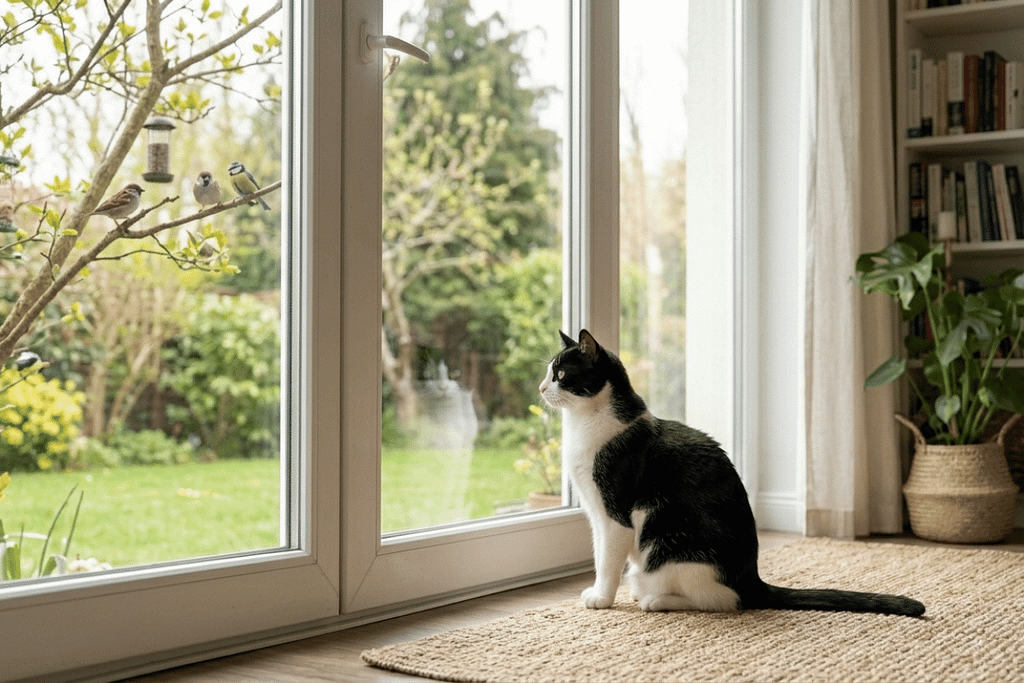
Indoor cat instincts shape far more of your cat’s behavior than most people realize.
Even cats that have spent their entire lives indoors continue expressing behavioral patterns that originated long before modern homes existed.
They sleep on sofas.
Eat from bowls.
Use litter boxes.
Live safely alongside humans.
Yet many indoor cat instincts remain active, influencing how cats explore, rest, monitor their surroundings, and respond to everyday life.
Your cat may wake up before dawn.
Patrol the same rooms repeatedly.
Stalk moving objects.
Scratch furniture.
Climb to the highest available location.
At first glance, some of these behaviors seem unnecessary.
After all, food is provided.
Predators are absent.
The environment is safe.
So why do so many instinctive behaviors remain?
The answer begins with understanding the relationship between indoor cat instincts and a concept known as environmental mismatch.
Cats have adapted remarkably well to life with humans.
But many of the behavioral systems they rely on today evolved under conditions very different from those found in modern homes.
🧠 What Environmental Mismatch Reveals About Indoor Cat Instincts
Environmental mismatch occurs when an animal’s evolved behavioral systems encounter conditions that differ significantly from those in which those systems originally developed.
The animal is not malfunctioning.
The environment is simply different from what evolution prepared it to handle.
Humans experience environmental mismatches too.
Our bodies evolved under conditions that often differ dramatically from modern life.
The same principle applies to cats.
Many indoor cat instincts evolved in environments that required:
- hunting,
- territory management,
- environmental exploration,
- resource monitoring,
- constant sensory awareness.
Modern homes often provide:
- predictable routines,
- concentrated resources,
- limited hunting opportunities,
- reduced environmental variation,
- stable surroundings.
None of these conditions are inherently bad.
But they are different.
And those differences help explain why indoor cat instincts sometimes appear out of place in domestic environments.
🐾 Cats Are Domesticated — But Not Like Dogs
One reason indoor cat instincts remain so visible is that cats followed an unusual domestication pathway.
Unlike dogs, cats were not extensively shaped through thousands of years of selective breeding for specific human tasks.
Instead, many researchers believe cats largely domesticated themselves.
Human settlements attracted rodents.
Rodents attracted cats.
Over time, a mutually beneficial relationship developed.
Cats gained access to reliable food sources.
Humans gained rodent control.
But domestication altered cats differently than it altered many other domestic species.
Understanding indoor cat instincts begins with recognizing that domestication changed cats without completely redesigning the behavioral systems inherited from their ancestors.
Many modern cats still express behaviors that closely resemble those seen in wild feline relatives.
This fascinating history is explored further in Are Cats Truly Domesticated? Understanding Feline Domestication.
To understand why cats followed a very different domestication pathway from dogs, see Feline Domestication: Why Cats Are Different From Dogs.
🌿 Why Indoor Cat Instincts Remain Active
Domestication changed some aspects of feline behavior.
But it did not eliminate the underlying systems that helped cats survive for thousands of years.
The need to hunt may be reduced.
Yet predatory instincts remain.
Many of the behaviors owners describe as “wild” are actually normal expressions of ancient hunting systems that remain active indoors. Explore these patterns in Wild Cat Behaviors Indoors: Why Domestic Cats Still Act Like Hunters.
Food may arrive automatically.
Yet resource-monitoring behavior continues.
The home may be safe.
Yet territorial behavior persists.
This does not mean cats are confused.
It simply reflects the fact that evolution operates over long timescales.
Many indoor cat instincts remain active because they continue to be part of the species’ biological design.
Behavioral systems do not disappear simply because the environment changes.
🏠 Why Modern Homes Challenge Indoor Cat Instincts
The environments that shaped feline evolution differ substantially from those most indoor cats experience today.
Natural environments often contain:
- changing sensory information,
- unpredictable movement,
- complex exploration opportunities,
- distributed resources,
- multiple observation points.
Indoor environments often provide:
- fixed layouts,
- predictable schedules,
- concentrated resources,
- limited hunting opportunities,
- reduced environmental complexity.
Many indoor cat instincts evolved in environments that offered far more sensory variation, behavioral challenges, and opportunities for exploration than most homes provide today.
Again, this does not mean indoor life is harmful.
It simply means the environment differs from the one many behavioral systems originally evolved to navigate.
To see how modern homes differ from the environments that shaped feline evolution, continue with Natural Cat Environment vs Indoor Life: What’s Different?.
⚡ When Indoor Cat Instincts Have No Natural Outlet
Most behavioral systems evolved to complete sequences.
Hunting is a good example.
A natural hunting sequence may involve:
- searching,
- tracking,
- stalking,
- chasing,
- capturing,
- consuming.
In modern homes, portions of these sequences are often reduced or absent.
Food appears without hunting.
Movement opportunities become limited.
Environmental challenges decrease.
The instinct remains.
The outlet changes.
This does not automatically create problems.
But it can create situations where indoor cat instincts have fewer opportunities for complete expression.
When that happens, behavior may appear repetitive, exaggerated, or difficult to interpret.
The instinct itself is not the problem.
The mismatch between instinct and opportunity is what matters.
When motivated behaviors repeatedly lack opportunities for completion, frustration can emerge. Learn more in Behavioral Frustration in Cats: When Natural Instincts Have No Outlet.
🚶 How Indoor Cat Instincts Can Lead to Behavioral Frustration
Behavioral frustration occurs when a motivated behavior repeatedly fails to reach a satisfying conclusion.
This does not mean the cat is unhappy all the time.
Nor does it mean indoor living is inherently inadequate.
It simply means that some indoor cat instincts may receive fewer opportunities for expression than they evolved to expect.
Examples may include:
- repetitive pacing,
- intense play behavior,
- excessive environmental monitoring,
- persistent attention-seeking,
- redirected predatory behavior.
When indoor cat instincts remain active but opportunities for expression become limited, behavioral frustration may become more noticeable.
These behaviors are often misunderstood.
Rather than signs of disobedience, they frequently reflect motivated behavioral systems seeking an outlet.
👁️ Why “Bad Behavior” Is Often Misunderstood
One of the most important consequences of environmental mismatch is interpretation.
Humans tend to judge behavior through human expectations.
Cats experience behavior through biological needs.
A scratching cat is not trying to damage furniture.
A climbing cat is not trying to create inconvenience.
A cat investigating every new object is not trying to be difficult.
Many so-called behavior problems are actually normal indoor cat instincts interacting with environments that do not always provide ideal opportunities for expression.
Understanding this distinction changes the conversation.
The question becomes:
Not:
“Why is my cat behaving badly?”
But:
“What need might this behavior be trying to fulfill?”
That shift often leads to far more useful answers.
⚖️ Domestication Changed Cats — But Not Completely
Cats are domesticated animals.
But domestication did not erase their evolutionary history.
Indoor cat instincts continue influencing:
- exploration,
- territory management,
- hunting behavior,
- environmental monitoring,
- social interactions.
Most of the time, these instincts coexist comfortably with domestic life.
Occasionally, they reveal the gap between modern environments and ancestral expectations.
That gap is environmental mismatch.
And understanding it helps explain many behaviors that otherwise seem confusing.
🌱 Understanding Indoor Cat Instincts Through Evolution
Indoor cat instincts are not signs that domestic life has failed.
Nor do they mean cats are secretly wild animals trapped inside homes.
They simply remind us that domestication is an ongoing evolutionary story.
Modern homes are relatively new.
Indoor cat instincts are much older.
Cats have adapted successfully to living alongside humans.
Yet many of their behavioral systems still reflect challenges, opportunities, and environmental conditions that shaped feline evolution long before indoor living became common.
Understanding indoor cat instincts helps explain why so many everyday behaviors continue to reflect needs, motivations, and expectations inherited from the past.
And once you begin viewing your cat through that evolutionary lens, behaviors that once seemed strange often become surprisingly logical.
❓ FAQ
What are indoor cat instincts?
Indoor cat instincts are natural behavioral tendencies inherited from feline ancestors, including hunting, territory monitoring, exploration, and environmental awareness.
Why do indoor cats still behave like hunters?
The predatory system remains part of feline biology even when hunting is no longer necessary for survival.
Are cats fully domesticated?
Cats are domesticated animals, but many researchers believe they retain more ancestral behavioral traits than species such as dogs.
Can environmental mismatch affect cat behavior?
Yes. Environmental mismatch can influence how indoor cat instincts are expressed and may contribute to behaviors that owners find confusing or problematic.
🐾 About the Author
Sissi is the founder of A Cat With Story, where she explores feline behavior through the lens of evolution, domestication, and environmental adaptation. Her work focuses on helping cat owners understand how ancient instincts continue shaping the behavior of modern domestic cats, transforming complex behavioral science into practical insights for everyday life.

With the sensitivity of one who loves deeply, Sissi writes stories celebrating the animal world. Her felines Estrela and Safira illuminate her days, while Pete and Gabrich live eternally through her words. Every piece she writes is a love letter to the companions who make life truly meaningful.