
? The Balinese Cat: The “Long-Haired Siamese” with a Dancer’s Grace ?
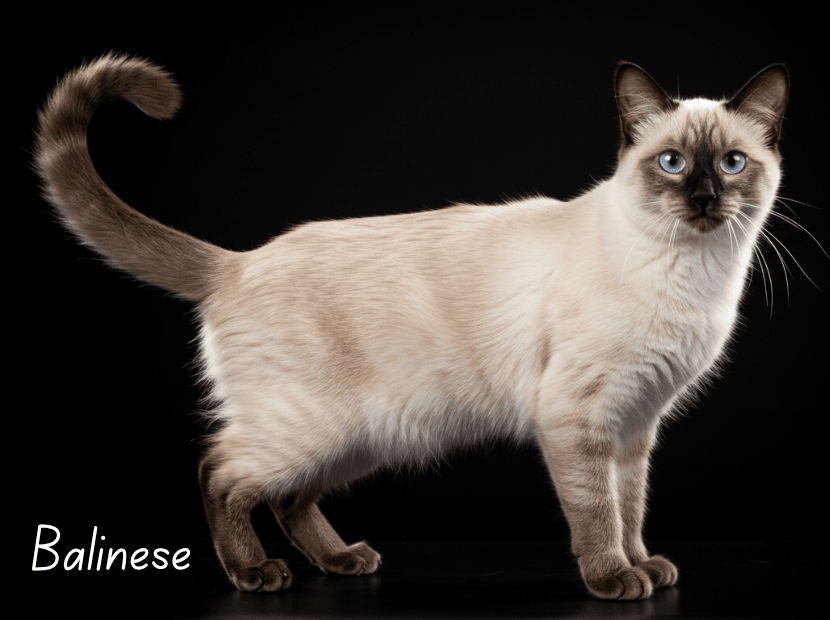
The Balinese Cat is the semi-long-haired, silky version of the Siamese Cat, originating from the United States in the 1950s through a spontaneous genetic mutation. Named after the graceful dancers of Bali Island due to its elegant movements and plumed tail, this striking breed inherits the Siamese’s intelligence, sapphire-blue eyes, and vocal nature. With a sleek, athletic body and fine silky coat, the Balinese is incredibly sociable, affectionate, and active, making it an ideal family companion. Known for jumping onto shoulders and climbing to high places, this breed requires weekly brushing and lives 10-15 years on average.
Balinese Cat key characteristics:
- Medium breed: 2.5-5 kg (5.5-11 lbs)
- Semi-long, silky coat with colorpoint pattern and plumed tail
- Extremely vocal, affectionate, and highly intelligent temperament
- Brush weekly (no dense undercoat, easy maintenance)
- Prone to amyloidosis, progressive retinal atrophy, and feline strabismus
- Lifespan: 10-15 years
The Balinese Cat is the semi-long-haired, silky version of the popular Siamese Cat, from which it inherits the intelligence, the striking sapphire-blue eyes, and a vocal nature. Its elegance and the way its coat flows led it to be named after the graceful dancers of Bali island, though its true origin is American.
The balinese cat is an incredibly sociable and active breed, ideal for families seeking a feline that is a truly participating member of the home.
? I. Origin and History: An Elegant Mutation
The Root of the Lineage
The Balinese cat story begins in the United States in the 1940s. In litters of Siamese Cats, which should have short hair, kittens with longer coats occasionally appeared due to a spontaneous and recessive genetic mutation.
The Birth of the Breed BALINESE
In the 1950s, American breeders, such as Helen Smith, started a breeding program to fix the long-haired trait. Helen Smith is credited with naming the breed the “Balinese” due to its grace and plumed tail, which reminded her of the movements of the Balinese dancers.
Colors and Recognition
Initially, only the four traditional Siamese colors were accepted (Seal, Blue, Chocolate, and Lilac Point). The breed was accepted by the CFA (Cat Fanciers’ Association) in 1970, solidifying its status.
? II. Table of Balinese Cat Physical Characteristics ?
The Balinese has a sleek and athletic body, inheriting the elegant structure of the Siamese.
| Characteristic | Detail |
|---|---|
| Size | Medium-sized. Sleek, slender, elegant, and athletic build. |
| Weight | 2.5 to 5 kg (5.5–11 lbs). |
| Height | 20–25 cm (8–10 inches). |
| Coat | Medium to long, fine, silky, and soft. Lies close to the body. No woolly undercoat — reduces matting and keeps the profile sleek. |
| Color Pattern | Always **colourpoint**. Light body with darker extremities (Seal, Blue, Chocolate, Lilac, Red, Cream, Tortie, Lynx). |
| Eyes | Almond-shaped, slanted, expressive. Always **deep sapphire blue**. |
| Head | Wedge-shaped (triangular) with a straight top and long, lean profile. |
| Ears | Large, broad at the base, pointed, following the wedge head shape. |
| Tail | Long, thin, and covered in long, plumed fur — resembling a feather duster. A defining feature of the Balinese. |
| Life Expectancy | 10–15 years; can live longer with good care. |
The Balinese combines elegance with intelligence, offering a low-shedding coat, affectionate personality, and strong desire for human connection. Despite its delicate appearance, it is athletic, playful, and highly vocal.
? III. Personality and Temperament of the balinese cat: The Feline Extrovert
The Balinese is known for its captivating personality and high sociability:
- Vocalization: It is a talkative cat, but its meow is generally softer and more melodic than the Siamese’s, using a repertoire of coos and trills.
- Intelligence: It is among the most intelligent long-haired breeds. They can be easily trained to fetch objects or walk on a leash.
- Affection: Extremely affectionate and devoted to the family, seeking physical contact and often jumping onto shoulders.
- Agility: They love heights. It is crucial to provide tall scratching posts and shelves for them to climb and “supervise” the environment.
? IV. Health and Specific Care
The Balinese Cat is generally healthy, but due to its close connection to the Siamese, it may inherit some genetic predispositions:
- Coat Grooming: Weekly brushing is sufficient to maintain the silky shine, due to the absence of a dense undercoat.
- Oral Hygiene: Daily dental brushing is essential, as the breed has a greater predisposition to periodontal diseases.
- Hydration: It is important to encourage water intake (ideally with wet food or water fountains) to support kidney and urinary health.
- Predispositions: Amyloidosis (a serious disease affecting organs), Progressive Retinal Atrophy (can lead to blindness), and Feline Strabismus (eye deviation).
? Want to Explore the Elegant Persian?
Learn about personality, grooming needs, and daily care:
Persian Cat – Care Guide, Grooming & Food Tips
❓ V. Curious Balinese Cat FAQ ?
1. Is the Balinese truly from the Island of Bali?
u003cstrongu003eNo.u003c/strongu003e The name is a tribute to the grace and elegance of the dancers of Bali, Indonesia, which American breeders felt the cat personified. The breed actually originated in the United States, from a mutation of the Siamese Cat.u003cbru003e
2. If it is the u0022Long-Haired Siamese,u0022 why was a different name created?
The new name (u0022Balineseu0022) was adopted to give the breed its own identity and avoid discord with more traditional Siamese breeders, highlighting its unique beauty and grace.u003cbru003e
3. Is its meow as loud as the Siamese’s?
u003cstrongu003eNo.u003c/strongu003e The Balinese is incredibly vocal and communicative, but it is considered the u0022lower-volumeu0022 version of the Siamese. Its meow is softer, more melodic, and they use a repertoire of chirps and trills to u0022talku0022 to their humans.u003cbru003e
4. Is it true that the Balinese likes to ride on shoulders?
u003cstrongu003eYes!u003c/strongu003e This is a very common trait of the breed. Due to their curious and affectionate nature, they love being at the eye level of their owners and will often jump onto shoulders.u003cbru003e
5. Why is its coat easy to care for, despite being long?
Unlike other long-haired breeds (like the Persian), the Balinese has a single-layer coat and u003cstrongu003edoes not have a dense, woolly undercoatu003c/strongu003e. The hair is fine and silky, meaning it is much less likely to mat and only requires weekly brushing.u003cbru003e
6. Does its coat color change with temperature?
u003cstrongu003eYesu003c/strongu003e, it can change! The Balinese, like the Siamese, is *acromelanic* (colourpoint). The color gene only activates in cooler areas of the body (extremities. Kittens are born completely white, and the color only begins to appear as the cooler parts of the body develop.u003cbru003e
7. Does it adapt to families with dogs?
u003cstrongu003ePerfectly.u003c/strongu003e Its sociable and outgoing personality means they tend to adapt well to other pets, including dogs and other cats, provided that socialization is done appropriately.u003cbru003e
8. Which country has the most breeders and registered specimens of the Balinese?
The Balinese was developed and established as a breed in the u003cstrongu003eUnited Statesu003c/strongu003e in the 1950s. Therefore, u003cstrongu003eNorth Americau003c/strongu003e (primarily the USA and Canada) is historically the region with the largest number of breeders, enthusiasts, and registered specimens of the breed.u003cbru003e
9. Where did the Balinese inherit its trait of being so u0022talkativeu0022 (vocal)?
It inherited this trait directly from its ancestor, the u003cstrongu003eSiamese Catu003c/strongu003e. The Balinese retains the communicative nature, but, curiously, its meow is generally softer, more melodic, and less harsh than that of the Siamese.
Want to learn more about other long-haired cat breeds? Check out our post “Long Haired Cats“
? Additional Resources
Explore veterinary and professional grooming resources: The ASPCA, AAFCO, and certified cat grooming professionals provide extensive guidance on feline coat care and health. Discover professional resources on long-haired cat care — access expert advice on nutrition, grooming techniques, and breed-specific health management.

Long-Haired Cats — Breeds, Characteristics & Essential Care
Majestic coats, gentle personalities, and special grooming needs — discover how to care for Persian, Maine Coon, Ragdoll and other long-haired breeds so they thrive and shine.

With the sensitivity of one who loves deeply, Sissi writes stories celebrating the animal world. Her felines Estrela and Safira illuminate her days, while Pete and Gabrich live eternally through her words. Every piece she writes is a love letter to the companions who make life truly meaningful.