
? The Sacred Cat of Burma (Birman): The White-Gloved with Sapphire Eyes ?
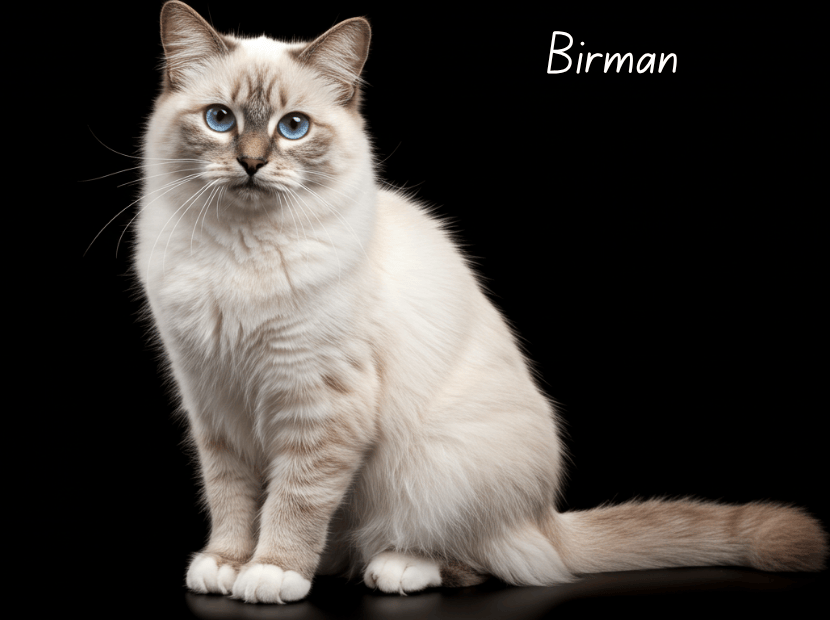
The Birman Cat, officially known as “The Sacred Cat of Burma,” is a medium-to-large breed renowned for its semi-long silky coat, distinctive colorpoint pattern, and uniquely pristine white paws resembling gloves and socks. With an origin shrouded in Buddhist temple legends, the Birman combines the sociability of the Siamese with a calm, gentle temperament, earning the nickname “velcro cat” for its devoted loyalty. Extremely affectionate and playful, this intelligent breed is ideal for families and apartment living. Birmans require only weekly brushing due to their minimal undercoat and live 12-16 years on average.
Birman Cat key characteristics:
- Medium-to-large breed: 4.5-8 kg males, 3-5 kg females
- Semi-long, silky coat with colorpoint pattern and white gloves
- Extremely affectionate, gentle, and loyal temperament
- Brush weekly (minimal undercoat, easy maintenance)
- Prone to hypertrophic cardiomyopathy (HCM) and spongiform degeneration
- Lifespan: 12-16 years
The Birman Cat, officially known as the “The Sacred Cat of Burma” is a breed of mystical beauty, renowned for its semi-long, colourpoint (point-colored) coat and, uniquely, for its pristine white paws, which resemble gloves and socks.
The Birman Cat, with an origin shrouded in legends of Buddhist temples, this cat combines the sociability of the Siamese with the charm and tranquility of a lap feline. This guide details the gentle temperament, the surprisingly low maintenance of its coat, and the physical characteristics that make this breed so special.
? I. Behavioral Characteristics of Birman Cat ?️
- Vocalization Tendency: The Birman Cat is generally a quiet and softly vocal cat, communicating in a sweet and melodious way, often with a pleasant “trill” or “coo.” They enjoy conversing with their humans but are not loud or demanding like the Siamese.
- Intelligence and Playfulness: They are intelligent, curious, and playful cats. While they have a moderate energy level, they prefer interactive play with their owner, such as fetching balls or chasing wands. They learn tricks easily and enjoy participating in household activities.
- Affection Towards Humans: The Birman Cat is famous for being extremely loving, affectionate, and gentle, often called a “velcro cat” for following its owner from room to room. They form very strong bonds with the family and love to be held and petted, making them loyal and faithful companions.
- Activity Level and Adaptation: They have a moderate energy level. They appreciate routine and tranquility but also need daily playtime sessions. They are highly adaptable, making them ideal for apartment living, provided they have scratching posts and interactive toys.
- Coexistence with Other Pets and Children: The Birman is one of the best breeds for families. They are patient and sociable with gentle children and get along well with other pets, including dogs and other cats, especially when introduced correctly.
? II. Physical Characteristics of the Sacred Cat of Burma ?
The Birman Cat is a medium-to-large cat with an elongated and muscular body, but not excessively massive. Its most iconic characteristic is the combination of color points with white gloves.
| Characteristic | Detail |
|---|---|
| Size / Build | Medium to large. Slightly elongated and rectangular body; strong boning and firm musculature. Balanced proportions without appearing overly massive. |
| Weight | Male: 4.5–8 kg (10–18 lbs) Female: 3–5 kg (7–11 lbs) |
| Height | Body length from head to rump: 40–60 cm. |
| Coat | Medium to long, silky and soft. Minimal undercoat → reduced matting tendency. Easier maintenance compared to Persian coats. |
| Color Pattern | Always **colourpoint**. Light body (white/cream) with darker extremities (mask, ears, paws, tail). |
| Point Colors | Seal, Blue, Chocolate, Lilac, Red, Cream, plus Tortie and Tabby/Lynx variations. |
| Gloves | Signature trait of the breed: **Pure white gloves on all four paws.** Hind paws feature white extending upward in a symmetrical inverted “V” (laces/gauntlets). |
| Eyes | Large, round to slightly oval. Always **deep sapphire blue**. |
| Head | Medium-sized, broad, rounded shape resembling an obtuse triangle. |
| Nose | Medium length with a gentle dip (not a Persian-style stop). Often described as a “Roman nose.” |
| Ears | Medium-sized, rounded tips, well-spaced, and harmoniously positioned. |
| Tail | Medium length, full and plumed — proportional to the body. |
| Life Expectancy | 12–16 years on average. |
The Birman is gentle, affectionate, and deeply bonded to its family. With minimal undercoat and naturally silky fur, grooming is easier than with many long-haired breeds.
? III. Essential Care and Health Considerations of the birman Cat
Despite its long and luxurious coat, care for the Birman is moderate:
- Coat Care (Grooming): Due to the absence of a dense undercoat, weekly brushing (with a stainless-steel comb) is generally sufficient to remove loose hairs and prevent tangles.
- General Health: The Birman is generally a robust and healthy breed, but like many purebreds, it may be predisposed to Hypertrophic Cardiomyopathy (HCM), the most common type of heart disease in cats, and certain genetic conditions like Spongiform Degeneration (affecting the central nervous system).
- Weight Control and Exercise: As a calm cat, it is important to monitor its diet and ensure daily exercise sessions (fetch or wand play) to prevent overweight and maintain cardiovascular health.
?️ Curious About the Elegant Balinese?
Discover their intelligence, silky coat, and expressive nature:
Balinese – Full Guide & Essential Care
❓ IV. Frequently Asked Questions about the Birman Cat?
1. What is the Legend Behind the “Sacred Cat of BURMA”?
The name refers to a Buddhist legend. The story tells that the cat Sinh, guardian of a temple in Myanmar (ancient Burma), had its coat turned to gold, its eyes to sapphire blue, and its paws to pure white (the gloves) by the goddess Tsun-Kyan-Kse, after his master’s death. The transformation symbolized purity of spirit and loyalty.
2. What is the Breed’s Origin and How Did it Reach Europe?
The factual (non-legendary) history asserts that the Sacred Cat of Burma was developed in France. A pair of cats (the male died during the journey) was supposedly smuggled from Myanmar (ancient Burma) to France in 1919, establishing the breed in Europe through a pregnant female.
3. What is the Difference BETWEEN the Birman (Sacred Birman) and the Burmese Cat?
They are entirely different breeds, despite their roots in Burma/Myanmar:
Birman (Sacred Birman): Semi-long-haired cat, colourpoint pattern (dark points), and white paws (gloves).
Burmese Cat: Short, smooth-haired cat, stocky body, and solid or sepia color (uniform colors, without the point pattern).
4. Did the Sacred Cat of Burma Appear in Movies or the Media?
Yes. The breed is directly linked to the Legend of Sinh (the transformed temple cat). While not a major Hollywood movie protagonist like the Himalayan Mr. Jinx, its mystical beauty and gentle temperament make it popular in European media and publications, often featuring as a symbol of feline elegance.
5. Which Country Has the Most Registered Specimens of the Breed?
The breed was extensively developed and popularized in Western Europe, with France being the country where the breed became established and was formally recognized first in Europe.
6. Why Does the Coat Color Change with Age?
The colourpoint pattern is a type of temperature-sensitive partial albinism (inherited from the Siamese). The colder areas of the body (ears, paws, tail, and facial mask) develop the dark color (point) as the cat ages, usually being fully defined by around 2 years old.
7. Is the Sacred Cat of Burma Hypoallergenic?
No. Although it sheds less hair than breeds with a dense undercoat (like the Persian or Maine Coon), it still produces the Fel d 1 protein (the main cause of allergies). Therefore, it is not considered hypoallergenic.
8. How Much Does a Sacred Cat of Burma Cost?
The price for a pedigree kitten from a reputable breeder in the US/Europe generally ranges between $800 and $2,000, depending on the lineage and color pattern.
Explore veterinary and professional grooming resources: The ASPCA, AAFCO, and certified cat grooming professionals provide extensive guidance on feline coat care and health. Discover professional resources on long-haired cat care — access expert advice on nutrition, grooming techniques, and breed-specific health management.

Long-Haired Cats — Breeds, Characteristics & Essential Care
Majestic coats, gentle personalities, and special grooming needs — discover how to care for Persian, Maine Coon, Ragdoll and other long-haired breeds so they thrive and shine.

With the sensitivity of one who loves deeply, Sissi writes stories celebrating the animal world. Her felines Estrela and Safira illuminate her days, while Pete and Gabrich live eternally through her words. Every piece she writes is a love letter to the companions who make life truly meaningful.