
Cat Interaction Method: How to Pet, Play & Groom Without Stress
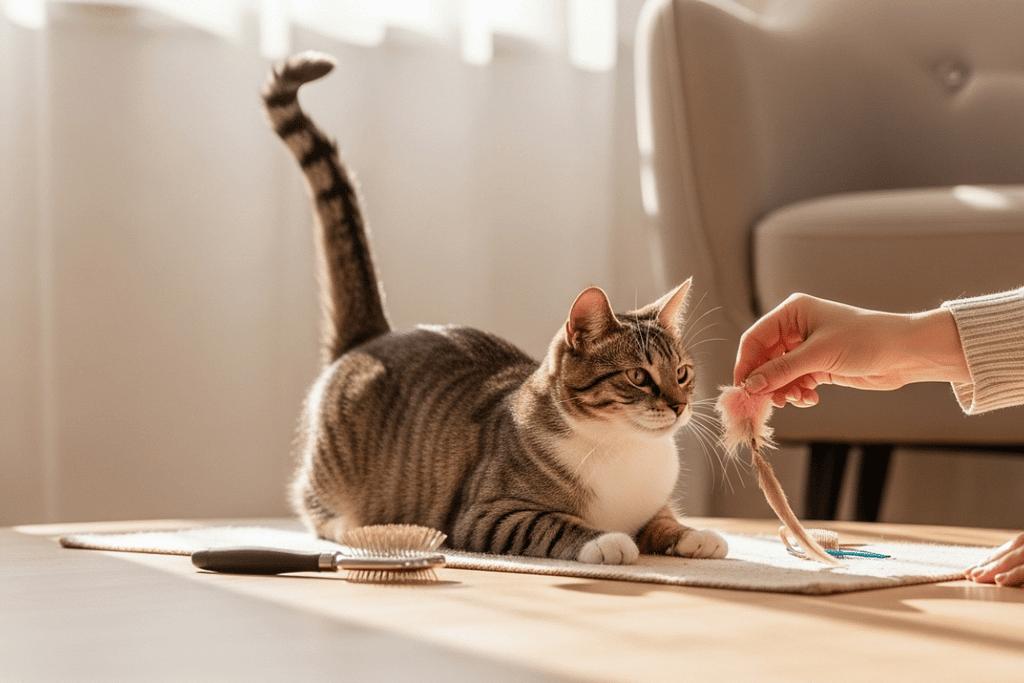
The cat interaction method is a simple 7-step system to prevent bites and overstimulation during petting, play, and grooming. You check a quick baseline (tail, ears, eyes, whiskers), use a 15-second go/no-go test, monitor every 15–30 seconds, pause at the first sign of tension, and end the session positively to build trust and safety.
? Your Cat Isn’t Unpredictable. You’re Missing the Conversation.
If you’ve ever thought:
- “My cat bites out of nowhere.”
- “She was purring — why did she suddenly attack?”
- “He likes affection… until he doesn’t.”
…you’re not alone.
The issue isn’t your cat — and it’s not you.
The issue is that most guardians interact using guesswork, not observation.
They:
- Approach whenever they feel like it
- Pet until something “feels off”
- Get bitten
- Feel confused or hurt
- Avoid interacting
- Try again another day… repeating the same cycle
This method breaks that cycle by giving you a real-time decision system.
It’s not training.
It’s not behavior modification.
It’s not desensitization.
? It’s a system to read your cat’s signals as they happen — and act accordingly.
? What This Method Actually Is
This method is:
- A framework for real-time reading
- A way to understand your cat’s tolerance window
- A system for preventing overstimulation
- A structure that teaches you when to start, when to pause, and when to stop
- A method to make interactions predictable and safe
This method teaches you how to:
- Check signals before approaching
- Detect tension 5 seconds before a bite
- Pause at the right moment
- Stop before your cat feels trapped
- End interactions positively
- Track patterns to build trust
When you read better, your cat behaves better — without you ever needing to “fix” anything.
? Who This Method Is For
This system is ideal for guardians who:
✔ Experience “surprise” bites
✔ Have cats who tolerate petting for only 1–3 minutes
✔ Have cats who escalate during play
✔ Feel anxious about grooming
✔ Want longer, calmer interactions
✔ Want to prevent overstimulation
✔ Want to understand their cat’s limits
✔ Want a repeatable method they can use daily
? Who Should NOT Start With This Method
Use a different method first if your cat:
- Hides all day
- Shows aggression even without interaction
- Runs from all attempts at contact
- Has chronic meowing, stress signals or litter box issues
? In those cases, begin with the Daily Baseline Method or Problem Diagnosis Method.
? The 7-Step Cat Interaction Method
A real-time reading system used before, during, and after every interaction.
? Step 1 — Quick Baseline Check (5 seconds)
From 5–10 feet away, check four critical signals:
Tail
- High & soft → +1
- Horizontal → +1
- Low/twitch → 0
- Tucked/puffed/lashing → STOP
Ears
- Forward → +1
- Sideways → 0
- Flattened → STOP
Eyes
- Soft → +1
- Wide → 0
- Dilated in normal light → STOP
Whiskers
- Relaxed → +1
- Forward → 0
- Pulled back → STOP
If your cat is busy (grooming, hunting, staring outside), wait.
This 5-second scan determines everything.
? Step 2 — Score the Signals (5 seconds)
- ? 4–5 points = GO
- ? 2–3 points = proceed cautiously
- ? 0–1 points = stop
- Any STOP signal overrides everything
Think:
“Today’s score: 5/5. Green light.”
? Step 3 — Consent-Based Approach (5 seconds)
Approach:
- From the side
- Slowly
- At the cat’s level
- With hand low, palm-down
- Offering space for the cat to sniff
Consent signals:
- Sniff + lean in
- Cheek rub
- Slow blink
Neutral:
- Sniffs but doesn’t lean → wait
No:
- Pulls away
- Ears back
- Hisses or growls
If the cat doesn’t lean in, you do NOT have consent.
? Step 4 — Start in Low-Trigger Zones & Establish Rhythm
Start in:
- Head
- Chin
- Cheeks
- Behind the ears
After 1–2 minutes (if signals stay positive), you may move to:
- Shoulders
- Sides
- Back
Avoid: belly, tail base, paws, legs.
Monitoring rhythm:
Every 15–30 seconds, glance at:
- Tail
- Whiskers
- Ears
- Eyes
- Body tension
Just like checking mirrors while driving — you don’t stop, you glance.
? Step 5 — The Real-Time Pause Rule
First sign of tension = pause your hand for 5 seconds.
Tension signals include:
- Tail flicks or speeds up
- Whiskers pull back
- Ears rotate sideways
- Eyes dilate suddenly
- Body stiffens or freezes
- Skin ripples
- Cat looks at your hand
- Purring stops or changes tone
If cat relaxes → continue briefly
If cat stays tense → end session
Two pauses = end immediately.
Your cat’s tolerance is done.
This step prevents 95% of petting-induced bites.
? Step 6 — Positive Exit Strategy
Always end:
- BEFORE tension escalates
- BEFORE your cat asks you to stop
How to end:
- Slow your hand
- Give 2–3 gentle strokes
- Say softly: “All done.”
- Offer a treat
- Stand and move away calmly
Treats teach predictability and safety.
If a bite already happened:
- Stop immediately
- Don’t punish
- Give space
- Reflect which signals you missed
? Step 7 — Post-Interaction Reflection (30 seconds)
Log:
- Duration
- First tension sign
- Where you were touching
- Session quality: green / yellow / red
- What you’ll adjust next time
Patterns appear within 7–14 days:
- “My cat tolerates head petting for 5 minutes.”
- “My cat tolerates back petting for only 2 minutes.”
- “Baseline of 3/5 = short session.”
This creates predictability.
| Signals | Meaning | Recommended Immediate Action |
|---|---|---|
| Flattened ears | Fear or defensive aggression; the cat feels threatened. | Give space, avoid eye contact, remove stressor if safe. |
| Slow blink | Relaxation and trust. | Return the slow blink; offer gentle petting if they approach. |
| Tail puffed & bristled | High arousal, fear, or fight-or-flight mode. | Back away calmly and give the cat a safe exit. |
| Wagging tail tip | Irritation or focused attention. | Pause interaction, observe, redirect with a toy if needed. |
| Exposed belly | Relaxation or trust, but not always an invitation to touch. | Check the rest of the body language; avoid touching if tense. |
| Hunched, hiding | Stress, illness, or pain. | Reduce handling; monitor; consult a vet if it continues. |
? Mini Cases
Case 1 — Preventing a Bite
Luna’s tail tip flicks → Maria pauses → Luna relaxes → session continues briefly → Maria ends early → treat.
Zero bites.
Case 2 — Grooming Without Stress
Milo’s whiskers pull back after nail #2 → Tom stops & treats.
Next week: Milo accepts 3 nails.
Trust preserved.
? Context-Specific Protocols
❤️ Petting Protocol
- Baseline must be green
- Start at head/chin
- Monitor tail
- Pause rule
- End before escalation
? Play Protocol
Watch for over-arousal:
- Hard tail lashing
- Full-body pounces
- Redirecting to hands
- Huge pupils in normal light
Cooldown: slow toy → allow catch → treat.
✂️ Grooming Protocol
Micro-sessions:
- 1–2 nails only
- 5–10 brush strokes
- Treat every step
- Stop at first tension
? This Method Creates Predictability, Safety & Trust
Within 1–2 weeks:
✔ No more surprise bites
✔ Longer, calmer interactions
✔ Easier grooming
✔ Safe, predictable play
✔ A cat who trusts you to respect boundaries
? Want to Go Deeper Into Feline Behavior?
? Read Understanding Cat Body Language Signals
Your cat’s age changes how these signals look.
? Cat Body Language Across Life Stages: From Kitten to Senior →
Learn:
- How kittens communicate differently
- How adult signals stabilize
- The subtle shifts in senior cats
- Early signs of cognitive decline (CDS)
- When “normal” behavior actually means discomfort
? Conclusion — When You Read Better, Your Cat Behaves Better
This method doesn’t fix your cat — it fixes the interaction system.
When you read early signals:
- Your cat never needs to escalate
- You never get bitten
- Trust grows effortlessly
Your cat is always communicating.
Now, you finally know how to listen.
Read more about how science explains your cat’s body language. Click here.

With the sensitivity of one who loves deeply, Sissi writes stories celebrating the animal world. Her felines Estrela and Safira illuminate her days, while Pete and Gabrich live eternally through her words. Every piece she writes is a love letter to the companions who make life truly meaningful.