
Domestication and Environmental Mismatch in Cats: Why Your Cat Doesn’t Fully Fit Indoors
Domestic cats live in human environments, but their behavior is still shaped by ancestral survival systems. Differences between natural habitats and indoor homes—such as space, stimulation, and rhythms—can create a mismatch that influences how feline behavior appears in daily life.
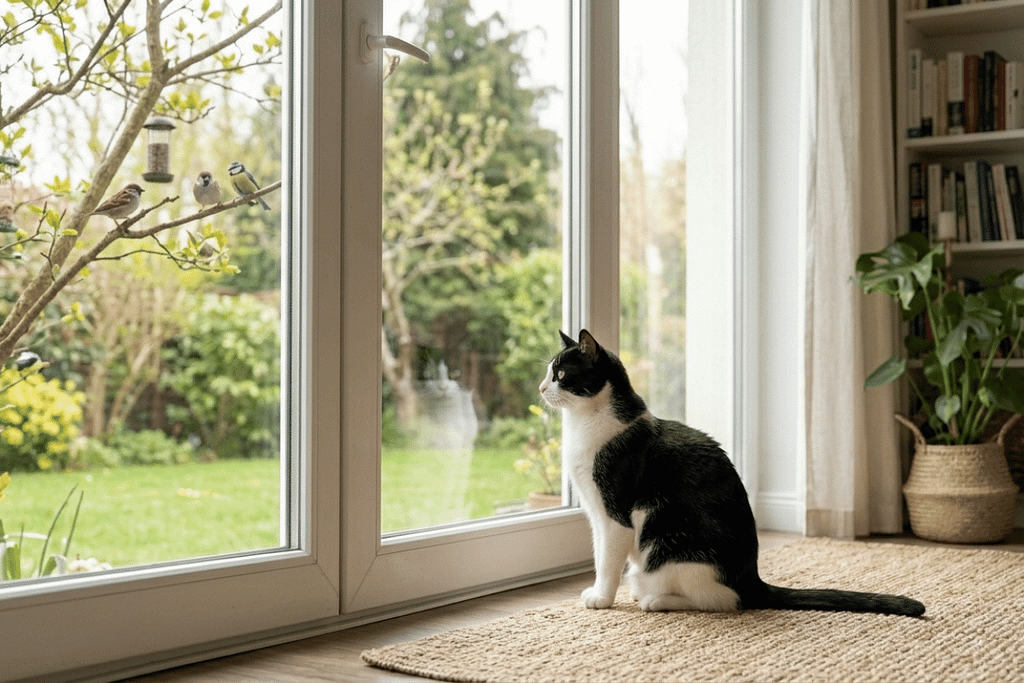
There’s a feeling that’s hard to explain at first.
Your cat is safe.
Fed.
Protected.
Everything is… technically right.
And still, sometimes, something feels slightly off.
They run suddenly.
Pause in unusual places.
React to things you don’t notice.
Ignore things that seem important.
And the question doesn’t come as criticism.
It comes quietly:
Why does my cat act like it doesn’t fully fit inside my home?
This is where something subtle begins to appear.
Not a problem.
But a difference in origin.
? Cats adapted to humans — but didn’t fully change
Unlike dogs, cats were not extensively reshaped through controlled breeding to align with human expectations.
They followed a different path.
Over time, wildcats moved closer to human settlements.
Not because they were trained.
But because it worked.
Food was available.
Shelter was nearby.
Risk could be managed.
This process is often described as self-domestication.
Cats adapted to living near humans.
But they retained much of their original behavioral structure.
In daily life, this often looks like:
- strong hunting instincts, even without need
- sensitivity to movement and sound
- preference for observation and distance
- independent spatial behavior
Nothing here is outdated.
It’s simply still present.
And naming this doesn’t mean your cat doesn’t belong.
It means their behavior didn’t start in the same environment they live in now.
? The environment changed faster than the behavior
Now imagine this:
You are placed in a space that is safe…
But very different from what your body expects.
Everything is controlled.
Predictable.
Contained.
You adapt.
But not everything aligns perfectly.
This is something similar to what happens with cats.
Modern homes often differ from natural environments in ways that are subtle — but significant.
They can:
- compress territory into smaller spaces
- reduce environmental variation
- change natural feeding rhythms
- alter light cycles
In daily life, this often looks like:
- increased indoor activity bursts
- attention to small movements or changes
- restlessness at certain times
- patterns that don’t match human routines
Nothing dramatic happens — and that’s why it feels confusing.
⚖️ Mismatch doesn’t mean failure
It’s easy to interpret this difference as a problem.
Something to fix.
Adjust.
Correct.
But this isn’t about something being wrong.
This doesn’t mean your home is inadequate.
And it doesn’t mean your cat is not adapting.
It simply means:
two systems are overlapping…
without being identical.
This is usually where people pause.
Because the expectation shifts.
? When instinct meets a different environment
Instinctive behaviors were shaped under conditions where:
- space was open
- resources were scattered
- activity was linked to opportunity
- light followed natural cycles
Indoor environments change those conditions.
In daily life, this often looks like:
- hunting behaviors without prey
- exploration without variation
- activity bursts without clear triggers
- attention directed toward small environmental cues
These behaviors are not misplaced.
They are expressions adapting to a different context.
? Rhythm changes — but the system remains
One of the most subtle differences happens in time.
Natural environments provide:
- shifting light
- changing stimuli
- irregular opportunities
Indoor environments tend to be:
- consistent
- predictable
- structured around human routines
In daily life, this often looks like:
- activity at unexpected hours
- alertness when the environment is quiet
- anticipation of events that don’t align perfectly
Nothing dramatic happens — and that’s why it’s easy to overlook.
? When behavior feels “too much” or “out of place”
Sometimes the mismatch becomes more visible.
Not extreme.
Just… noticeable.
A behavior that repeats.
A pattern that feels excessive.
A reaction that seems disproportionate.
This doesn’t mean your cat is difficult.
And it doesn’t mean something is broken.
It often means:
a behavioral system is active… without the conditions it evolved for.
In daily life, this can look like:
- repeated attempts to engage with limited stimuli
- persistence in certain behaviors
- heightened sensitivity to small changes
- difficulty settling at specific times
This is explored more deeply in Behavioral Frustration: When Instinct Has No Completion — where the mismatch becomes more visible.
? When understanding replaces confusion
At some point, something softens.
The question changes.
From:
Why is my cat acting like this?
To:
What part of this comes from a different environment?
And that shift matters.
Because it removes a quiet pressure:
- the need to interpret everything as intentional
- the feeling that something is wrong
- the expectation that behavior should fully align
You don’t need to recreate a natural environment.
You don’t need to eliminate these differences.
You only need to recognize:
your cat is living in your home…
but not entirely shaped by it.
And that doesn’t create distance.
It creates context.
Nothing here asks you to change everything.
Only to see that what feels out of place…
often comes from something that was never meant to fit perfectly.
Nothing here asks you to feel less.
Only to feel with less pressure.

With the sensitivity of one who loves deeply, Sissi writes stories celebrating the animal world. Her felines Estrela and Safira illuminate her days, while Pete and Gabrich live eternally through her words. Every piece she writes is a love letter to the companions who make life truly meaningful.