
Are You Imagining the Bond With Your Cat — or Noticing Something Real?
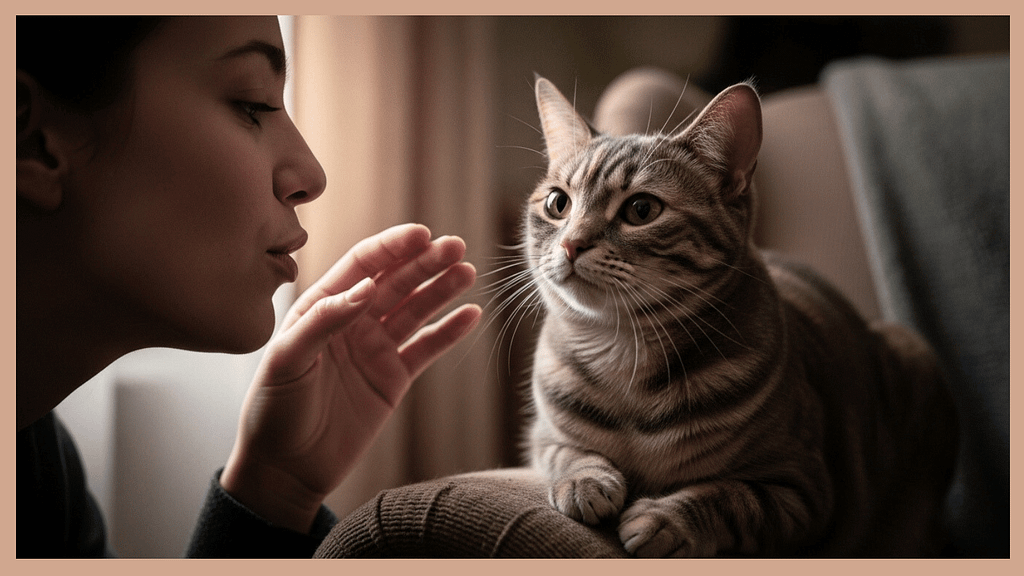
Sometimes it feels like your cat understands how you’re feeling — but that sense doesn’t come from imagination alone. Cats respond to changes in tone, movement, and behavior. When an interaction starts to matter between you, the bond is real — even if each of you responds for different reasons.
Many cat guardians experience a quiet, familiar moment.
You’re tired. Emotionally full. Maybe overwhelmed — though nothing obvious is happening.
Your cat enters the room.
Stays nearby.
Doesn’t demand attention — just remains.
And a thought appears:
“Is my cat responding to how I’m feeling… or am I reading into this?”
This article exists for that exact pause — not to prove anything, but to clarify what’s actually happening between you and your cat.
?When We Notice Our Cats More Than Usual
On emotionally neutral days, many feline behaviors pass unnoticed.
Your cat follows you.
Sits nearby.
Watches quietly.
But during moments of stress, sadness, or emotional fatigue, those same behaviors suddenly feel important.
This happens because emotional states change how humans pay attention.
When we feel vulnerable, our awareness sharpens. We notice tone, movement, and proximity more closely — including our cat’s behavior.
That doesn’t mean the experience is fake.
It means personal interpretation naturally becomes part of the experience.
?Are You Projecting — or Responding?
The word projection often sounds dismissive.
As if it means imagination or self-deception.
In psychology, however, projection simply describes placing our own emotions onto another being.
And in everyday life, this process is far more gentle than it sounds.
?What Projection Looks Like in Daily Life
Here’s a simple, common example.
You feel emotionally comforted by your cat.
Because of that feeling, you begin to speak more softly.
Your movements slow down.
The way you act becomes calmer.
Your cat hears your gentler voice and senses a quieter environment.
For a cat, that signals safety.
So your cat relaxes — staying nearby, settling in, or even purring.
The result:
You feel as though your cat “consoled” you.
Your cat experiences you as a calm, safe human.
The bond happened for both of you —
even though the reason each of you responded was different.
That doesn’t make the connection imaginary.
It explains how it formed.
?What Cats Actually Notice
Cats may not understand emotions as concepts — but they notice change.
They respond to:
- differences in movement
- changes in pacing
- shifts in tone
- alterations in routine
When your emotional state changes how you move, speak, or behave, your cat has new information to respond to.
So the more useful question isn’t:
“Does my cat know how I feel?”
It’s:
“What changed — and how is my cat responding to that change?”
For a deeper explanation of this distinction between emotional meaning and behavioral response, you can explore
Can Cats Sense Human Emotions — or Are They Reacting to Something Else?
⚠️When Emotional Meaning Turns Into Pressure
Emotional meaning only becomes heavy when it turns into expectation.
This often happens quietly:
- expecting comfort on demand
- feeling rejected when your cat chooses distance
- interpreting absence as emotional failure
Cats don’t operate on obligation.
They operate on choice.
Their presence feels meaningful precisely because it isn’t guaranteed.
Recognizing this doesn’t weaken the bond.
It protects it — from pressure your cat never agreed to carry.
?Why Inconsistency Creates Doubt
Many guardians begin questioning themselves after noticing contrast.
One day, the cat stays close.
Another day, the cat keeps distance.
That inconsistency can feel personal.
But closeness and distance often reflect regulation — not affection levels.
In simple terms, regulation is how a cat adjusts its closeness based on comfort, stimulation, and energy in the moment.
Cats move in and out of proximity to feel balanced and safe, not to send emotional messages.
Distance doesn’t cancel connection.
It simply expresses choice.
f this pattern sounds familiar,
Why Does My Cat Act Differently When I’m Sad or Stressed?
looks more closely at how cats adjust their behavior during emotionally charged moments.
?So… Are You Imagining It?
Not entirely.
But not in the way the doubt suggests.
Your cat notices change.
You notice response.
A sense of importance forms through the way you respond to each other.
That sense isn’t proof — and it isn’t delusion either.
It’s the layer humans naturally add when relating to quiet companions who pay close attention.
Understanding that layer doesn’t make the bond weaker.
It makes it lighter.
?You Don’t Need to Solve This
If you’ve ever wondered whether you’re imagining your cat’s sensitivity, the answer doesn’t need to be absolute.
Your cat doesn’t need to recognize emotions as ideas to respond to change.
And you don’t need certainty to feel connected.
If this question keeps returning for you, it sits at the heart of a broader experience shared by many cat guardians.
? Why Does It Feel Like My Cat Knows How I’m Feeling?
explores that shared uncertainty with more emotional context.
Nothing here asks you to feel less —
only to feel with less pressure.
Sometimes trust lives exactly in that quiet middle.

With the sensitivity of one who loves deeply, Sissi writes stories celebrating the animal world. Her felines Estrela and Safira illuminate her days, while Pete and Gabrich live eternally through her words. Every piece she writes is a love letter to the companions who make life truly meaningful.