
Why Does It Feel Like My Cat Knows How I’m Feeling?
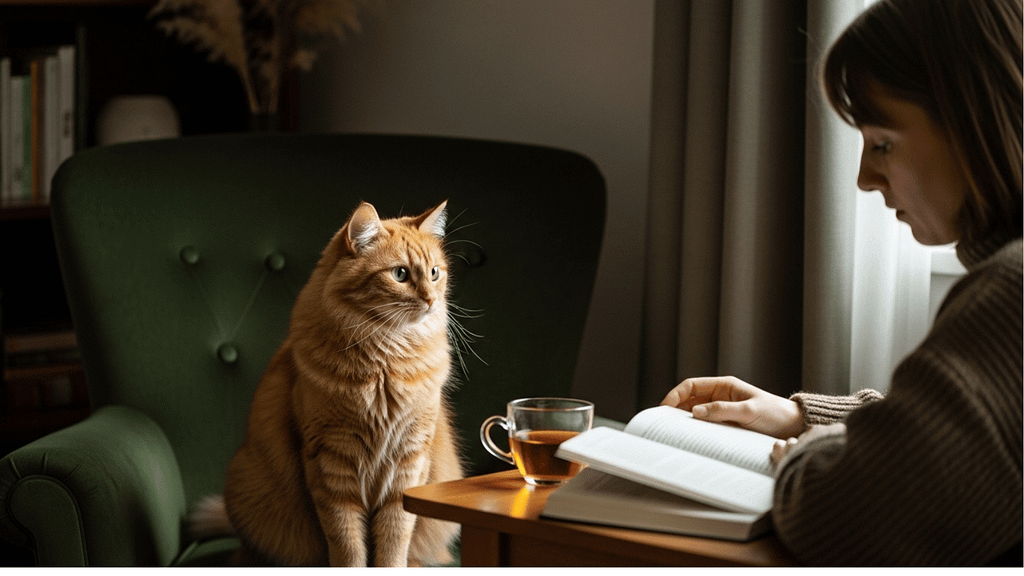
Cats don’t actually understand human emotions.
What they respond to are subtle changes in presence, routine, and environmental predictability.
When something about their human feels different, cats often adjust their proximity or behavior — creating the strong impression that they “know” how we’re feeling.
Cats don’t read human emotions the way humans do.
What they respond to are changes — in presence, routine, and predictability.
When something about their human feels different,
cats often adjust proximity or behavior.
That adjustment can feel like being noticed —
even without emotional understanding.
? Moments That Are Hard to Explain
There are moments with a cat that feel hard to explain without sounding irrational.
You’re quieter than usual.
Sitting longer.
Moving less.
And somehow, your cat appears.
Not demanding attention.
Not playful.
Just… present.
At other times, when your thoughts race or your energy sharpens,
that same cat chooses distance.
Watching from across the room.
Alert, but detached.
? Moments like these create a powerful impression:
“My cat knows how I’m feeling.”
It’s such a common experience that many people hesitate to say it out loud.
This feeling is often where people pause —
and where a larger question quietly begins wheter cats understand human emotions at all
— or whether they’re reacting to something more fundamental in their environment.
Can Cats Understand Human Emotions – or are they reacting to something else ?
Is it intuition?
Projection?
Or something real that doesn’t fit neatly into words?
➡️ This article exists for one purpose:
to normalize that feeling without turning it into a claim.
? Why This Feeling Is So Common
This sensation rarely comes from a single dramatic moment.
It builds slowly —
through repetition.
Cats live close to us not only physically,
but rhythmically.
They notice when we:
- wake up later
- sit still longer
- speak less, or more softly
- move differently through familiar spaces
Over time, this creates the sense of being “tracked.”
What strengthens the feeling is how cats respond.
No exaggeration.
No obvious feedback.
Their attention feels selective —
and humans naturally read selectivity as awareness.
That interpretation isn’t wrong.
It’s human.
? Feeling Noticed ≠ Being Understood
Here’s the distinction that keeps this grounded:
? Feeling understood
≠
? Being cognitively understood
Cats don’t need to recognize sadness or stress as named emotions
for their behavior to feel personal.
What matters is simpler:
Something about you has changed.
Your body is quieter.
Your movements are slower.
Your energy fills the room differently.
Cats are remarkably sensitive to change.
This is where many people quietly get stuck:
- If the cat responds, it must understand
- If it understands, it must be empathy
? That internal doubt — “am I imagining this?” — is explored more directly in
-Are You Imagining the Bond With Your Cat — or Noticing Something Real?
That uncertainty isn’t a flaw in the bond.
It’s where most interspecies relationships actually live.
? Why Sadness Often Feels Different From Stress
Many people notice something subtle but consistent:
Cats often feel more “supportive” during sadness
than during stress.
This doesn’t mean cats prefer sadness.
It means the two states look very different from the outside.
From a cat’s perspective:
- stillness can feel safe
- tension and erratic movement can feel uncertain
That contrast alone can shape how close — or distant —
a cat chooses to be.
? This difference is explored more closely in
Why Does My Cat Act Differently When I’m Sad or Stressed?
❤️ Presence, Distance, and Trust
One of the hardest experiences for cat guardians
is feeling close one day — and distant the next.
That inconsistency can feel personal.
But for cats, closeness and distance are forms of regulation.
Choosing space doesn’t cancel trust.
In many cases, it depends on it.
? This pattern of closeness and distance is explored further in
Why Does My Cat Get Closer Sometimes — But Stay Distant at Other Times?
? When Your Cat Notices Change
If it feels like your cat knows how you’re feeling,
you’re not strange for sensing that.
Living closely with another species creates shared rhythms
that don’t always translate cleanly into language or proof.
Cats may not recognize emotions the way humans do.
But they are deeply aware of change, presence, and stability.
Sometimes, that awareness is enough to feel seen.
Not because your cat understands why you feel the way you do —
but because they notice
that something about you isn’t the same.
And in a relationship built on choice rather than obligation,
that quiet noticing can feel profound.

With the sensitivity of one who loves deeply, Sissi writes stories celebrating the animal world. Her felines Estrela and Safira illuminate her days, while Pete and Gabrich live eternally through her words. Every piece she writes is a love letter to the companions who make life truly meaningful.