
Do Cats Learn Emotional Patterns Through Repetition and Routine?
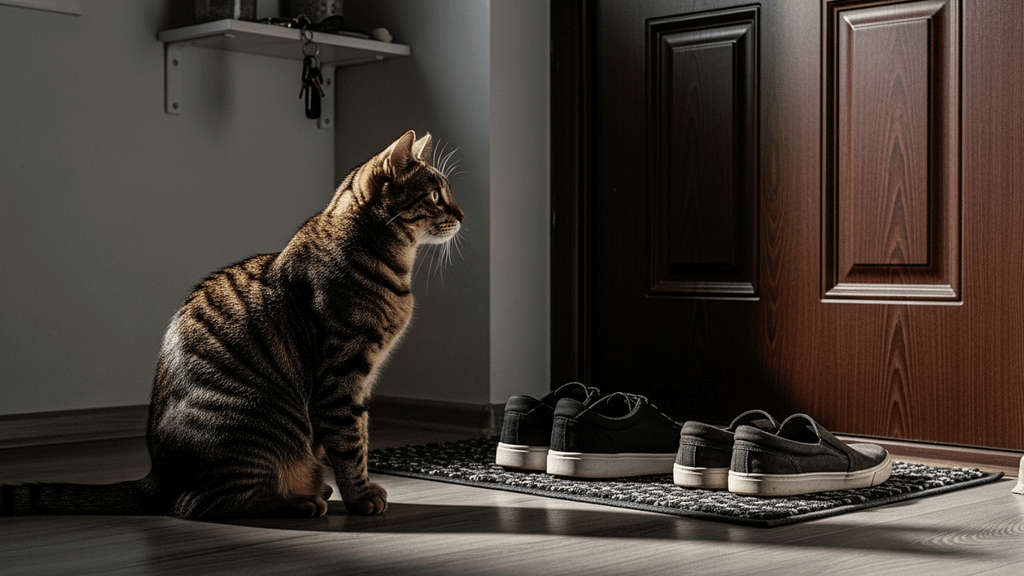
Cats don’t learn emotions as feelings — they learn sequences. Through repetition and routine, cats recognize what usually happens next. Over time, these familiar patterns help them anticipate change, not because they sense emotions, but because they know the order of events.
At some point, many cat guardians notice something curious.
Their cat seems to “know” what’s about to happen — sometimes before anything obvious changes.
Not because of mood.
But because the pattern is familiar.This can feel impressive, even emotional.
But what’s actually happening is something cats are very good at: learning routines.To understand this, we need to shift away from emotions and focus on repetition, building on the framework introduced in
How Can Cats Detect Changes in Human Emotions?
? Cats Learn Sequences, Not Feelings
Cats don’t learn emotions as concepts.
They learn what tends to happen next.Living with humans exposes cats to repeated sequences:
- specific sounds
- specific movements
- specific times of day
- specific outcomes
When the same elements appear together often enough, the cat links them into a pattern.
Over time, that pattern becomes predictable.From the cat’s perspective, this isn’t emotional insight.
It’s environmental memory.? Everyday Routines Cats Learn Easily
In daily life, this learning looks very ordinary.
For example:
- Every time a person puts on their shoes, it usually means they’re about to leave the house.
The cat may become alert, move toward the door, or wait nearby — not because of sadness, but because that sequence is familiar.- If the doorbell rings every morning at the same time and a specific person enters the home, the cat learns that pattern.
The cat may only run to the door when the bell rings in the morning — not in the afternoon or evening — because time is part of the sequence.- Evening routines are often the clearest.
A treat is given, lights dim, movement slows, and bedtime follows.
The cat may calmly go to the bed and wait, already anticipating the next step.These behaviors aren’t emotional predictions.
They’re routine recognition.? How Repetition Turns Signals Into Expectations
Single events don’t teach cats much.
Repetition does.When the same sequence happens again and again, cats begin to expect the outcome as soon as the early signals appear.
That’s why feline behavior can look anticipatory rather than reactive.
Nothing mystical is required — just consistency.
? Routine Is the Glue That Holds Patterns Together
Cats are especially sensitive to:
- time-based consistency
- repeated order of events
- predictable results
When routines stay stable, cats relax into them.
When routines shift, cats notice immediately.If certain emotional states regularly disrupt routines, cats don’t register the emotion — they register the change in sequence.
This is why long-term cohabitation matters more than any single dramatic moment.
? Why This Can Feel Like “Emotional Awareness”
From a human perspective, anticipation often feels like understanding.
When a cat waits by the door before anything “happens,” it can feel personal.
But that feeling comes from our interpretation — not from the cat’s motivation.Cats aren’t responding to inner emotional states.
They’re responding to patterns that have proven reliable over time.? Learning Also Explains Inconsistency
Pattern learning isn’t perfect.
If routines change, signals appear without their usual outcome, or schedules shift, cats adjust.
This can look like inconsistency:
- closeness one day
- distance the next
But inconsistency isn’t confusion.
It’s recalibration.Cats are updating their expectations based on new information.
? What This Understanding Changes
Seeing feline behavior through the lens of learning makes things clearer — and lighter.
Your cat isn’t reading emotions.
They’re navigating a world that has become familiar through repetition.That doesn’t make the relationship mechanical.
It makes it grounded in shared life.Over time, routines create predictability.
Predictability creates safety.
And safety is what allows cats to relax, approach, or step back when needed.Sometimes, what feels like emotional insight is simply the quiet intelligence of a cat who knows what usually comes next.

With the sensitivity of one who loves deeply, Sissi writes stories celebrating the animal world. Her felines Estrela and Safira illuminate her days, while Pete and Gabrich live eternally through her words. Every piece she writes is a love letter to the companions who make life truly meaningful.