
? Norwegian Forest Cat – The Majestic Viking of the Feline World ?
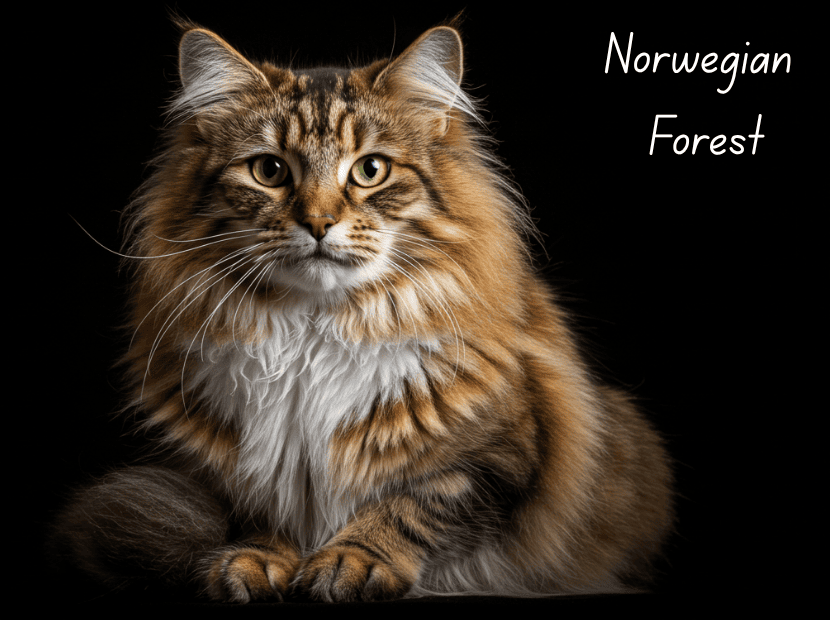
The Norwegian Forest Cat (Norsk Skogkatt), affectionately called “Wegie,” is a large, semi-long-haired natural breed from the cold forests of Norway. Known for its majestic size, thick water-resistant coat, and wild appearance, this robust yet gentle feline served as a hunter on Viking ships. Wegies are loyal, intelligent companions with moderate affection, preferring to sit near rather than on laps. They require brushing once or twice weekly and live 12-16 years on average, with some reaching 18-20 years with proper care.
Norwegian Forest Cat key characteristics:
- Large breed: 6-9 kg males, 4-6 kg females
- Thick, double-layered, water-resistant coat with prominent mane
- Loyal, intelligent, and moderately affectionate temperament
- Brush 1-2 times weekly (daily during shedding)
- Prone to hypertrophic cardiomyopathy (HCM) and hip dysplasia
- Lifespan: 12-16 years (up to 18-20 with good care)
The Norwegian Forest Cat (Norsk Skogkatt), affectionately nicknamed “Wegie,” is an ancient and natural breed, originating from the cold forests of Norway. Known for its wild appearance, large and majestic size, and thick, water-resistant coat, this robust yet gentle feline served as a hunter on Viking ships.
This guide explores the behavioral characteristics, social tendencies, physical traits, and essential care of the Norwegian Forest Cat, helping you understand what makes this “gentle giant” so special.
? I. Personality and Behavioral Characteristics of the “Wegie” ?
The Norwegian Forest Cat is known for being a loyal, balanced companion with moderate affection.
- Vocalization Tendency: It is generally a quiet cat, with a low tendency for loud or demanding meows. They often communicate through soft chirps and trills, especially when greeting their owners or requesting attention.
- Intelligence and Memory: Extremely intelligent, curious, and observant. They are great problem-solvers, quickly learning tricks, commands, and routines, and are fascinated by activities that stimulate their hunter’s mind.
- Affection Towards Humans: They form strong bonds with the family but display balanced affection: they enjoy being near and interacting, often following owners around the house, but are generally not “clingy” lap cats, preferring to sit next to their human on the sofa.
- Activity Level: They are moderately active and very athletic cats. They love to climb and explore vertical spaces, making tall scratching posts and cat trees essential.
- Patience with Children and Other Pets: Due to their calm, gentle, and tolerant nature, they are excellent companions for families with children and usually get along well with most other pets, including dogs.
? II. Physical Characteristics of the Norwegian Forest Cat ?
The Norwegian Forest Cat is a natural and robust breed, known for its large size and thick coat, perfectly adapting it to harsh winters.
| Characteristic | Detail |
|---|---|
| Size | One of the largest domestic cats. Robust, muscular, powerful body structure. |
| Weight | Males: 6–9 kg (13–20 lbs) Females: 4–6 kg (9–13 lbs) |
| Height & Length | Height: 30–35 cm. Length: up to 75 cm including tail. Males are noticeably larger and more robust. |
| Coat |
Medium to long, thick double coat with water-resistant top layer and dense undercoat. Soft “windswept” texture. Shorter on shoulders and neck; longer on stomach, flanks, and back legs. Prominent ruff (lion-like mane), full breeches, heavy seasonal shedding. |
| Colors & Patterns |
Over 75 accepted colors/patterns.
Common: brown tabby, silver tabby, red, black, white, cream, blue, golden. Patterns: solid, tabby (classic/mackerel/ticked), bicolor, tricolor. Not accepted: chocolate, lilac, pointed patterns. |
| Distinguishing Features | Prominent ruff; lynx-tipped ears; ear and toe tufts (for warmth); dense fur adapted for cold climates. |
| Eyes | Large, almond-shaped, wide-set. Colors: amber, gold, green, or copper. Some white individuals may have blue or odd eyes (heterochromia). |
| Head Shape | Large, triangular wedge with high cheekbones, a strong jawline, and pronounced whisker pads. |
| Ears | Large, tall, triangular, slightly rounded tips. Lynx tips and long inner hair for protection. Slightly forward-facing, giving alert “wild” expression. |
| Tail | Long, wide at the base, bushy and flowing like a plume. Carried high while walking; wraps around body in cold weather. |
| Physical Maturity | Slow maturing natural breed. Full size and coat development achieved at 3–5 years. Kittens often appear large yet slightly “gangly.” |
| Life Expectancy | 12–16 years on average; some live up to 18–20 years with proper care. |
The Norwegian Forest Cat thrives in cooler climates, loves climbing, and benefits from weekly grooming, especially during seasonal shedding. Their calm yet adventurous spirit makes them cherished family companions.
? III. Essential Care and Health ?
Essential Care Tips
Despite the long coat, the Norwegian Forest Cat is surprisingly low-maintenance. Brushing once or twice a week is usually sufficient, increasing daily during shedding periods.
Common Health Issues
The breed is considered robust but has a predisposition to certain genetic conditions:
- Hypertrophic Cardiomyopathy (HCM): A common heart disease in cats.
- Hip Dysplasia: A joint problem, more common in large breeds.
- Glycogen Storage Disease Type IV (GSD IV): A severe metabolic disease, which can be screened for with a DNA test.
Ideal Nutrition
A high-quality diet with a high content of animal protein is crucial to support their large size and muscular structure.
? Interested in the Charming Himalayan?
Learn about their peaceful personality and their Persian–Siamese origins:
Himalayan – Breed Guide & Essential Care
❓ IV. Frequently Asked Questions about the Norwegian Forest Cat ?
u003cstrongu003e1. Why is it Called the u0022Norwegian Forest Catu0022?u003c/strongu003e
The name is literal. The breed naturally evolved in the forests of Norway for thousands of years, adapting to survive the harsh winters. The original Norwegian name is u003cemu003eNorsk Skogkattu003c/emu003e, which translates directly to u0022Norwegian Forest Cat.u0022
u003cstrongu003e2. What is the Norwegian Forest Cat’s Connection to the Vikings?u003c/strongu003e
It is believed that the ancestors of the Norwegian Forest Cat were brought to Norway by navigators and u003cstrongu003eVikingsu003c/strongu003e around the 11th century. They were essential hunters, keeping the ships free of rodents and protecting supplies during long sea voyages.
u003cstrongu003e3. Does the Norwegian Forest Cat Have a Link to Norse Mythology?u003c/strongu003e
Yes. The Norse goddess of love and fertility, u003cstrongu003eFreyjau003c/strongu003e, was said to have her chariot pulled by two large cats, and legend held that even the god Thor could not lift one of these cats. This legend gives the breed a mythical status.
u003cstrongu003e4. Is the Norwegian Forest Cat Hypoallergenic like the Siberian?u003c/strongu003e
No. Unlike the Siberian, the Norwegian Forest Cat is not generally considered hypoallergenic. It produces normal levels of the Fel d 1 protein (the main cause of allergies in humans) and sheds heavily during seasonal changes.
u003cstrongu003e5. Do u0022Wegiesu0022 Enjoy Heights and Sitting on Laps?u003c/strongu003e
Yes, they u003cstrongu003eenjoy heightsu003c/strongu003e as they are natural climbers, loving to observe from elevated spots. However, they are generally u003cstrongu003enot constant lap catsu003c/strongu003e, preferring to sit next to or near their humans, often due to their dense coat which can cause them to overheat on a lap.
u003cstrongu003e6. What Does the Nickname u0022Wegieu0022 Mean?u003c/strongu003e
u0022Wegieu0022 is an affectionate and popular nickname used in the US to shorten the breed’s name: u003cemu003eNorwegian Forest Catu003c/emu003e.
u003cstrongu003e7. Is There a Difference Between the Norwegian Forest Cat and the Maine Coon?u003c/strongu003e
While both are large, semi-longhaired breeds with a natural origin in cold climates, they have notable differences: the Norwegian has a perfectly u003cstrongu003etriangular headu003c/strongu003e and a more u003cstrongu003eoily, water-resistant coatu003c/strongu003e, while the Maine Coon has a squarer head and is typically more u0022cuddlyu0022 and demanding of lap time.
8. u003cstrongu003eIs the Norwegian Forest Cat a natural breed or man-made?u003c/strongu003e
It is a u003cstrongu003enatural breedu003c/strongu003e, not selectively created. The breed developed naturally in the forests of Norway and northern Europe, evolving traits to survive cold climates and rugged terrain.
9. u003cstrongu003eAre there any books featuring the Norwegian Forest Cat?u003c/strongu003e
The Norwegian Forest Cat is often referenced in u003cstrongu003echildren’s books and folkloreu003c/strongu003e in Scandinavia. For example: In u003cstrongu003eNorse mythologyu003c/strongu003e, cats were associated with the goddess u003cstrongu003eFreyjau003c/strongu003e, and these cats were said to pull her chariot. u003cbru003e
10. u003cstrongu003eWhat are some unique characteristics of this breed?u003c/strongu003e
Extremely u003cstrongu003eadapted to cold climatesu003c/strongu003e with thick double coats and bushy tails.u003cbru003eKnown for u003cstrongu003elynx-like ear tuftsu003c/strongu003e and expressive almond-shaped eyes.u003cbru003eAgile climbers and natural hunters, retaining strong instincts from forest life.u003cbru003eVery u003cstrongu003efriendly, social, and intelligentu003c/strongu003e, often described as dog-like in loyalty.
11. u003cstrongu003eHow rare is the Norwegian Forest Cat?u003c/strongu003e
The breed is u003cstrongu003emoderately rareu003c/strongu003e, more common in Europe, especially in Scandinavia, than in North America. It is recognized by major cat associations like CFA, FIFe, and WCF.
12. u003cstrongu003eWhat are some fun curiosities about the Norwegian Forest Cat?u003c/strongu003e
Their u003cstrongu003emane and ruffu003c/strongu003e can give them a “lion-like” appearance.u003cbru003eThey are u003cstrongu003eexcellent climbersu003c/strongu003e and love u003cstrongu003ehighu003c/strongu003e u003cstrongu003eplacesu003c/strongu003e.u003cbru003eDespite their large size, they are known for being u003cstrongu003egentle and affectionateu003c/strongu003e.u003cbru003eSome have u003cstrongu003esurvivedu003c/strongu003e extreme Scandinavian u003cstrongu003ewintersu003c/strongu003e, even u003cstrongu003eoutdoorsu003c/strongu003e, thanks to their thick u003cstrongu003ecoatsu003c/strongu003e and strong build.
Explore veterinary and professional grooming resources: The ASPCA, AAFCO, and certified cat grooming professionals provide extensive guidance on feline coat care and health. Discover professional resources on long-haired cat care — access expert advice on nutrition, grooming techniques, and breed-specific health management.

Long-Haired Cats — Breeds, Characteristics & Essential Care
Majestic coats, gentle personalities, and special grooming needs — discover how to care for Persian, Maine Coon, Ragdoll and other long-haired breeds so they thrive and shine.

With the sensitivity of one who loves deeply, Sissi writes stories celebrating the animal world. Her felines Estrela and Safira illuminate her days, while Pete and Gabrich live eternally through her words. Every piece she writes is a love letter to the companions who make life truly meaningful.