
Why Cats Sleep So Much: An Evolutionary Explanation
Why cats sleep so much is closely connected to feline energy conservation and fragmented sleep cycles. Cats evolved as small predators that conserve energy during long recovery periods while remaining ready for rapid bursts of movement, alertness, and hunting behavior.
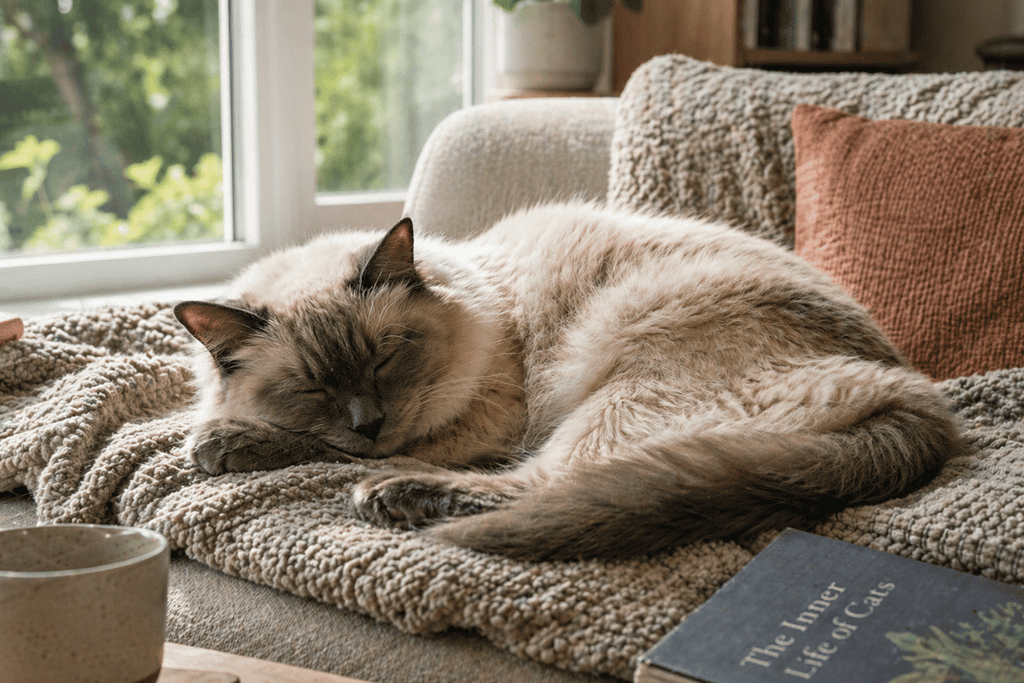
Many cat owners eventually ask the same question:
Why do cats sleep so much?
A cat may spend most of the day resting in the same location, barely moving for hours before suddenly becoming alert, active, or intensely playful for a short period of time.
Compared to human routines, this can feel excessive.
But feline sleep is not organized the same way human sleep is.
Cats evolved around a behavioral strategy built on energy conservation, rapid responsiveness, and short periods of intense activity. Long periods of rest are not separate from that system — they are what make the system possible.
Understanding why cats sleep so much begins with understanding how feline physiology balances recovery, readiness, and energy efficiency throughout the day.
💤 Why Cats Sleep So Much Is Connected to Energy Conservation
Cats are biologically designed to conserve energy rather than spend it continuously.
As small predators, they evolved in environments where energy needed to be used carefully. Hunting required explosive movement, rapid acceleration, and focused bursts of muscular activity — all of which demanded efficient recovery afterward.
Instead of maintaining steady activity all day, cats alternate between:
- long recovery periods,
- short bursts of movement,
- alert observation,
- rapid neurological activation.
This is one reason why cats sleep all day and then suddenly become active for a few minutes.
Sleep is not inactivity replacing behavior.
It is part of how feline behavior is organized.
This broader structure becomes easier to recognize in Cat Energy Cycles Explained, where cats alternate between activation, recovery, and energy conservation throughout the day.
🧬 The Evolutionary Explanation Behind Feline Sleep
Feline sleep patterns were shaped by predatory evolution.
Unlike animals built for endurance movement, cats developed around short periods of high-intensity activity followed by recovery. This strategy helped conserve metabolic resources while maintaining readiness for hunting opportunities.
Research in animal physiology suggests that many predators organize behavior around energy efficiency rather than continuous movement.
This is why domestic cats still display:
- extended resting periods,
- sudden activation bursts,
- rapid transitions between stillness and alertness,
- short windows of focused activity.
Even indoor cats continue to follow these inherited biological patterns.
What appears excessive from a human perspective is often normal feline energy organization.
👁️ Feline Sleep Is Fragmented, Not Fully Disconnected
One of the biggest misunderstandings about cat sleep is assuming it always resembles deep human sleep.
In reality, feline sleep often exists on a spectrum between light rest, alert stillness, and deeper recovery states.
This fragmented sleep structure allows cats to:
- conserve energy efficiently,
- remain environmentally aware,
- respond rapidly to stimulation,
- wake quickly when necessary.
You may notice:
- ear movements during rest,
- partial eye opening,
- immediate responsiveness to sound,
- sudden transitions from sleep to alertness.
This does not mean cats are never deeply asleep.
It means their nervous systems are adapted for rapid responsiveness even during recovery periods.
⚡ Why Cats Wake Up So Quickly
Many cats can move from complete stillness to full alertness within seconds.
This rapid transition is part of feline survival physiology.
Because cats evolved around short activation windows, the nervous system remains prepared for fast behavioral shifts when environmental stimulation crosses the right threshold.
This is why cats often:
- react instantly to unfamiliar sounds,
- wake quickly during household movement,
- transition rapidly from sleep to activity.
The body is resting — but readiness is still being maintained underneath the stillness.
This same pattern connects closely to Energy Economy in Cats, where rest supports future activation rather than functioning as simple inactivity.
🌙 Why Cat Sleep Patterns Differ From Human Sleep
Humans often organize sleep into one long consolidated period.
Cats do not.
Feline sleep cycles are distributed across the day in multiple shorter phases shaped by:
- biological rhythms,
- environmental stimulation,
- activity windows,
- recovery needs.
This is why many cats:
- nap repeatedly throughout the day,
- become active at dawn or dusk,
- wake briefly between rest periods,
- sleep lightly in changing environments.
These rhythms are strongly connected to the Feline Biological Clock, where circadian timing systems regulate alertness, rest, and activity across the day.
The difference is not dysfunction.
It is biological organization built around a different survival strategy.
🌿 Rest Is Not Laziness in Cats
One of the most human interpretations of feline behavior is assuming long periods of stillness mean laziness.
But rest is not laziness in cats.
What appears inactive externally often supports:
- recovery,
- energy conservation,
- muscular restoration,
- neurological readiness.
A cat resting quietly may still remain highly aware of its surroundings and capable of immediate activation if necessary.
Understanding this changes how feline stillness is interpreted.
The sleep no longer feels excessive.
The stillness no longer feels empty.
Both become part of a biological system designed around balance between recovery and action.
To understand how these systems organize broader feline behavior, Why Do Cats Get Bursts of Energy — Then Suddenly Go Still? explores how energy, timing, and activation shape everyday cat activity patterns.
Sissi is the creator of A Cat With Story, where she explores feline behavior through real-life observation and practical insight. Her work connects everyday cat behavior to instinct, environment, and patterns informed by veterinary guidance.
❓ FAQ
Why do cats sleep so much?
Cats sleep so much because their bodies are designed around energy conservation, recovery, and short bursts of intense activity rather than continuous movement.
How many hours do cats sleep per day?
Most cats sleep between 12 and 16 hours daily, although age, health, and activity levels can influence individual sleep patterns.
Why do cats wake up so quickly?
Cats evolved around rapid responsiveness. Even during rest, the nervous system remains prepared for sudden activation when stimulation appears.
Is it normal for cats to sleep all day?
Yes. Long resting periods are a normal part of feline biological organization and energy management.

With the sensitivity of one who loves deeply, Sissi writes stories celebrating the animal world. Her felines Estrela and Safira illuminate her days, while Pete and Gabrich live eternally through her words. Every piece she writes is a love letter to the companions who make life truly meaningful.