
Territorial Instincts in Cats: Why Territory Matters So Much
Territorial instincts in cats evolved as survival mechanisms that helped felines secure food, shelter, safety, and access to resources. Although domestic cats no longer face many of the challenges of their wild ancestors, territorial behavior remains an important part of how they organize and interact with their environment.
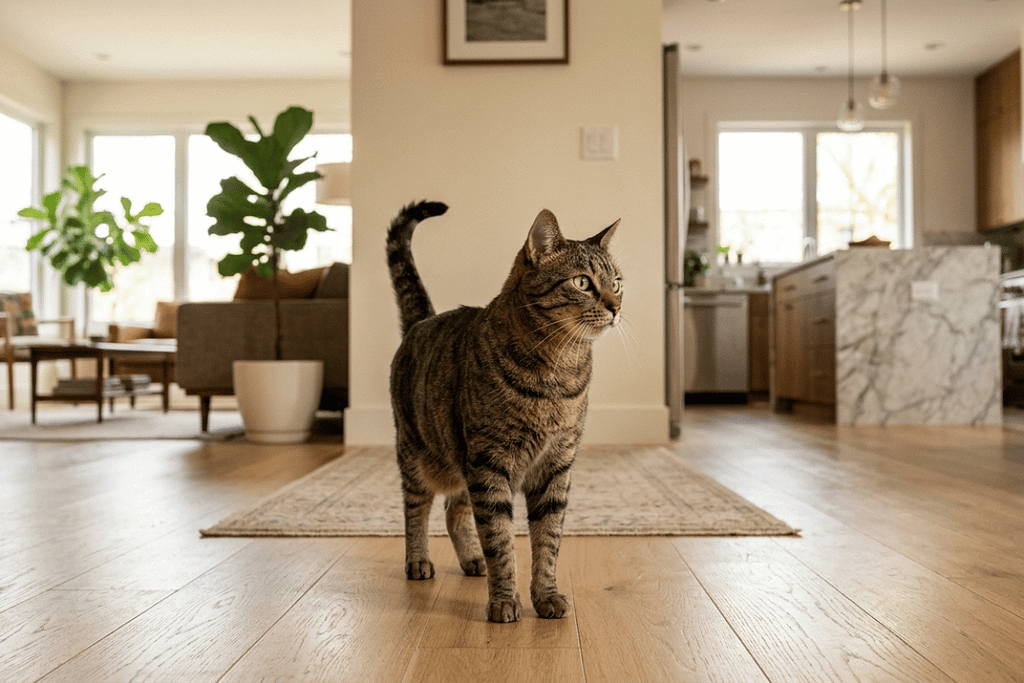
Most cat owners eventually notice it.
Their cat seems attached to certain places.
A favorite window.
A particular chair.
The top shelf of a bookcase.
The same pathway through the house.
These preferences often feel personal.
But beneath them lies something much older.
Territorial instincts.
Long before cats lived in homes, territory played a central role in survival. It helped determine where a cat could hunt, rest, avoid danger, and raise offspring.
While modern domestic life has changed many things, it has not erased the territorial instincts that continue shaping feline behavior today.
🧠 What Are Territorial Instincts in Cats?
Territorial instincts in cats are behavioral tendencies that encourage cats to organize, monitor, and maintain familiarity with their surroundings.
In evolutionary terms, territory provided access to critical resources such as:
- food,
- water,
- shelter,
- resting locations,
- safe escape routes.
Because these resources influenced survival, cats evolved strong motivations to become familiar with the spaces they occupied.
This instinct remains visible even in indoor cats.
Although food and safety are provided by humans, cats still benefit from understanding and organizing their environment.
Territory creates predictability.
And predictability creates security.
🌿 Why Cats Evolved Territorial Behavior
Unlike many highly social species, the ancestors of domestic cats often hunted alone.
This meant they could not rely on a group to provide resources or protection.
Instead, they depended heavily on their own knowledge of the environment.
A well-understood territory offered advantages such as:
- reliable access to prey,
- awareness of potential threats,
- knowledge of safe resting areas,
- efficient movement between resources.
Over thousands of years, these pressures helped shape the territorial instincts that still influence cats today.
The modern living room may be very different from a natural hunting range.
But the underlying behavioral systems remain surprisingly similar.
🏠 Why Indoor Cats Are Still Territorial
Many people assume territorial behavior disappears indoors.
It does not.
Indoor cats continue organizing space because territory serves functions beyond survival.
It helps them:
- understand their surroundings,
- anticipate daily events,
- identify safe locations,
- monitor environmental changes.
This is why cats often develop strong preferences for specific areas of the home.
The behavior is not random.
It reflects the same instinctive tendency to create familiarity and stability within a defined space.
This process becomes easier to recognize when examining Territorial Behavior in Cats: Why They Choose Specific Places in Your Home.
👁️ How Territorial Instincts Influence Daily Behavior
Territorial instincts appear in many everyday activities.
For example, cats often:
- return to the same resting spots,
- patrol familiar routes,
- observe activity from preferred locations,
- investigate environmental changes,
- monitor entrances and windows.
These behaviors may seem ordinary.
But together they reveal a consistent pattern.
Cats are continuously gathering information about their territory.
This ongoing monitoring helps maintain a sense of environmental control.
What appears to be simple observation is often part of a much larger territorial system.
🌳 Why Cats Value High Places
One of the clearest expressions of territorial behavior is the preference for elevated locations.
Many cats seek out:
- shelves,
- cat trees,
- window perches,
- furniture tops.
These locations provide a broader view of the environment and allow cats to monitor activity from a safe distance.
Height increases awareness.
And awareness contributes to security.
This relationship between territory and observation is explored further in Why Cats Need Vertical Space.
🚶 Territory Is Maintained Through Movement
Territory is not defined only by where a cat rests.
It is also maintained through movement.
Many cats repeatedly follow the same routes throughout the day.
They move between:
- resting areas,
- feeding locations,
- observation points,
- safe zones.
These repeated movements help reinforce familiarity with the environment.
Rather than wandering aimlessly, cats are often moving through an internal map of territory they know well.
👃 Why Familiar Scents Matter
Territory is not only visual.
It is also sensory.
Cats use scent information to recognize familiar spaces and distinguish them from unfamiliar ones.
When a cat rubs its face against furniture or walls, it is helping create an environment that feels recognizable and predictable.
These scent signals contribute to territorial stability.
They help transform a collection of rooms into a familiar home territory.
This behavior is explored further in Why Cats Rub Their Face on Furniture and Walls.
⚖️ Territorial Instincts Are About Security, Not Ownership
Humans often think about territory in terms of possession.
Cats experience territory differently.
For them, territory is primarily about familiarity and security.
A territory helps answer important questions:
- Where can I rest safely?
- Where are important resources located?
- What changes have occurred in the environment?
- Where can I observe without disturbance?
Territorial instincts in cats help provide those answers.
The goal is not ownership.
The goal is predictability.
And predictability helps reduce uncertainty.
🌿 Understanding the Territory Behind the Behavior
Many everyday feline behaviors make more sense when viewed through the lens of territorial instincts.
The favorite chair.
The preferred shelf.
The repeated route through the hallway.
The need to inspect something that changed.
These behaviors are not random habits.
They are expressions of an instinctive system that helped cats survive for thousands of years.
Modern homes may look different from natural territories.
But the underlying instincts remain remarkably similar.
And understanding those instincts helps explain why cats interact with space in such structured and predictable ways.
❓ FAQ
What are territorial instincts in cats?
Territorial instincts in cats are natural behaviors that help cats organize, monitor, and maintain familiarity with their environment.
Are indoor cats territorial?
Yes. Even indoor cats display territorial behavior through location preferences, route selection, environmental monitoring, and scent communication.
Why do cats become attached to certain places?
Specific locations often provide safety, comfort, visibility, or predictable access to important resources, making them valuable within the cat’s territory.
Do territorial instincts mean cats are aggressive?
No. Territorial instincts are primarily about organization, familiarity, and security. While territorial conflicts can occur, most territorial behaviors are not aggressive.
About the Author
This article reflects Sissi’s lifelong experience living with cats, informed by years of observation and behavior-focused research. Through A Cat With Story, she explores how instinct, territorial behavior, environmental organization, and feline cognition shape everyday life with cats.

With the sensitivity of one who loves deeply, Sissi writes stories celebrating the animal world. Her felines Estrela and Safira illuminate her days, while Pete and Gabrich live eternally through her words. Every piece she writes is a love letter to the companions who make life truly meaningful.