
Why Cats Need Vertical Space ? The Hidden Role of Height in Feline Behavior
Why cats need vertical space is closely linked to their natural instincts for safety, observation, and territorial organization. Elevated locations allow cats to monitor their surroundings, reduce stress, avoid disturbances, and interact with their environment from positions that feel secure and predictable.
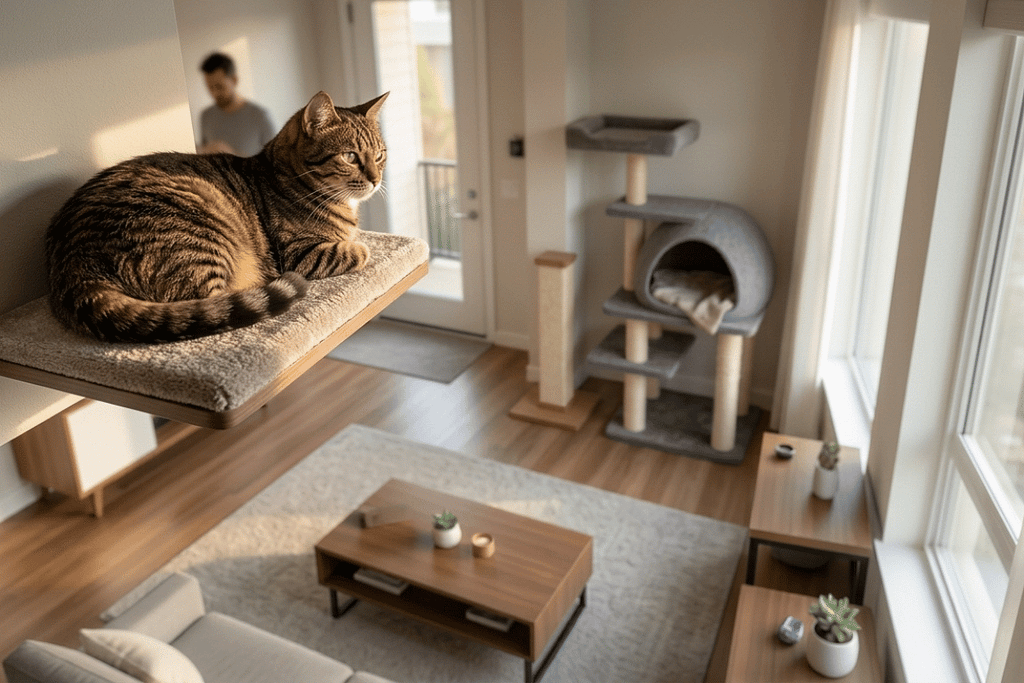
Look around your home.
Where does your cat choose to be?
Not always on the floor.
Not always beside you.
Quite often, the answer is somewhere higher.
A shelf.
A cat tree.
The top of a bookcase.
A windowsill.
A refrigerator.
Many cats actively seek elevated locations, even when comfortable spaces exist at ground level.
At first glance, this can seem like a simple preference.
But the attraction to height reflects something much deeper.
It is connected to how cats experience safety, awareness, and territory.
Understanding why cats need vertical space helps explain many everyday behaviors that otherwise seem difficult to interpret.
🧠 Why Cats Need Vertical Space
Cats do not experience space in only two dimensions.
They naturally use both horizontal and vertical environments.
In the wild, elevated positions can provide important advantages:
- greater visibility,
- increased awareness of surroundings,
- protection from potential threats,
- safer resting locations.
Although domestic cats live very different lives, the underlying instincts remain.
Vertical space expands the territory available to a cat.
It creates additional locations for observation, movement, and rest.
For many cats, height is not a luxury.
It is an important part of how they organize their environment.
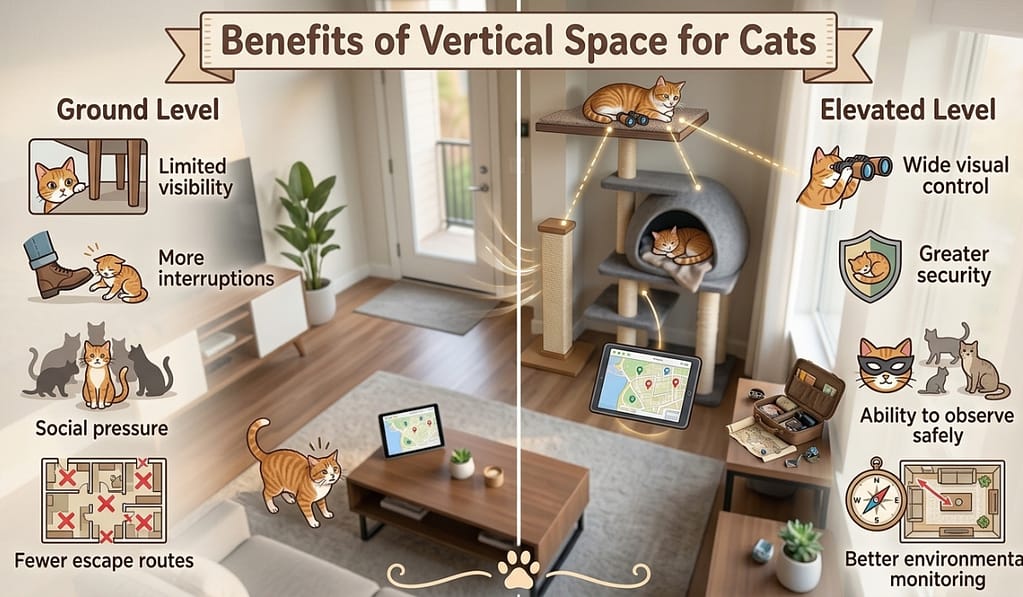
👁️ Height Provides Information
One reason why cats need vertical space is that elevated locations improve environmental awareness.
From above, a cat can observe:
- people moving through the home,
- other animals,
- entrances and exits,
- outdoor activity through windows.
This broader view allows the cat to gather information without needing to participate directly.
Observation is a major part of feline behavior.
Cats often prefer understanding what is happening before deciding whether to engage.
A higher position supports that process.
The goal is not control.
The goal is awareness.
🛡️ Elevated Locations Feel Safer
Height is often associated with security.
When a cat rests on an elevated surface, it becomes easier to monitor approaching activity.
This reduces the likelihood of being surprised.
For a species that evolved as both predator and prey, this matters.
Many cats appear more relaxed when they have access to elevated resting places because those locations provide:
- visual control,
- distance from disturbances,
- predictable access to escape routes.
This is one reason cats often choose shelves, cat trees, and window perches even when comfortable beds are available elsewhere.
The location itself contributes to the feeling of safety.
🏠 Vertical Space Expands Territory
Territory is not measured only across the floor.
Cats naturally incorporate height into their territorial organization.
A room may contain several different territorial zones:
- floor-level pathways,
- resting locations,
- observation points,
- elevated safe areas.
Adding vertical space effectively increases the usable size of a territory without changing the physical dimensions of the home.
This is especially important for indoor cats.
When horizontal space is limited, vertical environments create additional opportunities for movement, observation, and environmental control.
This relationship becomes easier to understand in Territorial Behavior in Cats: Why They Choose Specific Places in Your Home.
🐾 Why Multi-Cat Homes Benefit From Vertical Space
The importance of vertical space often becomes even more noticeable in homes with multiple cats.
Not every cat wants to occupy the same area at the same time.
Elevated locations help create separation.
They allow cats to:
- avoid unwanted interactions,
- observe without participating,
- rest without interruption,
- establish personal space.
This can reduce social tension and increase environmental flexibility.
Rather than competing for a single location, cats can distribute themselves throughout different levels of the territory.
For many multi-cat households, vertical space becomes an important resource.
🌿 Vertical Space Supports Natural Behavior
Cats are natural climbers.
They jump.
Balance.
Observe.
Explore elevated environments.
These behaviors are part of their behavioral repertoire.
Providing vertical space allows cats to express these instincts in appropriate ways.
It encourages:
- exploration,
- movement,
- observation,
- environmental engagement.
The goal is not simply providing a place to climb.
It is creating opportunities for behaviors that cats are naturally motivated to perform.
🪟 Why Windows and High Perches Are So Popular
Many favorite cat locations combine two important elements:
- height,
- information.
A windowsill provides both.
From this position, a cat can observe:
- birds,
- people,
- weather,
- movement outside the home.
The window becomes an observation station.
The height increases visibility.
Together, they create one of the most attractive environments many cats can access.
This helps explain why window perches remain among the most consistently used elevated spaces in feline households.
⚖️ Why Cats Need Vertical Space: More Than Just a Preference
The attraction to height is not simply a personality quirk.
It reflects deeper behavioral needs.
Why cats need vertical space is closely connected to:
- territorial organization,
- environmental awareness,
- safety,
- exploration,
- stress reduction.
Height allows cats to experience their environment differently.
It provides information.
It creates security.
It expands usable territory.
And it supports behaviors that have been important throughout feline evolution.
When viewed through that lens, the shelf, cat tree, or windowsill becomes more than a place to sit.
It becomes part of how cats successfully interact with the world around them.
To explore how cats organize the spaces they occupy, continue with Why Cats Follow the Same Routes Every Day.
❓ FAQ
Why do cats like high places?
Cats often prefer high places because elevation provides better visibility, greater environmental awareness, and a stronger sense of security. From elevated locations, cats can observe their surroundings while remaining removed from potential disturbances.
Do indoor cats need vertical space?
Yes. Vertical space allows indoor cats to climb, observe, rest, and manage social interactions more comfortably. Access to elevated areas can help support confidence and environmental control.
Is climbing a sign that a cat is trying to dominate?
Not usually. Most climbing behavior is related to observation, safety, exploration, and access to preferred resting locations rather than dominance.
What happens if a cat has no vertical space?
Cats without access to vertical space may have fewer opportunities for observation, retreat, and environmental control. While every cat is different, many individuals naturally seek elevated locations when they are available.
🌿About the Author
Sissi is the founder of A Cat With Story, where she writes about feline behavior, environmental needs, and the evolutionary roots of everyday cat habits. Her articles combine behavioral science with real-world observations to help cat owners understand why cats interact with their homes the way they do—from territory and scent marking to exploration, security, and social behavior.

With the sensitivity of one who loves deeply, Sissi writes stories celebrating the animal world. Her felines Estrela and Safira illuminate her days, while Pete and Gabrich live eternally through her words. Every piece she writes is a love letter to the companions who make life truly meaningful.