
cat Territorial Routes: Why Cats Follow the Same Routes Every Day
Cats often follow the same routes every day because familiar pathways help them monitor their territory, move efficiently between important locations, and maintain awareness of environmental changes. These repeated routes are part of how cats organize and navigate the spaces they consider their own.
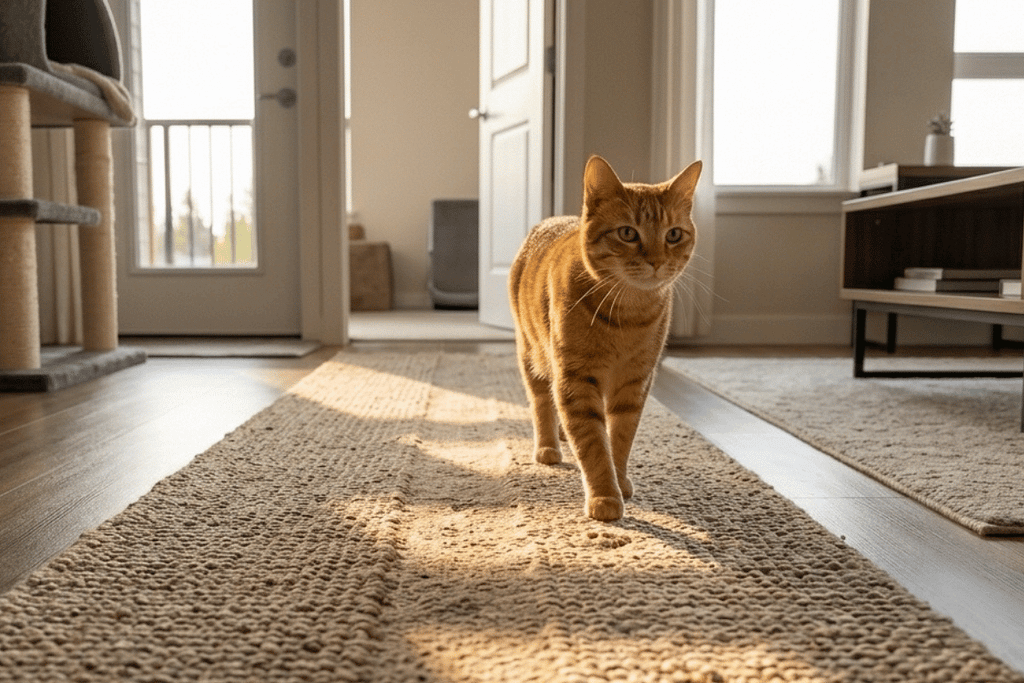
You may have noticed it before.
Your cat leaves one room.
Walks through the hallway.
Pauses near a doorway.
Stops at a window.
Then continues to a favorite resting spot.
The next day, the same route appears again.
And the day after that.
At first, it seems like habit.
But over time, the repetition becomes difficult to ignore.
Why do cats follow the same routes every day?
The answer begins with territory.
Cats do not simply move through their environment.
They move through a space they know, monitor, and continuously update.
🧠 Why Cats Follow the Same Routes Every Day
Cats rely heavily on familiarity.
Unlike humans, who often move with specific destinations in mind, cats frequently combine movement with environmental monitoring.
Repeated routes help them:
- confirm that important locations remain unchanged,
- check access to resources,
- gather information about their surroundings,
- maintain familiarity with the territory.
These routes become part of an internal map built through experience.
The more often a pathway is used, the more predictable it becomes.
And predictability contributes to a sense of security.
🏠 Cats Organize Their Territory Through Movement
Territory is not defined only by where a cat rests.
It is also defined by how a cat moves.
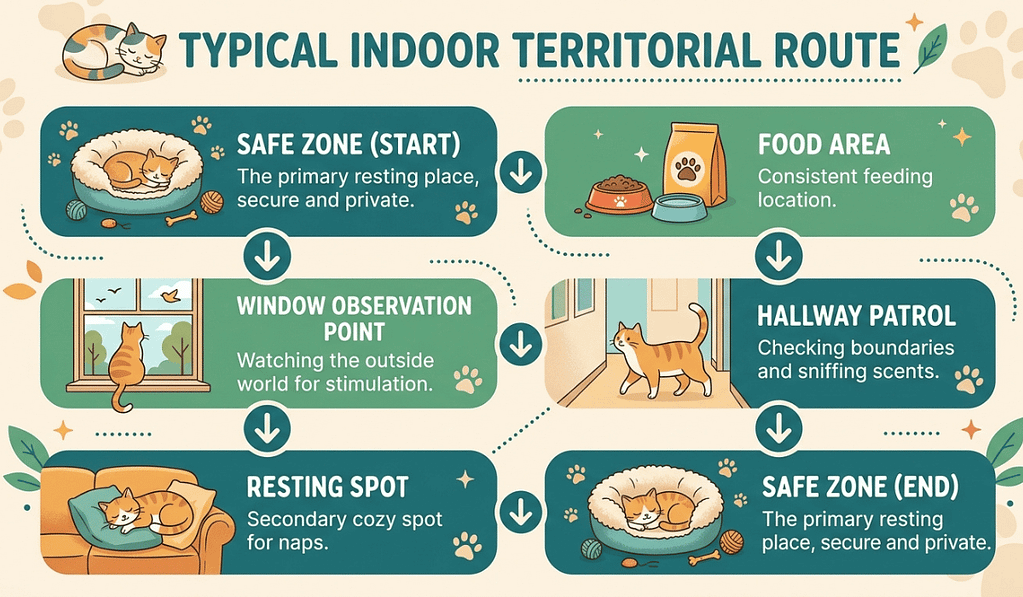
Most cats repeatedly travel between:
- feeding areas,
- resting locations,
- observation points,
- litter box areas,
- safe zones.
Over time, these locations become connected by familiar pathways.
Rather than wandering randomly, cats often follow routes that allow them to move efficiently through the parts of the territory that matter most.
This is one reason movement can appear surprisingly structured.
The route itself becomes part of the territory.
👁️ Familiar Routes Provide Information
Every movement through the home offers information.
As cats travel familiar paths, they can quickly detect:
- changes in the environment,
- unfamiliar objects,
- unusual sounds,
- altered scents,
- new activity.
This ongoing monitoring helps maintain awareness of the territory.
What appears to be a simple walk through the house is often an inspection process.
Cats are constantly updating their understanding of the environment.
The familiar route makes those checks easier and more efficient.
🚶 Why Cats Prefer Predictable Paths
Most animals benefit from predictability.
Cats are no exception.
A known route provides:
- familiarity,
- confidence,
- efficient movement,
- reduced uncertainty.
Because the path is already understood, less attention is required to navigate it.
This allows the cat to focus on monitoring the environment instead.
The result is a pattern that looks repetitive but serves important territorial functions.
What appears to be routine is often environmental management.
🌳 How Territory and Routes Work Together
Territory and movement are closely connected.
A territory is not simply a collection of locations.
It is a network of relationships between locations.
Resting spots connect to observation points.
Observation points connect to feeding areas.
Safe zones connect to travel routes.
The territory functions as a system.
Repeated movement helps maintain that system.
This relationship becomes easier to understand in Territorial Behavior in Cats: Why They Choose Specific Places in Your Home.
🛡️ Why Cats Inspect Small Changes
Have you ever moved a chair and watched your cat investigate it immediately?
Or placed a new object in a familiar room?
Cats often notice changes that humans barely register.
This happens because familiar routes provide a baseline.
Anything that differs from that baseline stands out.
As cats travel their usual pathways, they compare current conditions to previous experiences.
This helps explain why environmental changes often attract immediate attention.
The route is familiar.
The change is not.
And that difference becomes important.
🐾 Indoor Cats Still Patrol Territory
Many people associate territorial patrols with outdoor animals.
But indoor cats often perform similar behaviors on a smaller scale.
They may:
- walk through multiple rooms,
- visit favorite observation points,
- inspect windows,
- check resting locations,
- travel established pathways.
These movements help maintain familiarity with the territory.
The behavior is usually subtle.
Yet it reflects the same territorial instincts that helped felines monitor space long before domestic life.
⚖️ Following the Same Route Is Not Random
At first glance, repeated movement may seem repetitive or unnecessary.
But from a cat’s perspective, these routes serve important purposes.
They provide information.
They reinforce familiarity.
They connect important locations.
And they help maintain awareness of the territory.
Why cats follow the same routes every day is not really about the route itself.
It is about what the route allows them to know.
The familiar pathway becomes a tool for understanding and managing the environment.
And that is one of the reasons these patterns remain so consistent.
To explore how cats create secure areas within their territory, continue with How Indoor Cats Define Safe Zones.
🌿About the Author
This article reflects Sissi’s lifelong experience living with cats, informed by years of observation and behavior-focused research. Through A Cat With Story, she explores how instinct, territorial behavior, environmental organization, and feline cognition shape everyday life with cats.
❓ FAQ
Why does my cat walk the same path every day?
Cats often repeat familiar routes because those pathways help them move efficiently, monitor their territory, and maintain awareness of environmental changes.
Do indoor cats patrol their territory?
Cats often repeat familiar routes because those pathways help them move efficiently, monitor their territory, and maintain awareness of environmental changes.
Why do cats notice small changes in the house?
Cats rely on familiarity. When something changes along a known route, it stands out and often triggers investigation.
Are repeated routes a sign of stress?
Usually not. Repeated routes are a normal part of territorial organization and environmental monitoring in healthy cats.

With the sensitivity of one who loves deeply, Sissi writes stories celebrating the animal world. Her felines Estrela and Safira illuminate her days, while Pete and Gabrich live eternally through her words. Every piece she writes is a love letter to the companions who make life truly meaningful.